

We’re already aware that our phones are spying on us even when they’re turned off. There’s no question that the internet tracks our browsing, searching, and spending patterns with the tender intimacy of a stalker who knows our mother’s maiden name. We’re pretty sure that somewhere in the cloud, an algorithm has figured out when we’re unusually susceptible to a “limited-time” discount code and which one of us will cave if we see “ONLY 3 LEFT” in red. And don’t even get me started on Flock cameras. I mean, what’s next—shopping carts that can smell a break-up and instantly double the price of ice cream, Kleenex, and boxed wine?

Maybe it’s just me, but it seems like the distance between a crackpot conspiracy theory and a Senate hearing is getting shorter by the flu season.
Last week, Sen. Josh Hawley chaired a hearing of the Senate Judiciary Subcommittee on Crime and Counter-Terrorism with the delightfully dystopian title “Your Data, Their Profit: The Consumer Cost of AI Surveillance Pricing.” Apparently we have reached the stage of technological progress where your supermarket, rideshare, and food-delivery apps might know more about you than your therapist—and can use that information to calculate your desperation down to the dollar. (And how does that make you feel?)

This isn’t the millennia-old “dynamic pricing” model—the one that looks at market conditions and external factors like supply, demand, weather, or time of day and adjusts consumer costs accordingly across the board. Surveillance pricing looks at you and says, “Based on your heart rate, your phone’s current battery status, and the fact that you were up at 3:14 a.m. googling ‘can anxiety cause chest pain,’ we’ve determined you’ll pay $47.99 for this pulse oximeter.”
And if you think I made up the pulse and battery parts for comedic effect, do I have some bad news for you.
“Major retailers like Walmart and Kroger are rolling out digital electronic shelf labels that can change prices instantly,” Gemini cheerfully explained when I asked if this is currently happening. “While people fear that cameras and data tracking could enable individualized ‘surveillance pricing,’ retailers state their digital tags do not use cameras to change prices on the fly for specific shoppers [emphasis mine].”
Oh, well, retailers state! I guess we have nothing to worry about, since Walmart says Walmart isn’t doing anything sketchy.
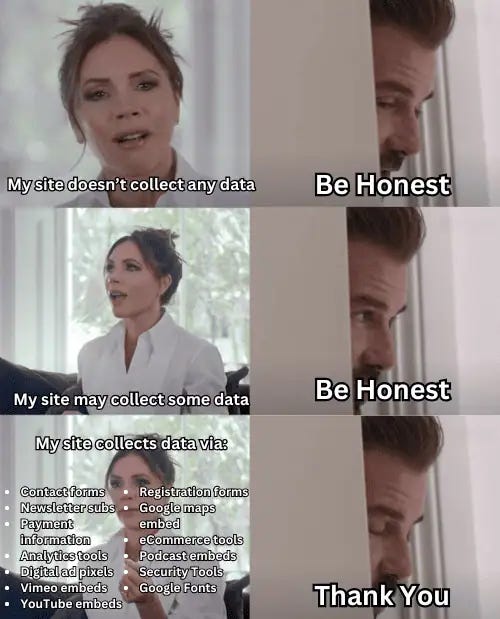
A curious assurance, seeing as in the Senate hearing, Hawley brought up Walmart’s patent for a spiffy new shopping cart—one equipped with sensors capable of tracking the cart’s speed as well as the shopper’s heart rate and body temperature. This information, you’ll be overjoyed to learn, can then be used to assign the shopper an “agitation score.”
Yes, an agitation score. This cart, you see, was not designed merely to transport your avocados and almond butter to the checkout—how quaint—but is also compiling a handy biometric profile on you like a rogue Fitbit ratting you out to corporate. I mean, how could they possibly estimate how much money they can squeeze out of you if they don’t know exactly how annoyed you are?

DoorDash has similarly pursued agitation-tracking technology “so they’ll know how desperate [customers] are to get food,” Hawley explained. (An insider has also claimed the company uses a “desperation score” to underpay drivers—an accusation DoorDash categorically denies.) Uber actively monitors your phone’s battery life after determining that number is one of the strongest predictors of price sensitivity. Think about it: if they know your battery is at 2%, they also know you’re not shopping around for the best deal or waiting out a temporary surge. You need your butt in a vehicle before your screen goes dark and you become one of those people forced to make eye contact with strangers—and that urgency is gonna cost you.
Uber, for the record, fully admits that they’re tracking your phone’s remaining run time and that they’re aware of the correlation between that percentage and a customer’s personal financial breaking point. But the company insists they don’t actually use this information to jack up prices. Which is comforting in the way “Relax, Mom, my drug dealer swears this meth is perfectly safe” is.

“What if I told you that a store like Staples, for example, charges more online based on your IP address or on your proximity to a rival?” Hawley asked. “What if I told you that Target’s shopping app tracked your location in real time in order to charge you as much as $150 more for a vacuum the moment that you enter their store? What if I told you that Lyft has charged 55 separate riders in my home state of Missouri 29 different prices for the same exact route at the same exact time with a difference of $37 between the different fares? These are all documented cases of what we are now calling AI surveillance pricing.”
A handful of states have begun passing laws against a practice we’re simultaneously assured is mostly hypothetical. New Jersey just became the latest to ban businesses from using personal consumer data to set individualized prices (and imposed a temporary ban on new electronic shelf labels while the technology is being studied). New York, Maryland, and Connecticut have enacted restrictions on Focker-style pricing—or at least imposed transparency requirements—as well.
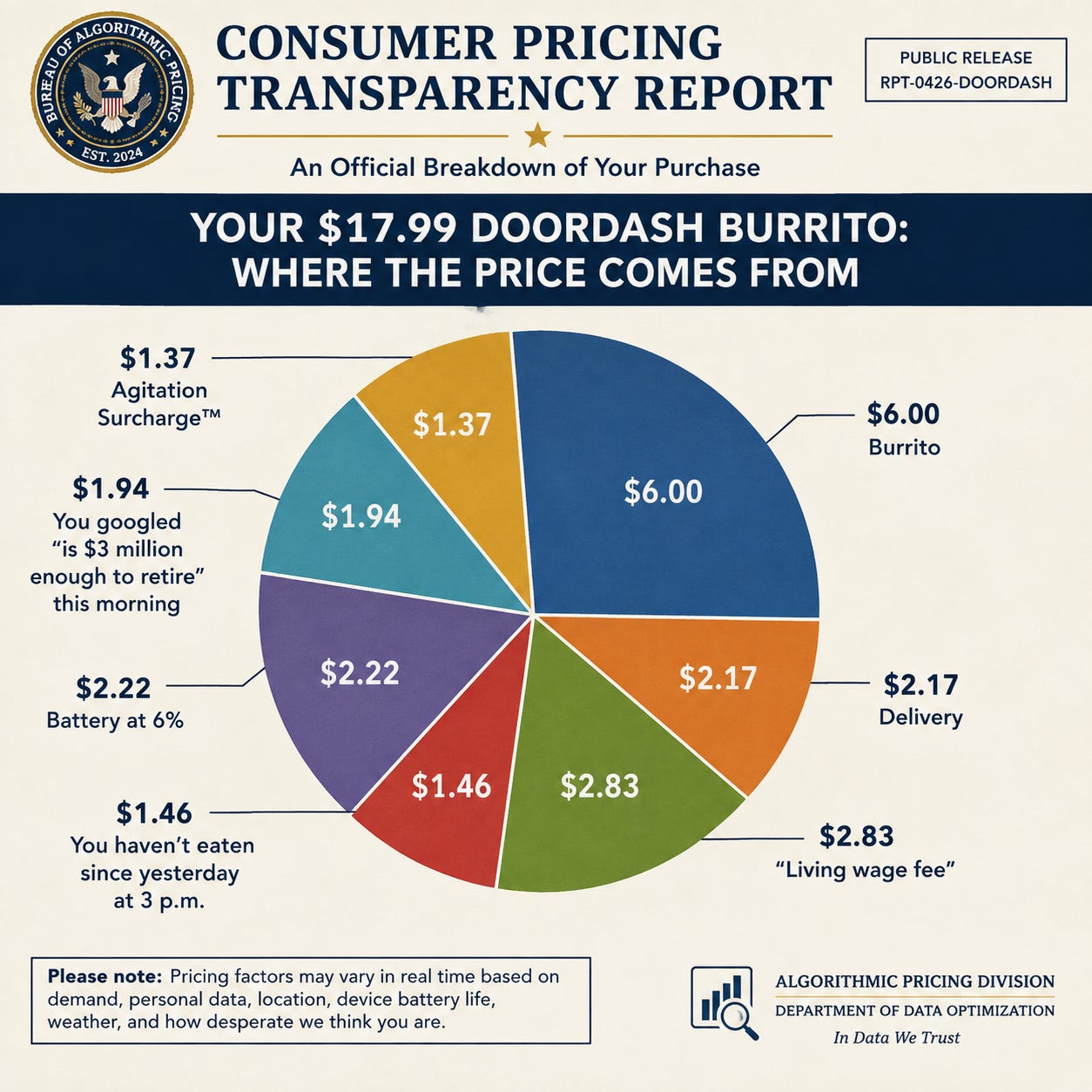
To recap: we’ve gone from corporations aren’t tracking you, you paranoid weirdo… to okay, they’re tracking you, but they’re not allowed to use the info… to fine, they *could* use it but they pinky-promise they won’t… to state legislatures are hurriedly passing laws to prohibit them from doing it. At this rate, by Christmas it’ll be Whole Foods’ new Emotional Vulnerability Surcharge™ rewards shoppers by giving them 10 points toward a free rotisserie chicken every time they cry in the produce aisle!
Hawley called the marriage between AI and mega-corporations the “unholy trinity of everything Americans hate: spying on people, ripping them off, and taking away jobs.” He’s not wrong.

Retailer “loyalty programs” don’t reward your patronage so much as exploit it. They record what you buy, when you buy it, where you live, whether you have cats or kids or koi, and presumably how often you stress-buy Oreos—and then package those insights and sell them to advertisers. Kroger, the third-largest grocery retailer in the U.S., raked in a third of its net income last year by auctioning off customer data. According to hearing testimony, Amazon now makes more money selling access to the exquisitely detailed profile it’s built on you than from selling actual products. Think about that.
The most perverse part is that we’re paying for the privilege of being fleeced. We carry the tracking device, download the app, scan the QR code to get 40 cents off oat milk, flash our frequent-shopper cards, and then act shocked when the store charges us 12% more than the guy behind us with the flip phone and a wad of cash.

More and more, I’m convinced that dude’s onto something. He doesn’t have an app, a personalized offer, or an agitation score. He’s out there living like it’s 1982 while the rest of us are financing our own digital prisons with a 2% cash-back card. SMH.
Until legislators make official sense of this nightmare, we can at least make it harder for Big Brother to compile our dossiers. Some thoughts: Have the person in your party whose phone has the most juice hail the Uber. Use websites instead of apps and deny every possible permission. Browse online in incognito mode. Lie your face off on loyalty-program applications like you’re in witness protection. (Me? Zero kids, allergic to cats, obsessed with sportsball, addicted to TV, birthday: February 31, 1899.) Connect to a VPN (virtual private network) in a ZIP code where people lock their trash cans at night. Clear your browser cookies and cache so stores don’t see your repeat searches. Pay cash whenever humanly possible… while that’s even still an option.
It’s probably too late for complete invisibility at this point, but being less profitable to track than someone else isn’t the worst idea in the world.
Geez, and here I thought ditching Facebook over a decade ago was my line in the sand. Guess it was only a line in the stream. Seriously creepy how far this has gone.
I treat a heckuva lot of Amish. And while I really do love my air conditioner (it's supposed to be between 100-105 for the next several days), they get a lot of things right. A LOT of things... Great post!
BTW, my bro, an MD, is finishing your War Against Chlorine Dioxide. He says it's as good as your previous book on "War".