

Remember when the answer to every privacy concern was, “If you haven’t done anything wrong, you have nothing to hide?” That was cute. Today, it’s increasingly, “If you haven’t done anything wrong, make sure you have text receipts, Ring camera footage, and several hours of bodycam backup explicitly showing you not doing it.”
Apparently Innocence™ is now a Premium upgrade requiring at least 20 terabytes of cloud storage.

The most terrifying example of this involved Chrisanna Elser, a Colorado woman who was accused of porch piracy after police used automated license plate reader technology to identify her Rivian in the vicinity. Armed with that rock-solid evidence, investigators reviewed a grainy video, concluded Elser was exactly as blonde as the thief, and charged her. The problem? She was completely innocent. What ultimately cleared her wasn’t a diligent police investigation or a dramatic last-minute confession. It was Elser’s own dashcam footage, which proved she had never actually stopped at the crime scene.
Think about how insane that is. The government accused Elser based solely on surveillance technology. She defended herself with... more surveillance technology. It’s hard to know whether to be comforted or horrified by that turn of events.
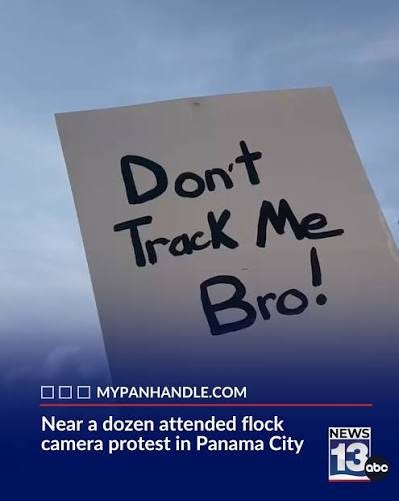
Today, “Flock cameras” are popping up on telephone poles across the country like pimples on prom night. Flock Safety is a private tech company that contracts with police departments, homeowners associations, businesses, and entire cities to install AI-powered security cameras. The cameras don’t record people, per se; they photograph passing license plates, along with the vehicle’s make, model, color, and distinctive features. (Congratulations, your “MY OTHER CAR IS A BROOM” bumper sticker is now a permanent identifier in a police database.)
The result is a searchable catalog investigators can use to trace exactly where a particular vehicle has been. That database is accessible to any officer in a participating department, typically with no warrant requirement and no meaningful audit trail—the honor system, but for stalking. (Retention policies vary, but 30 days is common, and some agencies hold the data far longer.)
In practice, this means a cop having a slow Tuesday can run your plate, pull up a tidy little map of everywhere your car has been for the past month, and nobody—not even you—will ever know they did.
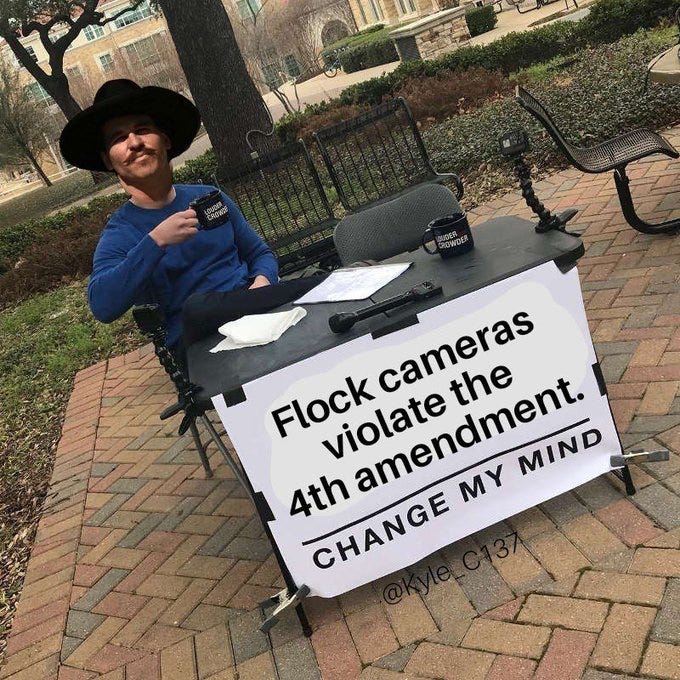
When Flock’s Chief Communications Officer was pressed on Elser’s case and asked if he wanted to atone for her ordeal, he replied, “Should I apologize for somebody misusing a tool? I don’t think so. It’s not Flock’s job to police the way police do their work.”
He’s not wrong. It’s not Ford’s job to enforce speed limits. It’s not the gun’s fault when someone pulls the trigger. Which is why guardrails matter. Powerful tools demand powerful rules.
Supporters point to the very real crimes the cameras have helped solve—murders, kidnappings, car thefts, human trafficking. It’s a powerful argument. If someone snatched my daughter out of her bed at 2:00 in the morning and police could pull up every vehicle that passed my house that night, I’d hardly be worrying about my neighbor’s privacy rights. That’s what makes this so difficult. The same surveillance system that might save your child can also quietly spy on everyone else’s.

The Colorado case wasn’t a one-off. Police have used Flock’s database to help ICE locate immigrants. A Texas officer reportedly searched it while looking for a woman suspected of obtaining an illegal abortion. The company is now expanding into AI-powered searches and products that connect license plates to commercial “people lookup” databases.
Funny how quickly “We’re just trying to find stolen cars” can turn into “Let’s see how many times Jenna’s been to the gym this week.”
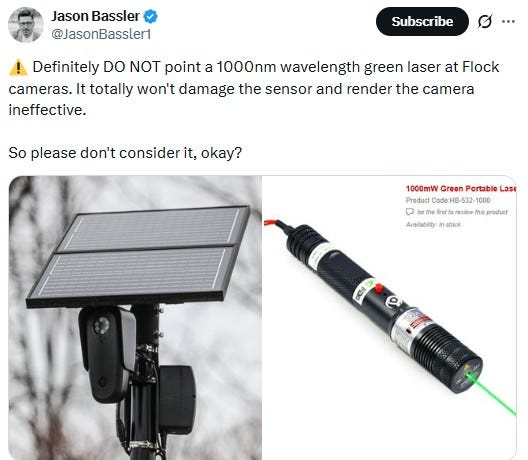
The argument has gotten so heated that people have started taking matters into their own hands. Across the country, vigilantes are climbing utility poles with baseball bats and bolt cutters, treating property damage as political protest. They looked at the same math everyone else is looking at—a private surveillance grid growing faster than any meaningful regulation—and concluded that the only real opt-out involves a ladder and a pair of vice grips. (A GoFundMe for an Air Force engineer facing charges for sawing down more than a dozen Flock cameras has raised more than $25,000, because “don’t tread on me” is apparently no longer just a sweatshirt slogan.)
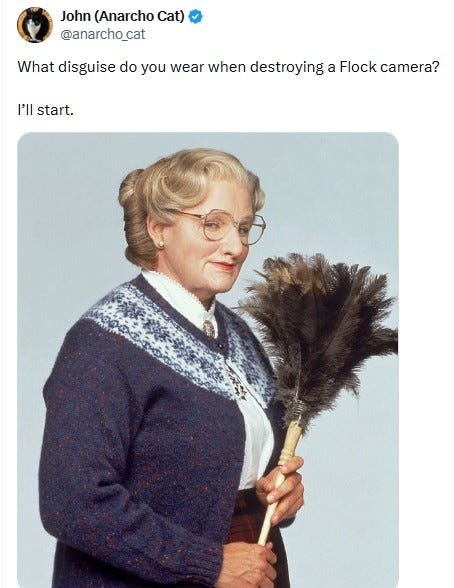
Civil liberties groups are sounding alarms. Some police departments are backing away from the technology after public backlash. A grassroots effort called DeFlock now crowdsources the locations of the cameras across the country, arguing that if surveillance is going to be everywhere, the public ought to know where “everywhere” is.
The Supreme Court recently stumbled into that very argument, ultimately ruling that police generally can’t scoop up the cellphone location data of everyone who happened to be near a crime scene without an actual probable cause warrant. The case wasn’t about Flock cameras—but it sets a precedent by basically declaring sweeping digital dragnets unconstitutional. The question has never been whether the state can collect more information. It’s whether it should.
The Flock debate isn’t black and white. I like criminals getting caught. I like kidnapped kids being rescued. I like murderers going to prison. I also don’t particularly enjoy the idea that I could accidentally be arrested for the offense of owning a car. And “but it helped catch some real criminals” is also the exact sentence every new layer of surveillance in history has used to justify itself. The tech works. That’s precisely what makes it worth worrying about.
What’s unsettling isn’t just that Flock cameras are everywhere. It’s that they are quietly rewriting the burden of proof. Not in a courtroom, but in real life, where being near something nefarious is the same thing as being responsible for it. Where proximity becomes suspicion, suspicion becomes accusation, and accusation becomes your problem to defend—like the Florida man who was arrested for trying to lure a child at a McDonald’s after AI facial recognition incorrectly flagged him as a match.
We’re building a world where the official record is whatever the system says happened—unless you can produce your own competing archive. Your alibi isn’t your word. It’s your data. Preferably timestamped, backed up, and stored in the cloud.
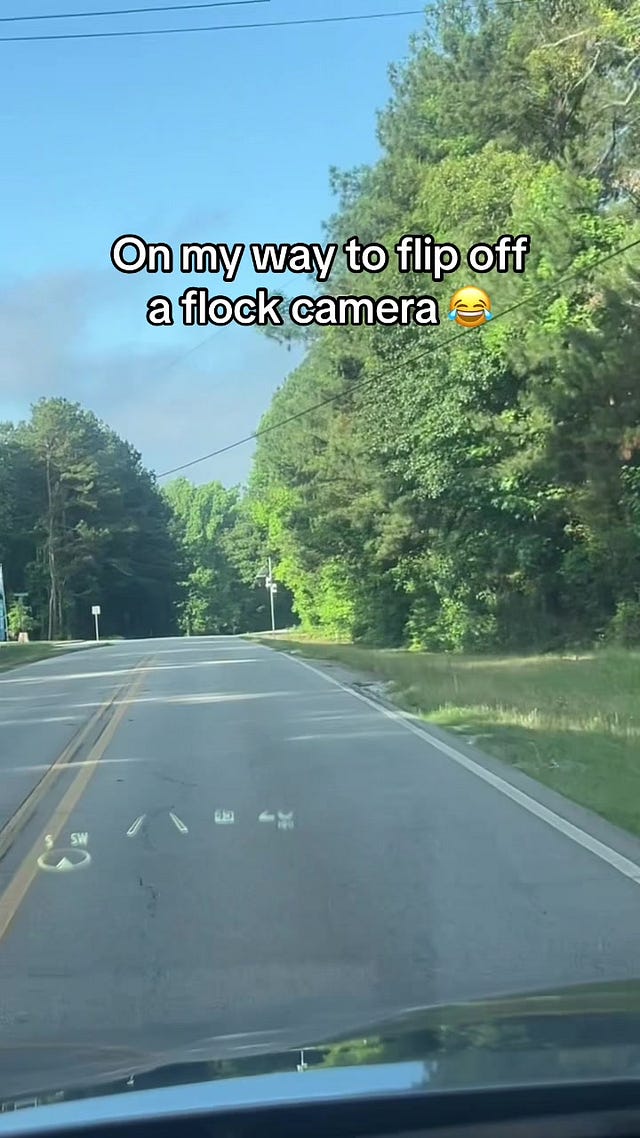
 Tiktok failed to load.
Enable 3rd party cookies or use another browser
Here’s the part that will likely keep me at night: that dashcam defense only works as long as footage means something. We already exist in an age where AI-generated video is good enough to fool a jury—and where real footage can be dismissed as a deepfake. So the woman in Colorado got lucky—her timestamp still meant something. Give it a few more years, and “I have footage proving I wasn’t there” and “they have footage proving I was” will carry exactly the same evidentiary weight, which is to say: none. Your fate could be decided by a single stranger willing to swear they saw you not murdering anyone on the night of February 4.

I’m not telling anyone to go grab a ladder and some Silly String. I’m just saying I’d rather have this conversation now than after everyone’s walking around with a GoPro strapped to their head just to establish probable innocence. Somewhere between “the government thinks you did it” and “good luck proving you didn’t” there has to be a better answer.
I was going to add another poll (“What’s the solution?”), but like I said, I don’t have the answers. If you do, please drop them in the comments!
It’s nice to see the American Revolutionary Spirit is still alive. Destroying Flock cameras is today’s version of dumping tea in Boston’s harbor. I’m also all for taking down Somali flags in front of certain Blue City Halls, during the Independence Day holiday.
"It's not that I have something to hide. I have nothing I want you to see."
- Amanda Seyfried's character in the movie Anon.