

Growing up in the 1970s, my family’s setup looked like most of my friends’: Dad worked—pretty much constantly—while Mom shopped for the groceries, prepared the meals, packed the lunches, scrubbed the toilets, and shlepped us to school and soccer and sleepovers and back on a perpetual loop. She was the nurse, maid, chauffeur, cook, therapist, tutor, social secretary, seamstress, activities director, procurement officer, and on-call emergency response team. She knew where the iodine was (and how to use it), never missed a field trip, and could magically get her hands on a piece of poster board at 9 p.m. on a Sunday in 1978.
Nobody called her a stay-at-home mom. It was just… mom.
Then came women’s lib, second-wave feminism, and Ms. Magazine. Suddenly, full-time motherhood wasn’t a calling but a trap; a product of the ultra-misogynistic patriarchy. Women were encouraged to put themselves—not their demanding spouses or their annoying spawn—first for a change. Get a job! Follow your dreams! Make your own money! YOU CAN HAVE IT ALL (*just not simultaneously)! And tell that husband of yours he can do his own damn laundry. Accidentally get yourself knocked up? That’s what abortion is for, silly!
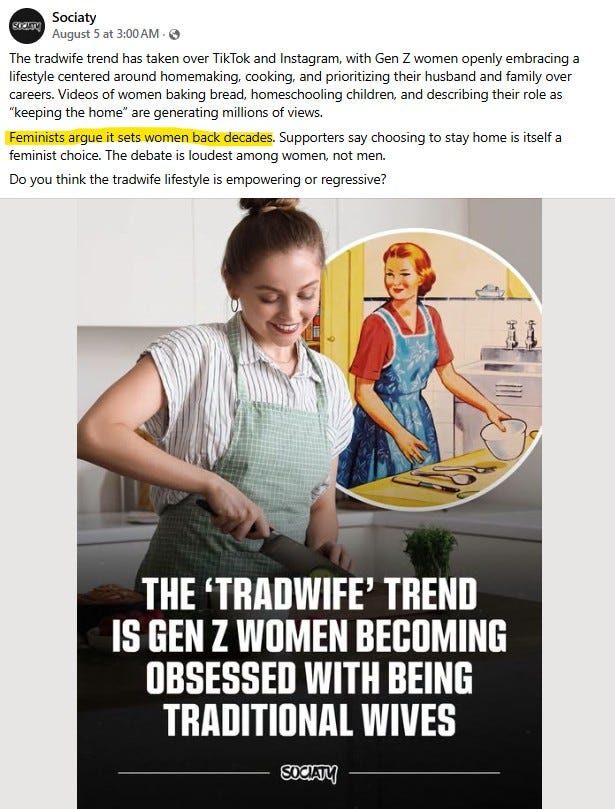
Fifty years and fifty million exhausted working moms later, an intrepid tribe of women haven’t just rediscovered old-fashioned homemaking; they’ve embraced it. They’ve rebranded it. Some of them are even monetizing it.

They’re called “tradwives”—social media-speak for traditional, stay-at-home married women—and they’re the Internet’s hottest unlikely subculture. They bake bread from scratch, homeschool their kids, grow vegetables, make elaborate meals, sometimes keep chickens, and appear to regard folding towels as something other than a human-rights violation. They wear aprons. Their toddlers are barefoot. Some of them are out there churning butter and making grain-mill tutorials.
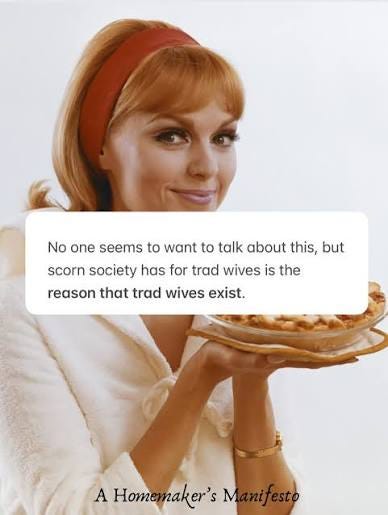
Naturally, there’s a faction of very vocal feminazis who are profoundly triggered by all of this voluntary domesticity. “Tradwives are just the new trophy wives,” insists one. “Because I’m better than you, I choose to make my children fresh bread every day,” mocks another. One particularly profane TikTok user calls tradwives “losers with no ambition, no aspirations, no dreams of their own that don’t revolve around centering a man or around depending on a man for the rest of their lives.” Oh, and their husbands are clearly all a bunch of miserable chauvinists who are going to trade them in for shiny new 28-year-old models the minute their uteruses shrivel up.
My two dearly departed grandmothers are deeply offended.

To be fair, the movement isn’t exactly crawling with blue-haired AOC fans. Some of its biggest influencers lean hard into Christian values, traditional gender roles, and the whole husband-as-head-of-household thing. But there’s also a considerably less biblical version that amounts to: We had children, we can afford for one of us to stay home, and we’d rather have their mother raising them than a nanny or the local Quality Learing Center. Take politics completely off the table and there are plenty of moms who want to be home with their kids—and plenty of dads who can afford that arrangement and sincerely want it, too.
Nevertheless, perhaps in an effort to save at least a few clueless young women from a life of submission, domestic drudgery, and way too much time with their own children, USA TODAY would like these ladies to know that the “tradwife life” being romanticized all over TikTok is definitely not as dreamy as it looks.
(Wait. You’re telling me that social media isn’t a 100 percent accurate portrayal of people’s lives, relationships, careers, finances, bodies, bank accounts, vacations, homes, happiness, and general day-to-day existence? Ima need a minute.)
Their big exposé centers around two “former tradwives” who, inconveniently, have some touching things to say about the experience. Stacey Aquino, 53, married at 19, had her first child at 21, and stayed home to raise six children while her husband built a successful career. She says she loved raising her kids and readily acknowledges that having her relentless presence “meant a lot to them.” Enitza Templeton, 43, married at 26 and had four children. She admits her husband didn’t force her to give up a career and that the life she had was the one she believed she wanted at the time.
Now, however, both women are sounding the alarm, warning the next generation of homemakers to think twice before throwing themselves into the world of scratch-cooking and DIY laundry detergent.
Why, you might ask?
Their marriages imploded. Both of them. And when they woke up one day with the dreaded divorcée title, the two women separately realized they had no education, no workplace skills, no résumés, no independent income, and no clue about their own family finances.
Like, at all.
“There was a lot of money,” Aquino explains. “But I didn’t know where any of it was.”

Ladies, I believe we’ve located the source of the problem—and it’s not the laundry basket or the chicken coop. The issue isn’t women choosing bread-making over breadwinning. It’s women entering any marriage—traditional, modern, corporate, crunchy, gay, common-law, or otherwise—without access to cash, the password to the bank accounts, or a contingency plan.
Because if your husband earns enough money that your family can function without a second full-time paycheck, it makes absolutely no difference whether you spend your days homeschooling sixteen children, running charity luncheons, painting landscapes, or collecting seashells and selling them on Etsy. This isn’t about tradwifery; it’s about not being fiscally ignorant in your marriage.
In her emotional, now-viral video, Templeton seems to deeply regret the schooling, career, and life sacrifices she made in order to be present for her offspring—sacrifices one has to wonder whether she’d be lamenting if her marriage had survived and she’d never had to learn what Indeed is.
“The one thing you’re not accounting for when you decide to not go to college, not get an education, and just jump straight into marriage and having children—and as many as you can—is that those children grow up and make friends and you have to hang out with their little friends’ families,” the teary voice of experience explains.
Apparently, the real danger of motherhood is invariably being trapped at a backyard barbecue with people who discuss their careers.
“Please,” Templeton begs hopeful homemakers. “Before you throw everything you’ve got into a family, think of all the situations you could find yourself in one day, and maybe that will help you understand the value of an education and a life independent and outside of a bunch of kids.”

These former tradwives aren’t wrong that complete dependence can be dangerous—especially when the husband controls all the money, discourages education or work, isolates his wife, or leaves her without an exit ramp. But those are warnings about unequal power and poor planning—not indictments of every family with one full-time parent.
Believe me, I’m fully on board with the have-a-life-outside-of-your-progeny plan. I may no longer be a huge fan of higher education, but hell yeah learn a new skill, take a few online courses, haunt the library, download Duolingo. Being helpless or defenseless is never a goal. I don’t care if you volunteer at the local animal shelter or are the President of Petco, for the love of kibble and compound interest, get friendly with your family budget. Know what you own. Know what you owe. Have an idea or two about what you’d do if your spouse dies, disappears, becomes incapacitated, or suddenly develops a gambling addiction or decides he identifies as a middle-aged woman.

But being a responsible, well-rounded adult with interests, knowledge, and a smidge of financial literacy doesn’t require collecting a paycheck. And raising kids doesn’t automatically render you incapable of discussing anything more sophisticated than juice boxes and diaper rash.
“Care work in America has been ‘dumbed down to diapers and laundry,’” USA TODAY was delighted to quote Neha Ruch, author of The Power Pause: How to Plan a Career Break After Kids – and Come Back Stronger Than Ever. “But it’s so much more than that. Parenting entails community building, educating, advocating, negotiating with insurance companies, trying to scaffold your family through mental and physical health and development, and so much more. Being a caregiver is taxing, and no one should be expected to work 24/7 like so many parents do.”
They shouldn’t? I think I have some unfortunate news about babies for Ms. Ruch.
Parenting is practically the only job on the planet that does not come with a handbook. But if it did, the very first rule would be YOU ARE NEVER, NOT EVER OFF THE CLOCK. Never. Your toddler does not care that you’ve worked 177 consecutive, sleepless hours. Nobody is coming at 9 p.m. to take the night shift. If the prospect of another human being requiring your attention at 2:17 in the morning strikes anger into your heart, maybe get a goldfish.
“The great irony of the online trad wife movement is that those content creators have figured out a way to earn an income alongside family life,” USA TODAY quotes Ruch as saying. “The problem is that in doing so, they are painting an unrealistic picture of motherhood and homemaking.”
OH MY GOD INFLUENCERS ON THE INTERNET ARE PAINTING UNREALISTIC PICTURES? WHERE ARE THE GUARDRAILS? CAN WE GET AN EXECUTIVE ORDER OVER HERE?
Of course they are! They have two million followers and five-figure tallow balm sponsorships! But is that in any remote way unique to tradwives? I watch fitness influencers doing yoga on the beaches of Bali and food influencers whipping up gourmet meals on their fancy dual-fuel Wolf ranges daily without grave emotional injury. If you see a stranger making carrot muffins in a prairie dress and then decide to abandon all financial common sense, I’m pretty sure the muffins aren’t the problem.

There is a difference, of course, between women who choose full-time homemaking and tradwife influencers. The former are raising kids, running homes, and presumably not filming themselves every time they knead a loaf of bread. The latter have turned the lifestyle into a brand. And there’s something particularly hilarious about feminists scolding women for being financially dependent on men and then getting furious when they figure out how to make money from home. Apparently financial security is empowering unless you achieve it in an apron.

There’s another curious assumption baked into the warnings about this lifestyle: it’s not if your husband leaves you, but when. The tradwife cautionary tale always ends the same way: he dumps you, you’re 47 with no work experience and three dollars in your checking account, and now look what the patriarchy has done. Which is certainly a possible outcome. So is staying married. So is the wife leaving. So is one of them getting run over by a bus. And in each of those scenarios, not knowing where your marital money is parked—or how much of it there even is—is a lousy idea.
I am absolutely not saying the tradwife life is for everyone. I’m not saying you can’t be a “real” tradwife if you feed your family store-bought English muffins. I’m not calling anyone selfish for wanting a career or suggesting women were put on this earth to breed. In fact, I happen to believe you should really, wholeheartedly, desperately want to be a parent before signing up for that frequently thankless gig. I’m certainly not advocating for a “little missus belongs in the kitchen, dinner better be hot and on time, and your opinion will be requested only if necessary” model of marriage. I’m simply saying—and this would definitely get me skewered on TikTok—that one-size-fits-all is for tote bags and toothbrushes.
I’m a mom. I have a career. I’ve spent my adult life trying to do both at the same time, sometimes successfully and sometimes with one of those plates wobbling precariously close to the floor. I loved raising my girls. I’m passionate about what I do for work. I thank God every day I never had to surrender either one.
Not every woman wants both. Not every woman is able to do both. Some desperately want children and never have them. Some have them and yearn for whatever-it-is they did or still want to do that mothering doesn’t give them. Some would happily trade their business suit or uniform for spit-up-stained sweats tomorrow. Some would rather gargle thumbtacks than homeschool. And some find untold fulfillment in making a beautiful home and raising a family.
Wasn’t that supposed to be the whole freaking point?
Because our mothers and grandmothers didn’t fight for jobs—they fought for choices. And now some of the women they liberated are choosing the lives their mothers and grandmothers lived before they discovered the intoxicating freedom of a 40-hour workweek and learned that “having it all” sometimes means missing the Spring Sing and spending half your paycheck so someone else can pick your kid up from school.
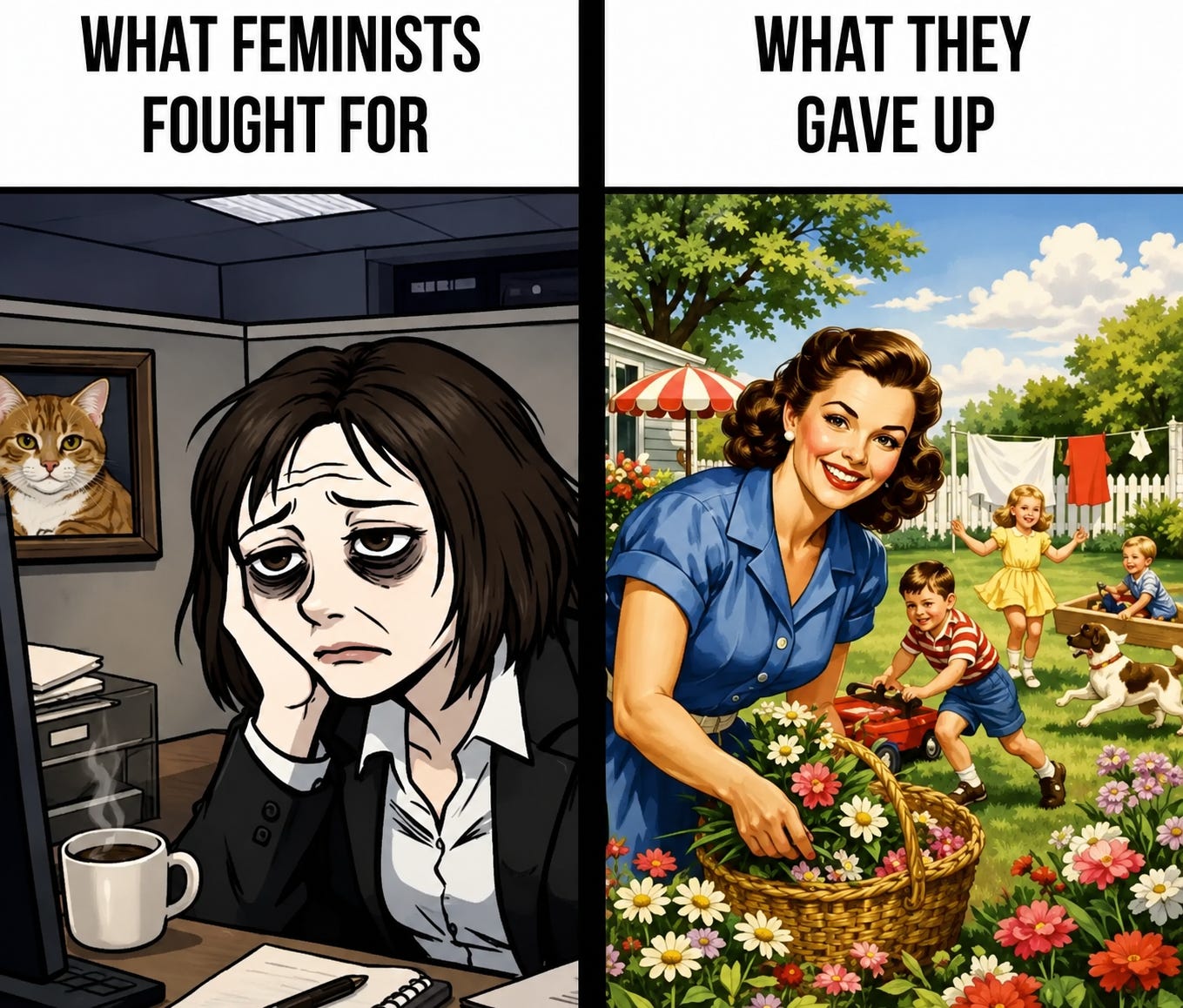
The real feminist betrayal isn’t a stay-at-home-mom in an apron canning peaches. It’s pretending she’s a pitiful idiot because she’s not making a six-figure salary, working LinkedIn like a boss, and paying someone else to do the job society insists doesn’t count as real work.
P.S. Some generous supporters who aren’t fans of online payment platforms have asked if I could include a mailing address for donations, so here you go:
Jenna McCarthy, POPME
POB 342111
Lakeway, TX 78734
(If you mail a contribution, kindly DM me so that I can add you to the paid subs list!)
“Because our mothers and grandmothers didn’t fight for jobs—they fought for choices.”
Boom. Mic drop.
Bad ass as always, my beautiful friend. 🙌🤬🍑❤️
Nature designed men to be the protectors and the providers, and for women to be the nurturers and the caretakers.
We are all better off when we understand that men and women are unique and different, and that we need each other and need to work with each other to keep civilization running a little more smoothly.
It’s not nice to fool Mother Nature: https://lizlasorte.substack.com/p/its-not-nice-to-fool-mother-nature?utm_campaign=post-expanded-share&utm_medium=web