Every December like clockwork—right after the Thanksgiving hangover and before the annual supply-chain panic over batteries—public health officials dust off their brightest, boldest, most optimistic smiles and remind us that it’s time for our annual flu shot. You know, the one scientists whipped up three seasons ago using a prediction model (designed by the WHO of course), a generous dose of government funding, and possibly a divining rod and some prayers.
Since it’s basically a scientific guessing game played months in advance, flu-shot effectiveness against any year’s dominant strain swings hard. In a year when virologists actually knock it out of the park, the shots clock in at around 50% effectiveness*. In a bad year, you’re looking at maybe a 10% dip in risk, something you might also be able to achieve by carrying a lucky potato in your pocket.
*Let’s quickly talk about what “50% effective” means. Does it imply that half the people who get the shot won’t get sick? Or that those who do catch the bug in question will only get half as sick? No, it does not. This number is your relative risk reduction—you might recall that from Covid—and in this case it means you are supposedly fifty percent less likely than someone who didn’t get the jab to contract the illness. (Not protected, mind you, just less likely.)
Imagine a town with a million people in it, exactly half of them vaccinated. The flu sweeps through. Two unvaxxed people get some sniffles but only one vaccinated person does. Because the unvaccinated percentage is 2/500,000 and the vaccinated is 1/500,000—or half of that—that vaccine can officially be considered to offer “50% (relative) risk reduction.”
Relative risk reduction tells you absolutely nothing about how many people actually got sick or dodged anything, and is categorically used because it produces big, impressive-sounding numbers—even (or especially) when the real-world impact is tiny.
Absolute risk reduction, on the other hand, reflects the odds of something bad happening on an individual level. This is not a number public health agencies use, ever, for the record.
In the scenario above, two out of 500,000 unvaccinated people got sick (0.0004%) versus one out of 500,000 vaccinated (0.0002%). The absolute risk reduction therefore is 0.0002% (0.0004 minus 0.0002).
Imagine trying to market that: “This year’s jab lowers your flu risk by 0.0002%! Hurry in!”
Math lesson over. You may now return to pretending the government cares about you and that everything you’ve ever been told wasn’t a big, fat lie.
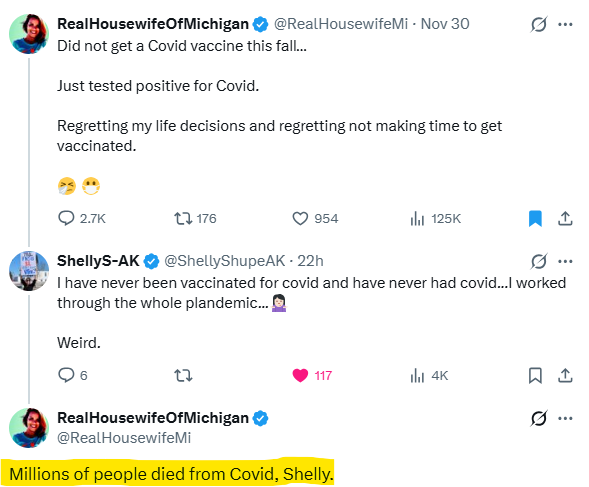
No, RealHousewifeOfMichigan, millions of people died from disastrous protocols and being denied effective early treatment. But please, keep buying the lies and parroting the narrative!
Anyway, according to infectious disease specialist Dr. Lisa Barrett, this year’s flu shot is a pretty lousy match for what turned out to be the germ headliner. So naturally, you should stop what you’re doing, drag yourself to Walgreens, and roll up your sleeve. (Dr. Barrett—who gushes about how lucky her fellow Canadians are to have free vaccines—also encourages folks to add a decorative-mask-that-doesn’t-work to your vaccine-that-doesn’t-do-diddly protocol, for maximum placebo-level protection.)
This is an actual exchange from this urgent public health discussion:
Interviewer: “I’ve heard that the flu vaccine we have right now isn’t a match for the strain that’s going around. Why should we still get vaccinated?”
Barrett: “Yeah, so it’s not a great match this year but it’s still a great vaccine and something I certainly will get and encourage my family to get.”
“Not a match but still great” sounds like a review you might leave for someone you feel sorry for on a dating site. (I mean, he’s not for me—but if you’re not bothered by paint-peeling halitosis or back hair long enough to braid, he’s a catch!)
This is one of six hundred analogies I came up with on the fly to illustrate the absurdity of this response:
Me: “Hi, I bought this pool floatie here, but it sinks like a brick the minute it hits the water. I’d like my money back, please.”
Hardware store guy: “Just because it failed in its singular purpose doesn’t mean it’s not a great product. Perhaps you’d like to purchase a few more as gifts?”
So yes, we’re now expected to clap politely while being told, essentially, that a failed seasonal guesswork serum is our best bet for holiday survival. (One suspects the “experts” here are the sort who would hand you a colander during a downpour to help you bail out your boat.)
You have to admire the loyalty.
Barrett explains that even though the vaccine is mismatched, it will still “prevent hospitalizations” and “ICU admissions,” though she doesn’t say how many or by what miracle. Meanwhile, she notes that other countries are having a “crappy” flu season—a technical term she invokes to suggest ours probably will be, too—but not to worry, because a great-but-not-matching shot apparently solves that! It’s the kind of anti-logic you only hear in public health messaging or the comment section of Nextdoor.
Also, I can’t count the number of comments I’ve seen here and on social media along the lines of “I used to get that damned shot every year—and still got the flu. Stopped getting it, and boom: flu’s like, ‘who?’”
None of this is new or shocking if you’ve ever peeked at the actual evidence. Cochrane—the group that reads every study ever conducted so you don’t have to—has spent years pointing out that flu-shot data are remarkably flimsy. In healthy adults, the benefit is minuscule; in kids it’s slightly better, but still hit-or-miss; in the elderly, the data are so old they should probably come with an AARP membership card and a cane. And when the vaccine doesn’t match the circulating strain? The effectiveness doesn’t just drop—it face-plants.
What Cochrane keeps saying, year after year, is basically this: we don’t actually have any evidence that flu shots prevent serious outcomes. We vaccinate millions of people every season on little more than epidemiological hunches—not solid, real-world results. So when experts insist that a mismatched shot is somehow still a win, keep in mind that repeating something often enough doesn’t make it true—it makes it propaganda.
“It doesn’t really work, but we still strongly recommend it.” If that isn’t the slogan of our era, I don’t know what is.
Loading...
If you’re relatively—or absolutely—sure this stack brings you both knowledge and joy, please consider supporting my work.
Signed books make thoughtful holiday gifts. Just saying.
The people who swear by the flu shot they take every year are hopeless. My mother-in-law will never not take the annual flu shot because of this one anecdote she gives about being the only one not to get sick at work one year decades ago. Who knows about all the other time she's gotten sick after the flu shot. Meanwhile, she will never attribute her recent heart issues that required surgery to the safe and effective my patience is wearing thin clot shots!
I agree with Laura that we are winning this vaccine war with more and more people questioning all shots and taking significantly less.




The people who swear by the flu shot they take every year are hopeless. My mother-in-law will never not take the annual flu shot because of this one anecdote she gives about being the only one not to get sick at work one year decades ago. Who knows about all the other time she's gotten sick after the flu shot. Meanwhile, she will never attribute her recent heart issues that required surgery to the safe and effective my patience is wearing thin clot shots!
I agree with Laura that we are winning this vaccine war with more and more people questioning all shots and taking significantly less.
Methinks the uptake numbers will reflect the fact that we are winning this war.
We don’t want your damn shots.
How timely - this post was just texted to me:
https://mariagutschi.substack.com/p/what-the-new-nejm-study-of-the-mrna