

I guess I just assumed this year’s October Surprise would be something fairly run-of-the-mill. An unexpected indictment. A leaked Signal group chat. A hot-mic recording involving a racial slur or an accidental confession. A newly unearthed video of some congressional candidate doing tequila shots off a lobbyist in 1997.
I was not expecting plague.
Yes. That plague. The Black Death. Yersinia pestis. The disease that killed tens of millions in the Middle Ages. The one synonymous with rotting flesh, bloody mucus, and being the barometer for all things in human existence worthy of avoiding.
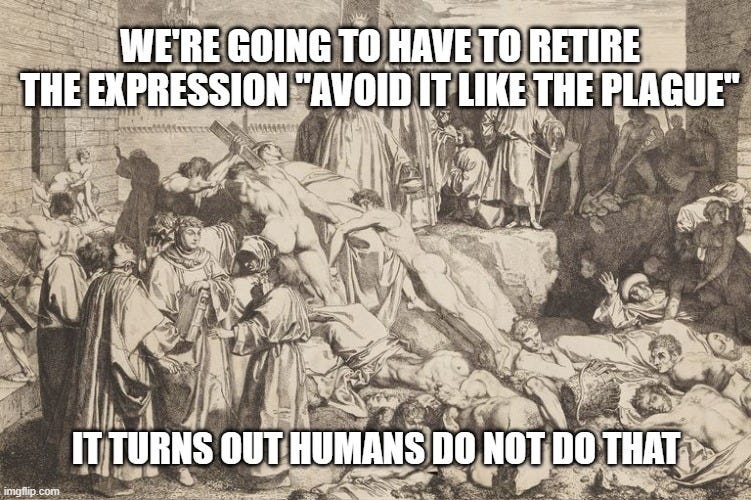
But apparently, here we are.
Earlier this week, a 28-year-old lab tech at an anti-plague research institute in Eastern Russia (which already feels like a problem TBH) died after an alleged accident involving a broken vial of live plague. As of today, hundreds of people are reportedly being monitored, several hospitals are under quarantine, masks are reappearing, and the words “lab accident,” “deadly outbreak,” and “fatal case,” are dominating headlines from ABC to Al Jazeera.
First of all, I sit all day long on a rolling chair on top of a glass chair mat. I have dishes that could survive a third-floor balcony dive. Security companies sell at least five different types of bulletproof glass. If anyone who works for any of these companies could reach out to literally anyone else who makes laboratory vials, that would be great.
Second of all, are we really doing this again?

Here’s what we actually know: Darya Shipilova was employed at the Irkutsk Anti-Plague Research Institute of Siberia and the Far East, which is exactly what it sounds like: a government research facility that studies the world’s deadliest diseases. On September 30, Shipilova was hospitalized. Two days later, she was dead. She was 28 years old.

Reports immediately began circulating in Russian media that Shipilova had accidentally broken a test tube containing Yersinia pestis while working in the lab. A regional official announced that she had died of plague, then quietly edited his post to say she had “possibly” died of the disease. Russia’s public-health agency, meanwhile, insisted there had been no laboratory accident and said Shipilova died of “pneumonia of unknown origin.”
But almost definitely not the deadly disease she was studying, probably.
Whatever officials believed privately, their response wasn’t exactly screaming nothing to worry about. More than 60 employees of the institute where Shipilova worked were reportedly isolated. Nearly 200 people who’d had contact with her were placed under medical observation. Public events were canceled. Several hospitals barred patients and visitors from leaving. Because nothing says ‘minor concern’ like turning visiting hours into a hostage situation.
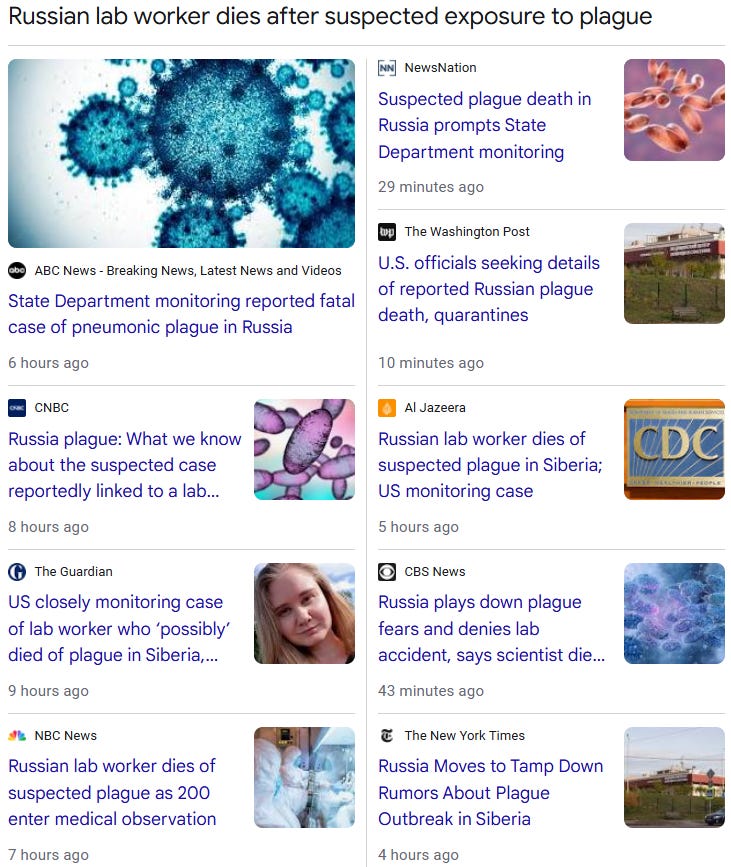
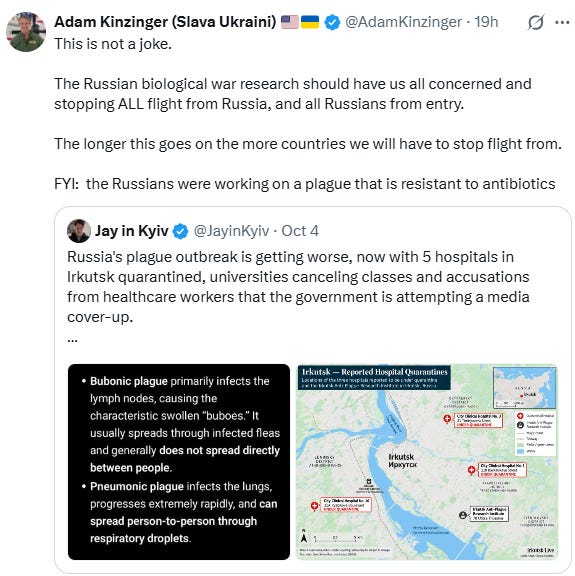
As the media feverishly doom-peddled, the internet responded with precisely the measured restraint you’d expect.
“It’s the most dangerous form,” @PatriotWoman22 helpfully explained. “Pneumonic versus bubonic plague—Pneumonic spreads easily between humans and kills quickly.”
“A friend of mine who works in Russia has just sent me a voicemail: St Petersburg is going to go into lockdown tomorrow because of the plague outbreak. Not joking,” wrote a guy who goes by RAW EGG NATIONALIST on X in a post that as of this writing already has a staggering 5.2 million views.
“3 hospitals locked down in Russia because of a potential PLAGUE outbreak,” added professional panicker Neil Stone—an infectious diseases doctor—before practically begging for a global lockdown.
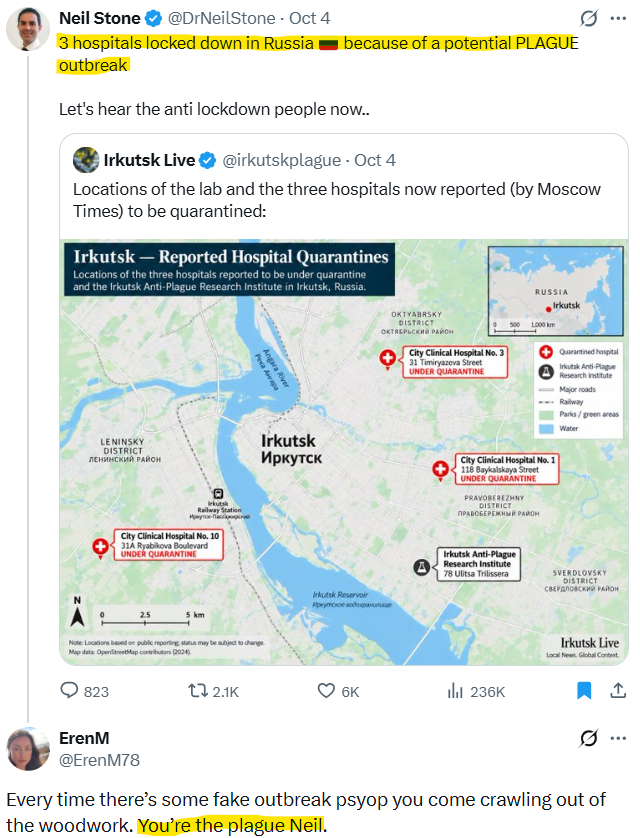
There were calls to halt flights from Russia, warnings about the return of lockdowns, and ominous reminders about precisely how quickly and easily pneumonic plague can spread and how spectacularly fatal it is. That last part, incidentally, is true. Most plague is still contracted the extremely medieval way: from infected fleas carried by rats. Pneumonic plague is the only form that spreads person-to-person. Untreated, the descent from bad to buh-bye can be frighteningly fast.
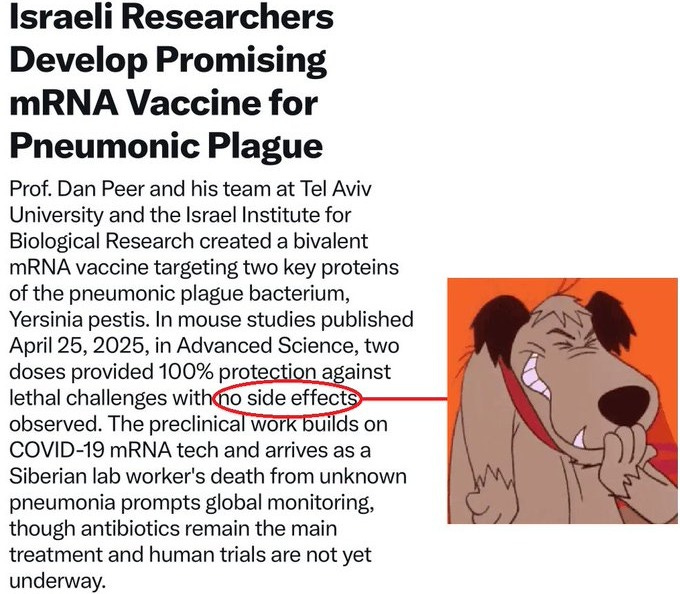
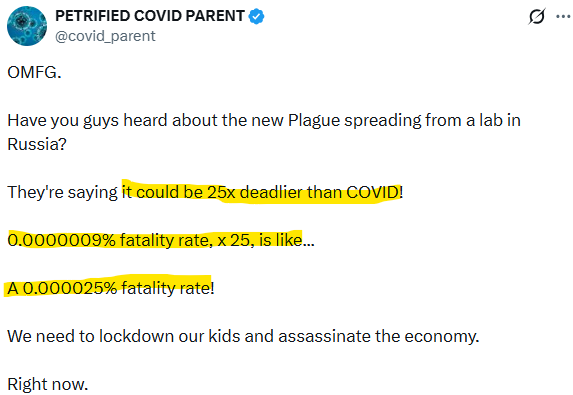
And because apparently no modern-day outbreak scare is complete without the words mRNA vaccine, internet sleuths quickly discovered that Israeli researchers have, in fact, developed an experimental mRNA vaccine against pneumonic plague. The research isn’t new—the study was published in 2025—and so far the vaccine has only been tested in animals and is not approved for humans. That factoid did little to keep the conspiracy industrial complex from clocking in for the day.
So. Terrifying Russian lab. Dead young scientist. Conflicting government explanations. Quarantined hospitals. Masks. Lockdowns. International monitoring. A genuinely lethal pathogen. An mRNA vaccine waiting in the wings. The typical media maelstrom.
GAME SHOW HOST: “Quick, what do you do?”
WINNING CONTESTANT: “Panic?”
And then there’s the Taylor Swift connection.
No, actually.
Apparently the songstress casually dropped a new single titled “Patient Zero” on the exact same day as the alleged lab accident. Which naturally prompted a chorus of “PREDICTIVE PROGRAMMING!” because obviously TayTay is in on the plague, too.

After what happened in 2020, I understand why people’s nervous systems are primed for hysteria. We’ve spent years hearing that another deadly pathogen is coming. Pharma is betting on it. Fauci predicted it. Bill Gates all but promised it. Bird flu has been auditioning for the job since before the plexiglass partitions even started coming down. Mpox had a brief moment. They’ve trotted out Ebola, measles, hantavirus, and even the not-yet-existent-but-extra-lethal “Disease X.” If they could somehow transport us all back to 2019, I’d probably be hyperventilating.
But guys. Come on. This is not our first pandemic.

(This is where I ruin the apocalypse.)
For starters, plague never went away.
I know. That feels like information someone should have mentioned before approximately 48 hours ago, but it’s true. Yersinia pestis still exists in rodent populations around the world, including right here in the United States, where people continue to contract plague every year. The CDC says most American cases occur in rural areas of the western U.S., typically after contact with infected fleas or animals. In other words, the Black Death has been quietly living among us this entire time without demanding Costco install directional arrows.
More importantly, this isn’t 1347.
Plague is a bacterial infection, not a virus, and several commonly available antibiotics are effective against it. With prompt, early treatment—the second part is key with the pneumonic variety—most people recover. (And since most of you are probably like me and will only ever be dragged unconscious into a hospital, it’s never a bad idea to have some antibiotics on hand.)
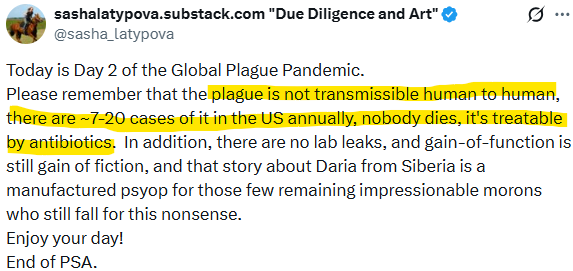
Regarding the person-to-person transmission part: yes, pneumonic plague can spread through respiratory droplets. But “can spread between humans” and “COVID 2.0” are wildly different propositions. Transmission generally requires close, direct contact with someone who is visibly sick and coughing like a Victorian orphan. It is not known for silently ripping through populations via hordes of asymptomatic people.
And even in Russia—the epicenter of the [*checks notes*] single not-even-confirmed-as-a-related-death epicenter—there is no verified plague outbreak. Shipilova’s death has not officially been attributed to plague. Russian authorities continue to deny there was even an accident. And despite nearly 200 people being monitored after possible exposure, there hasn’t been a cascade of sick contacts that would suggest the Black Death has begun its long-awaited comeback tour.
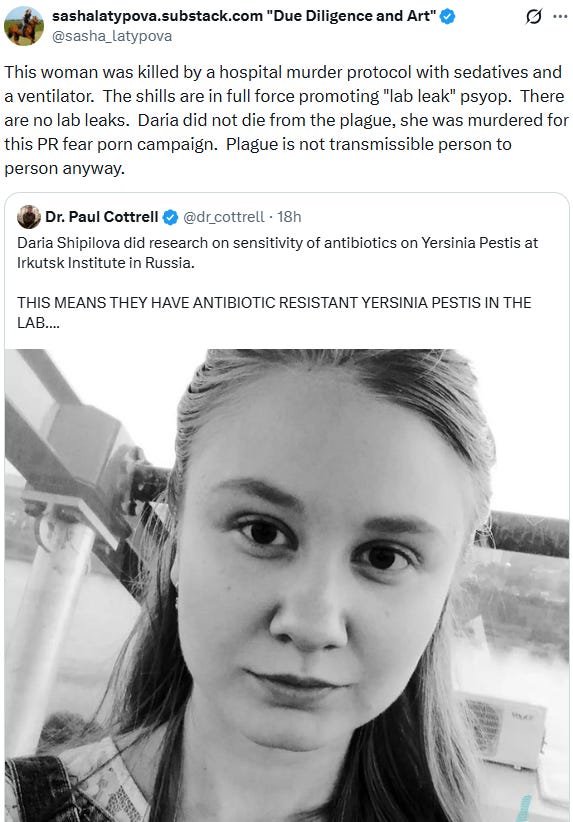
Could Russia be lying? Of course Russia could be lying. Russia could tell me Wednesday follows Tuesday and I’d still check my calendar. But that doesn’t mean the scariest possible explanation wins by default.
Which leaves me with the question I can’t stop asking: Why does plague suddenly have a publicist? Because again, we’re talking about a pathogen that’s been around for centuries, already infects Americans on occasion, is well understood by modern medicine, and is treatable with antibiotics. Which we have! And yet the whole thing is being presented as though somebody just loaded up a fleet of crop-dusters and started circling the suburbs.

Maybe Shipilova really did break a vial of plague. Maybe Russian officials are minimizing what happened. Maybe their aggressive response is pretty much what you’d expect to see when someone who works with extraordinarily dangerous pathogens suddenly dies of turbo-pneumonia.
What none of those possibilities requires—from me, anyway—is panic. My plague protocol therefore remains remarkably consistent: exist. I’m not busting out my mask. I’m not hoarding toilet paper. I’m not disinfecting groceries. And unless a feverish Siberian marmot shows up hacking up phlegm in my kitchen, I will not be reorganizing my life around a Russian flea problem.
POLL REDUX FOR FINICKY PHONES:
What’s your plague preparedness plan?
Already in self-quarantine.
Stockpiling supplies just in case.
Wait, there’s a plague?
Wake me when the locusts show up.
*combo/unsure/other
Well, there has been the Moronic Plague in the U.S., especially affecting "blue areas". At this point, I may take Pneumonic or Bubonic over Moronic :-)
I haven’t seen a rat in 50 years…other than the ones attempting to control our government and destroy our way of life.