

Six short years ago, the phrase “global health emergency” had people stampeding through grocery stores and fist-fighting over the last six-pack of Charmin. Today, it elicits roughly the same level of alarm as “pollen counts may be slightly elevated tomorrow” or “eating expired Spam can cause mild nausea.”
That collective ennui is unfortunate for the World Hysteria Organization, because this weekend our friends at the WHO declared the latest Ebola outbreak in central Africa a Public Health Emergency of International Concern (PHEIC), which is Geneva-speak for “it’s time for cable news to dust off the doomsday ticker and wheel out the giant touchscreen maps again.”
I know. We haven’t even taken our hantavirus decorations down yet and already we’re doing Ebola. Here’s the full scope of the current crisis: As of yesterday, authorities had recorded 8 laboratory-confirmed cases, 246 suspected cases, and 80 deaths. (Don’t ask me how you can have 80 deaths with only 8 confirmed cases. I’m not a scientist or a mathematician, okay?)
Out of a global population of roughly 8.3 billion people, we’re talking about the equivalent of roughly four drops of water in an Olympic swimming pool. At this point, statistically speaking, a vending machine remains a more realistic threat to your personal safety than Ebola.
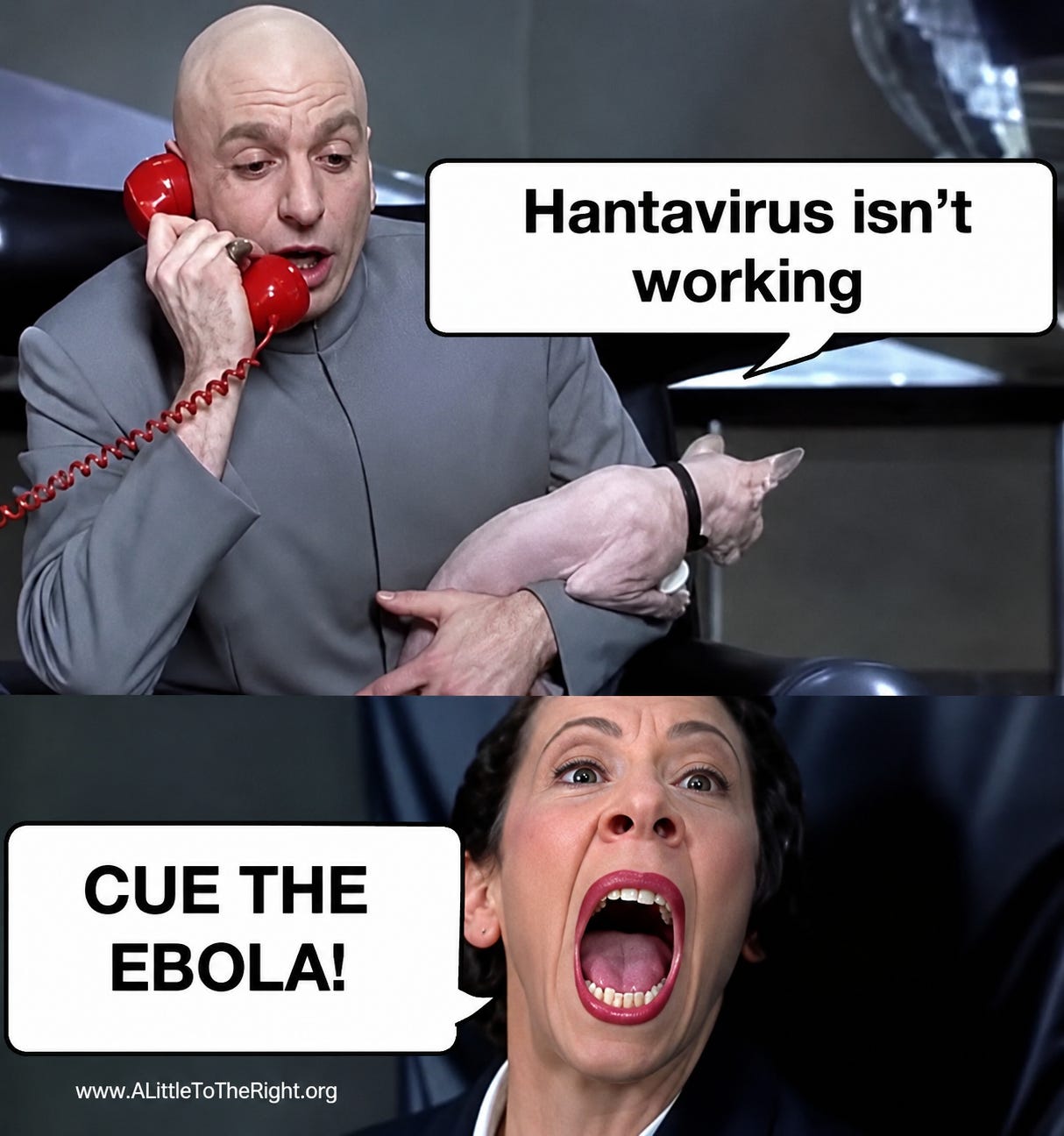
Nevertheless, it’s a PHEIC. Please panic accordingly.
It’s hard to believe that it was less than two weeks ago that the media nearly sprained something trying to convince Americans that hantavirus was the next civilization-ending nightmare. Fortunately, the WHO calmly clarified at the time that hantavirus was not a global emergency. See? This is how you know you can trust these people. They don’t call everything a global emergency. Just the outbreaks involving international coordination, emergency declarations, cross-border spread, “suspected cases” at least in the triple digits, and breathless dispatches beginning with “there is no approved vaccine for this species of Ebola.”

And there it is. No approved vaccine.
That line appeared right in The New York Times’ subhead, because catastrophe reporting now operates like the opening scene of Contagion. Americans have been thoroughly conditioned to hear “novel outbreak” and immediately wonder whether we’re headed toward “wash your hands and avoid sneezy people” or “download the government app and stand six feet apart inside Costco.”

To be fair, Ebola is genuinely terrifying. Unlike Covid—which many people experienced as a weird flu that robbed their ability to distinguish Coke from Pepsi—Ebola’s symptom list reads like a medieval curse: violent vomiting, internal hemorrhaging, multi-organ failure, loss of consciousness, and bleeding from the nose, gums, mouth, and nether regions, to name a few. The fatality rate ranges from 25 to 90%, depending on the strain. Think Old Testament plague meets Pulp Fiction.
The current outbreak involves the Bundibugyo strain of Ebola—and no, I am not making that up—for which there is allegedly no treatment. (Except see here and below.) That particular detail was repeated throughout coverage with the subtlety of a guy pacing outside your window whispering, “Just so you know, the locks on your doors don’t actually work.”
Conveniently, serendipitously, and in no way suspiciously, just four months ago Bill Gates’ vaccine research organization CEPI handed Moderna and Oxford $26.7 million to develop an mRNA vaccine for the Bundibugyo strain specifically. (I’ll add here that in all of history, dating back to the beginning of recorded time, there have been a grand total of [*checks notes*] 104 confirmed cases of the Bundibugyo species in the entire world. Not a typo. One hundred and four.) Gates is also, since America’s exit, the WHO’s single largest funder. File that info wherever you’d like.
So if there’s no vaccine… and no approved treatment… I guess the only option left is locking everyone inside again. You know, to prevent the spread. So conscientious. So responsible.

Because this is the decade’s second scamdemic rodeo, it took approximately eleven minutes for internet sleuths to rediscover that the U.S. government—specifically the Department of Health and Human Services—has actually spent years filing patents on none other than the Bundibugyo species, along with the methods to detect and treat it. It’s comforting to know that while we’re supposed to be out here worrying about our internal organs imploding, the NIH is busy ensuring that no one else is allowed to develop a cure without cutting them a royalty check.
Raise your hand if you’re shocked.
The confusing thing is that the WHO insists this outbreak does not meet the criteria for a pandemic emergency, which is the highest level of alert (and, you’ll recall, the one they assigned to the-flu-that-was-Covid). Officials are simultaneously advising against border closures while also warning of “significant uncertainties” regarding the true number of infected people and the geographic reach. Cases have popped up in multiple African cities and health authorities are openly acknowledging that they frankly have no idea of the true scope of the outbreak.
Which is a totally normal and reassuring set of statements to make simultaneously.
“We’re not at DEFCON 1-level threat but also we have no idea how many people have it or where it is and we are not actively trying to contain it.” It’s the disease-management equivalent of “There may or may not be a snake that may or may not be deadly under your bed but definitely don’t check.”
Here’s the actual problem (spoiler: it’s not Ebola): Somewhere between “two weeks to flatten the curve” and “masks don’t work, wait, actually they do, wait, actually the cloth ones don’t but we’d like you to wear one anyway while seated at a restaurant between bites,” the wheels fell off. We trained an entire population to treat pathogen-control guidance the way most people treat the terms and conditions on a software update—something to scroll past on the way to the cute kitten videos.
So here we are, staring down a genuinely frightening virus with a truly alarming symptom list and disturbingly uncertain case counts that’s been declared an official planetary emergency. And a significant portion of the population’s first instinct is I could be bleeding from my rectum and I still wouldn’t trust the WHO to tell me which end it was coming from.

It’s worth noting that Ebola is not airborne. You cannot get it from casual contact or from a visibly healthy stranger. It is transmitted through direct contact with the bodily fluids—blood, vomit, sweat, saliva—of someone who is actively symptomatic. (The one notable exception: semen, in which the virus can apparently survive for a year or longer after full recovery. So if you are considering intimate relations with a recent Ebola survivor, perhaps lead with some questions. This has been your Jenna’s Side public health bulletin of the week.)
In other words, you’d essentially have to enjoy (?) prolonged, intimate contact with someone in the middle of actively liquefying—which, given the symptom list, is not a situation most people are going to accidentally stumble into.
Here’s the thing about living on Earth: it has always been trying to kill us. Flesh-eating bacteria. Venomous spiders. Lightning strikes. Falling coconuts. Piranhas. Tsunamis and sinkholes and salmonella. Chainsaws. Unrefrigerated potato salad at the company picnic. The list of legitimate threats to our continued existence is long, varied, and largely indifferent to our feelings about it.
C.S. Lewis, writing in 1948 about the dawn of the nuclear revolution, asked: “How are we to live in an atomic age?” His answer was essentially: the same way we lived before it (which was not cowering beneath beds thinking about bombs). Because a scarier explosive didn’t change the fundamental human condition—it just gave us a new, more dramatic thing to catastrophize about.
And we already have vending machines.
Once again, I couldn’t decide on a single poll. Be sure to vote in both!
I don’t mean to brag but I have the exact same medical degree as Bill Gates.
"Please panic accordingly." - Jenna, you've nailed it with that single sentence. Hopefully 99% of us completely ignore the WHO.
Now I want the kitten videos!