

While we were all busy earning online degrees in Somali nonprofit fraud, a bomb blew the lid off the news cycle. Suddenly the planet became overrun with Immigration and Customs Enforcement specialists, constitutional consultants, and body-cam policy scholars.

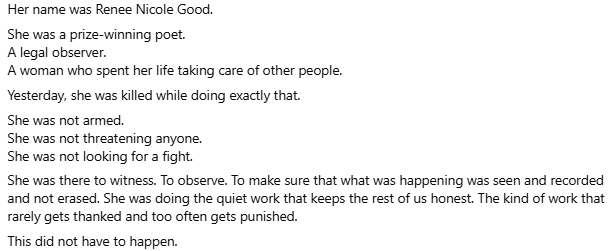
The trigger was this: Last Wednesday in Minneapolis, an ICE enforcement operation intersected with some local activists protesting their efforts. One of the demonstrators was Renee Good, a 37-year-old stay-at-home mom, writer, poet and “ICE watch warrior who’d been trained to resist feds.” After Good intentionally stopped her SUV sideways in the street to impede the operation, several agents surrounded her vehicle and ordered her out of her car. She ignored their demands while her wife filmed the exchange. When an officer tried to open her car door, Good backed up, turned her wheels and accelerated—striking ICE agent Jonathan Ross. As she attempted to flee, Ross fired his weapon, killing her. The SUV continued down the street and crashed.
A woman is dead. A family is shattered. A community is traumatized. A country is inflamed. None of that is debatable. What is debatable—and what matters enormously—is how quickly and carefully the story was curated by both sides of the aisle.

Within hours, the liberal media narrative had hardened into some derivative of this: an unarmed woman was doing absolutely nothing wrong and ICE executed her in cold blood. Protests erupted. Headlines escalated. Pundits began warming up the phrase “the next civil war,” which—if you’re keeping score—was also invoked after Trump’s first impeachment, George Floyd, Kyle Rittenhouse, January 6, Trump’s second impeachment, vaccine passports, Trump’s third indictment, Charlie Kirk, “Trump’s National Guard antics,” and at least four separate Tucker Carlson monologues.
The gist: Good was a saint; Ross is a sinner. MAGA has blood on its hands. Case closed. Investigation unnecessary.
The Department of Homeland Security told a wildly different story. DHS Secretary Kristi “ICE Barbie” Noem claimed that Good had been “stalking and impeding ICE agents all day” before attempting to “weaponize her vehicle.”
“It was an act of domestic terrorism,” Noem explained. “What happened was our ICE officers were out in enforcement action. They got stuck in the snow because of the adverse weather that is in Minneapolis. They were attempting to push their vehicle when a woman attacked them and those surrounding them and attempted to run them over.”
Eyewitness accounts verified the stuck-car part of the story. What the internet couldn’t agree on was whether Good was actively trying to run someone over when she was killed—or just run, period.
Videos flooded social media. Security camera captures. Bystander footage. The agent’s own recording. Different angles. Side-by-side. Slowed down to frame-by-frame motion. Another surreal montage of a murder humans were never meant to witness over and over in painstaking detail.
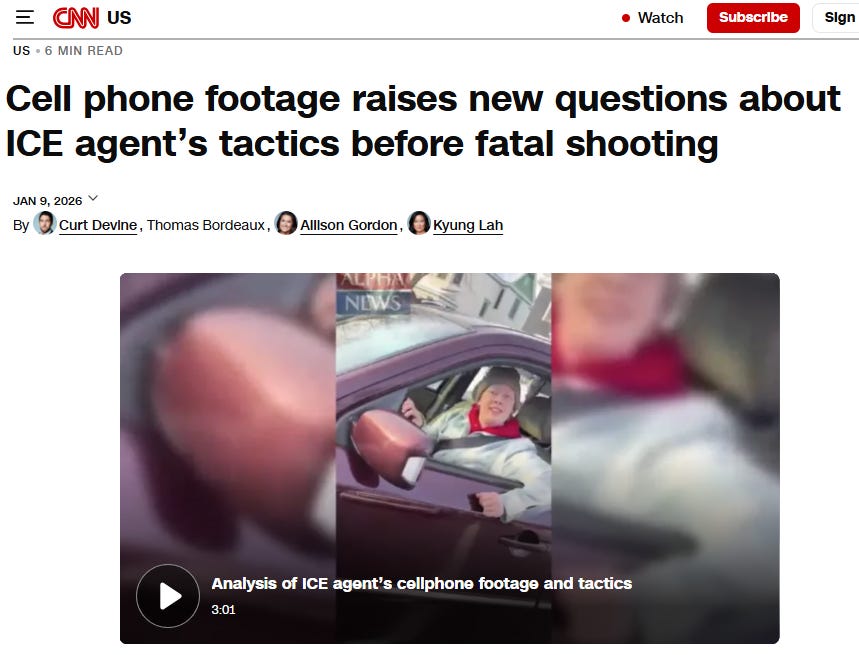
What the footage shows is a woman deliberately blocking a legally authorized operation—not an innocent bystander simply rolling onto the scene. It wasn’t a suicide mission, but it also wasn’t someone simply going about her business. Good ignored official orders. A confrontation occurred. Tensions escalated. Fast. In Minnesota, cars driven recklessly or used to threaten officers can be treated as deadly weapons under state law. Could the agent who pulled the trigger (a U.S. army veteran who had previously been dragged and injured by a vehicle in an incident involving a fleeing suspect) have feared for his life? Sure. Could he have shown more restraint or exercised better tactical judgment? Absolutely. Can any of us say unequivocally how we’d respond in that situation? Probably not. Would Good still be alive had she not tried to interfere with federally sanctioned activity that day? Sadly, yes.
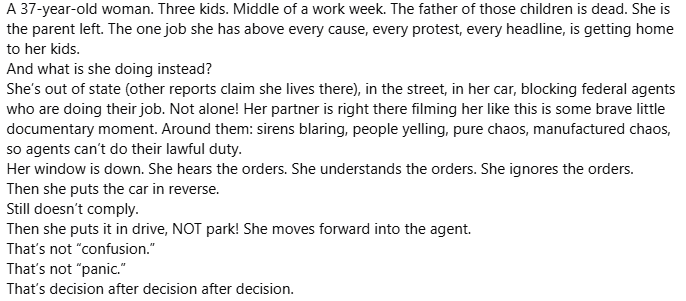
There’s an uncomfortable contradiction here that no amount of sloganizing can smooth over: A woman protesting the removal of people who violated the law chose to do so by deliberately violating the law herself. That doesn’t make her evil. But it’s relevant.
The problem is that we no longer weigh facts—we weigh feelings. We look for confirmation. The initial framing didn’t say, “An altercation occurred, footage is emerging, and investigators will determine whether deadly force was justified.” It said: “ICE murdered an innocent woman.” Full stop. Hashtag ready. Positions were locked in before the body was cleared from the scene. Once a narrative settles, evidence isn’t evaluated; it’s filtered. Every new detail is sorted into helps my side or hurts my side, and inconvenient facts are immediately branded propaganda.
You could watch that process unfold in real time. First, the media insisted Good never struck the officer. When video made that impossible to maintain, the story shifted: okay, she hit him—but it was accidental. Then: fine, maybe it wasn’t accidental, but she wasn’t trying to kill him. And because intent is impossible to prove posthumously, the conclusion became retroactive: the officer was never in danger, thus the shooting was an act of excessive force, therefore the original story stands. The facts didn’t drive the conclusion; the conclusion dictated which facts were allowed to be considered at all.

But truth doesn’t live in the fairytale land of Either/Or. It lives in the massive gray area in between where countless realities can exist at the same time: a woman can be unjustly killed and also make choices that put herself in danger; an officer can feel threatened and also still make bad judgment calls and strategic errors; activism can be rooted in good intentions and also be catastrophically ill-conceived. But none of that fits neatly on a protest sign or a chyron, and arguing in absolutes is the reflex we’ve been conditioned to perform.
While the left spat profanities at MAGA, mourned the death of social justice, and elevated Good to instant martyr status, the right worked to turn her into a monster. They’re excoriating her for trying to protect a Somalian sex offender. They’re digging into her past and claiming she lost custody of two of her children because her wife was abusing them. (I do not know these things to be true, incidentally, only that people are saying them.) A GoFundMe for Good’s family has raised well over a million dollars—a generous gesture some liken to funding a terrorist organization.
JD Vance called Good a victim of left-wing ideology, asking, “What young mother shows up and decides she’s going to throw her car in front of ICE officers enforcing legitimate laws? You’ve got to be a little brainwashed to get to that point.” Victims of immigrant violence were held up as proof that liberals like Good care more about pushing activist agendas than promoting safer communities. It was impossible for either side to divorce the events from race and politics.

I don’t doubt for a second that Renee Good believed she was selflessly fighting for the vulnerable (as twisted as I find her logic and motives to be). I also believe that Jonathan Ross did not go to work last Wednesday with the intention of ending someone’s life. Here’s the unpopular opinion: None of this requires anyone to pick a villain, crown a hero, or pretend this was anything other than a tragedy compounded by high stakes, inherent tension, and split-second failures. An activist interfered with a law enforcement operation—and lost her life. That should be a sobering cautionary tale. A federal agent fired a lethal shot. That demands scrutiny. From either perspective, actions have consequences.
A woman is dead. An officer will live with that forever. Both things are gut-wrenching. But turning every tragic operation-gone-wrong into a prewritten morality play—complete with mass protests, apocalyptic language, and zero tolerance for nuance—doesn’t advance justice. It just guarantees we keep mistaking noise for facts and certainty for truth… and arguing about them both.
NOTE: I put the combo option at the top of the poll because a) people often comment that they pulled the trigger too soon, and b) I suspect it will be the most popular pick. Maybe I’m wrong. I look forward to finding out. :)
Allow me to comment as a law enforcement spouse. My husband was a police officer in Norfolk, Virginia for 5 years, where we buried 3 of his friends who were killed in the line of duty and has been with Louisville Metro Police Department for 18 years, including several years as a homicide detective (including 2020 when Breonna Taylor was killed by a police officer after her boyfriend shot a cop who was serving a warrant in the femoral artery). What non LEO families do not understand is that the narrative around police shootings by the media is always one sided and always makes the officer the villain (except in the case of Michael Byrd, who killed Ashli Babbitt). Some of the past narratives have never been corrected, and friends of mine still believe the "hands up don't shoot" narrative about Michael Brown (later determined to be a justified shoot by the cop). They still believe Breonna Taylor was an innocent EMT, not involved with drug dealers and some even believe the cops served the warrant on the wrong house and that they did NOT knock (they knocked repeatedly, which was their mistake in hindsight). Renee Good was a victim of indoctrination by Democrats, including their media, and she was used as a pawn by a highly funded group of radicals who want to see the American experiment fail, i.e. Marxists. I pray that my husband never gives a person the benefit of the doubt if he finds himself in a situation where a person is apparently prepared to use a 4 ton vehicle as a weapon. While he says he would have used different "tactics" and likely would not have been in this position, the reality is that she was told to get out of the car, and she did not comply. She made several decisions that day that unfortunately led to her death. Lastly, Minnesota is corrupt. If you have not watched the documentary about George Floyd, produced by Liz Collin and others, I highly recommend it. Liz basically lost her job as an anchor at a local news station in Minneapolis, because she was married to a cop and was not willing to lie about what happened. https://www.thefallofminneapolis.com
Some people support illegal immigration, the majority oppose it. The law is on the side of those who oppose it.
If those who support it resort to violence and/or obstruction, they become criminals. Arrest them. Renee Good agitated and escalated to physical violence. Her choice.