The Surveillance State Just Enlisted Millions of Strangers to Spy on You
Meta's new privacy policy is basically: good luck

Back in March I wrote about Meta’s AI glasses and the unsettling revelation that humans in another country were reviewing let’s just call it deeply personal footage captured by people wearing them in their offices, their cars, their bedrooms, their bathrooms. Fights. Financial details. Full-frontal nudity. Reviewed by actual strangers, for actual money, with no meaningful security and even less shame. I noted at the time that this seemed like the sort of thing that should generate congressional hearings, criminal investigations, or at the very least a strongly worded letter from someone’s mom.
Instead, we got a software update.

This week, security researchers discovered that Meta has been quietly shipping facial recognition code to millions of smartphones since January—buried inside the Meta AI app that pairs with its Ray-Ban and Oakley smart glasses. The feature, called NameTag, is not currently enabled. Meta would very much like you to find that reassuring.
I do not find that reassuring.
Here is what NameTag does, or will do, the moment someone flips the switch: it scans faces through the glasses’ cameras, converts them into biometric data, and matches them against a database of stored faceprints. In plain English: a complete stranger at the grocery store, your gym, the park, or your kid’s swim meet can look at you through a pair of sunglasses and within seconds know more about you than your neighbors do—without your knowledge, without your consent, and with absolutely nothing you can do about it. Oh, and they can record the moment for posterity.

Think about what “identifies you” actually means for a second. It’s not just your name. It’s everything attached to your name. Your address. Where you work. Where your kids go to school. Your social media profiles—including the ones you thought were private. Your daily routine, reconstructed from public check-ins and tagged photos. If you were a stalker, an abusive ex, or a garden-variety predator, NameTag wouldn’t just be a useful tool. It would be the single greatest gift technology has ever handed you, wrapped in a Ray-Ban case and available at your local Best Buy for $224.
Oh, and don’t think you’ll just pay extra attention to whether the potential perv you’re talking to has a flashing recording light on his temple. The same species that immediately taught itself to jailbreak iPhones, pirate Netflix, and cheat at Wordle quickly figured out how to disable that feature, too—and is out there offering free lessons. So that’s terrific. (Lawmakers are already trying to get ahead of the workaround, but good luck enforcing that.)

Meta’s response to all of this? “Nothing has shipped to consumers and no final decision has been made.” Which is roughly as reassuring as your kidnapper telling you “the gun isn’t loaded yet.”
And here’s the part that makes a lean-to in the woods start looking like a reasonable life choice. An internal Meta memo reviewed during reporting revealed that the company is interested in launching NameTag during a “dynamic political environment” because “civil society groups that we would expect to attack us would have their resources focused on other concerns.”

Read that again.
Meta didn’t just build a secret facial recognition system and quietly push it to millions of phones. They admitted in writing that they’re just sitting on it, waiting for the perfect political moment to flip the switch—specifically, a moment when the people most likely to fight back will be too distracted to notice. That’s not a technology company trying to optimize a product launch. That’s a backroom surveillance operation with tinted lenses and an agenda.
For context, Meta shut down Facebook’s facial recognition system in 2021 and deleted more than a billion faceprints after mounting criticism from privacy advocates and regulators. The company was ordered to pay $650 million to settle a class action lawsuit over biometric data. So they’ve done this before, paid an enormous fine, solemnly promised to do better, and then apparently spent the next five years building a smaller, sneakier version and hiding it in a glasses app. Pharma would be proud.

The official reassurance is that Meta is “not building a central face database.” Central doing the work of an entire legal department there. Because what they’re building is millions of individual face databases—on your phone, connected to their servers, worn on the faces of people standing next to your children at the park, the pool, the school pickup line. But definitely not a central one, so we can all relax.
And lest you think the facial recognition and the dude in India watching you undress are the only glaring neon problems with these glasses, let’s talk about something else that’s already happening, right now, without NameTag even being activated.
Women leaving the beach, walking into shops, attending their kids’ sporting events, or simply existing in public are being filmed by men wearing Meta Ray-Bans without their knowledge or consent. The women only discover the footage exists after it goes viral. When one woman asked the person who posted a secret recording of her to remove it, she was told that doing so was “a paid service.” So, yeah, you could be charged to have your own face taken down from the internet. That’s where we are.
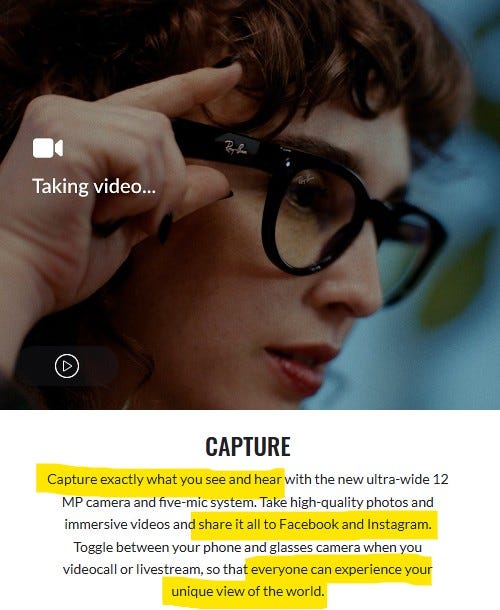
Meta markets its glasses under the tagline: Designed for privacy, controlled by you. Which begs a host of questions: Designed for whose privacy, exactly? Not the ladies unknowingly being filmed in Walmart. Not the drive-through employee being pranked. Not the gal who realized in the middle of a Brazilian wax that her aesthetician was wearing a pair. (And if you’re not familiar with the waxing world, a Brazilian is the Telly Savalas of hair-removal treatments.) Not the folks whose faces are being converted into biometric profiles and stored on strangers’ phones.
And “controlled by you” is doing some of the heaviest rhetorical lifting in the history of consumer electronics: you, the wearer, control whether you record people without their consent. You, the wearer, control what you do with that footage. You, the wearer, control whether you use NameTag to identify strangers. The person being recorded controls absolutely nothing, and Meta would really appreciate it if you didn’t dwell on that part.

Researchers expect as many as 100 million people will buy smart glasses in the next few years. Apple is developing its own version. So is Snap. Google is trying again—and if you’ll recall, the reason Google Glass failed a decade ago was that the public collectively looked at a bunch of strangers wearing cameras on their faces and said, "Absolutely not." We apparently needed ten years to forget why.
At some point we have to stop whining about the legality of it and start addressing the consequences. The creep at the playground has always existed. Meta just gave him Ray-Bans and a user manual. It looks like—once again—it’s up to us to protect ourselves.