

The modern-day nanny state didn’t arrive with paparazzi and a red carpet. It rolled in slowly, one “helpful” gadget at a time. It started with carrying mini-computers with microphones embedded in them everywhere we went. What was the harm in that anyway? It’s not like we were sharing state secrets or plotting murders (probably). If some bored data analyst wanted to spy on me yelling at my kids or texting my husband another cat photo, have at it, my guy. They probably don’t pay you enough, but enjoy.

Next came the Ring doorbells. Ring was revolutionary! We could see who was at the door without having to open it, get notified when our Amazon order was delivered, and sometimes even help the neighbor figure out who ding-dong-ditched them last night at two-thirty in the morning. What a time to be alive.
Wait, did somebody say smart speaker? As in, my very own personal assistant to tell me what time it is or play my favorite song or remind me to make a dentist appointment and all I have to do is summon her by name? (Otherwise she’s definitely not listening. Unless I murder someone, which obviously I wouldn’t.) Sign me up!

Life360 was a game-changer. What nervous parent wasn’t relieved to discover they could track their kids’ every move? Did they make it to school? Indeed they did! Had they been speeding? Shockingly, no. Were they still at the shopping center? “Hey hon, could you pop into TJs and grab a carton of organic eggs?”
Before you knew it, we’d handed over our fingerprints, our faces, and the floor plans of our homes to our robot vacuums. We streamed our sleeping babies straight to our smartphones. We wore rings that calculated exactly how many calories we burned today and how many minutes of REM sleep we got last night. We bought six-figure driverless mobile monitoring pods that map our surroundings from a guy who’s obsessed with putting chips in our brains. What innovation! How cutting-edge! Such convenience!
If you thought we’d collectively reached peak “voluntarily broadcasting our entire existence to Big Brother” energy with all of this, I’ve got a ski chalet in Silicon Valley to sell you—and it’s dirt cheap.
Probably the most Orwellian I-can’t-believe-it’s-even-a-thing to emerge from the tech pipeline: Meta’s frighteningly popular Ray-Ban AI glasses.
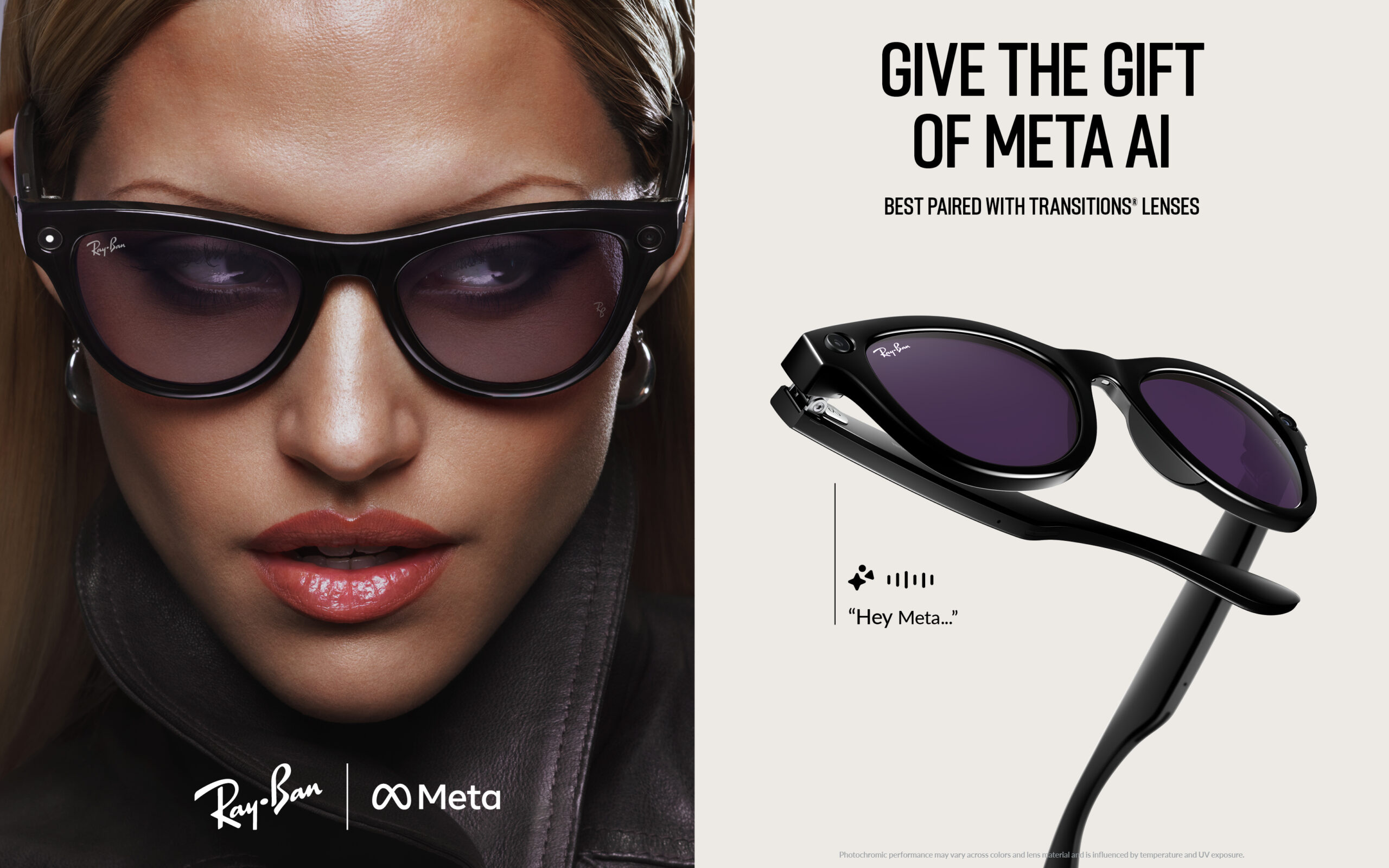
These aren’t the beyond-dystopian frames I wrote about a while back (you know, the ones that basically create a nice holographic life for you, because why bother owning pesky things or having annoying real-life friends when AI can just beam a perfect facsimile into your living room?). These are “stylish smart glasses”—they’re Ray-Bans, for crying out loud—that translate foreign conversations in real time, tell you about landmarks as you travel, and “capture every single thing you see with precision and clarity—without even having to take out your phone!”
How. Lazy. Have. We. Gotten?

Apparently, very. Meta reportedly sold more than seven million pairs last year alone, a considerable jump from the two million sold across the previous two years combined. It would seem that the future people want comes equipped with shades that double as a face-mounted documentary crew.
Beyond the tiny little detail that the company behind this spyware eyewear is the same one that spent the last decade treating your personal data like the open bar at your ex’s wedding, there’s an even bigger concern: when your glasses capture every single thing you see… where does all of that video live? Who else is seeing it? And what are they doing with it?

A recent investigation revealed that much of the footage recorded by these glasses is being shipped overseas for human review. As in: real people watching every frame your glasses record. Artificial intelligence may be able to spit-shine your cover letter or give you a quick and easy recipe for egg bites, but it still needs an army of very real humans to sift through the data and tag it with notes like, “This is a refrigerator.” “That is a dog.” “Here we have what appears to be a man brushing his teeth.”
And sometimes, disturbingly, “Yowza! That’s someone taking their clothes off!”
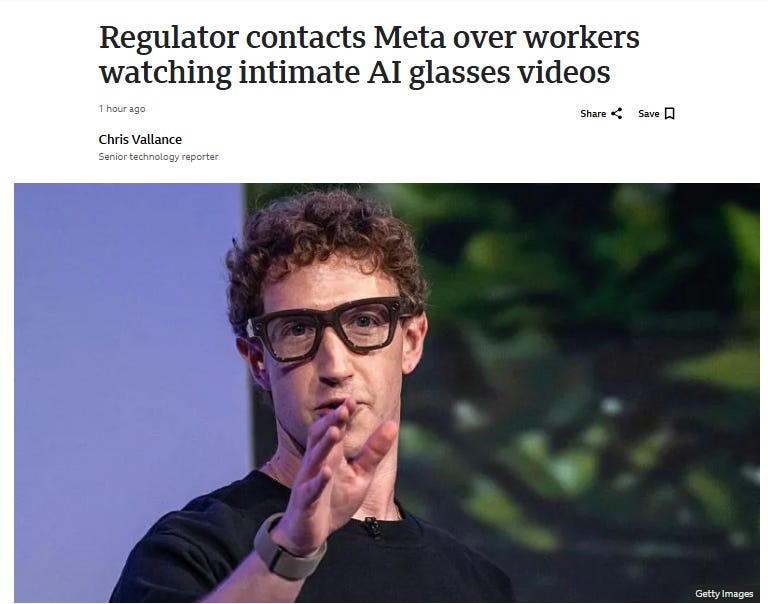
One data annotator interviewed in the investigation explained that many of the videos contain extremely personal moments—people showering, watching porn, using the bathroom, and otherwise doing things that absolutely nobody on Earth intends to broadcast to a stranger on another continent.
“I saw a video where a man puts the glasses on the bedside table and leaves the room,” the contractor told interviewers. “Shortly afterward, his wife comes in and changes her clothes.” And just like that, this guy whose job description probably said something vague like AI training specialist suddenly found himself being paid to watch a stranger get naked.

People aren’t just watching X-rated stuff in their Ray-Bans; they’re wearing them while doing X-rated stuff and then unwittingly sharing these intimate moments with the Metaverse. And somewhere in Nairobi, contractors are dutifully labeling footage like: “two humans… interacting.”
The sad part is, nobody who’s been awake for more than five or six minutes is even a tiny bit surprised by this. And yet, there are people out there who honestly believe these new-fashioned specs are just quietly capturing every nanosecond of their life and then respectfully deleting it like a polite digital butler.

With all due respect: They’re Meta glasses. The company literally built an empire by vacuuming up every scrap of human behavior it could find and selling it to advertisers. And now people are surprised that glasses that come equipped with a camera, microphone, AI assistance, and constant internet connection are… recording things?
That’d be like buying a Roomba with teeth and being shocked when it eats the carpet.

The investigators said that when they bought their Meta wearables, the Terms of Use made it seem like the company prioritizes privacy. They wrote:
“It states that voice recordings may only be saved and used for improvement or training of other Meta products if the user actively agrees. But for the AI assistant to function, voice, text, image and sometimes video must be processed and may be shared onwards. This data processing is done automatically and cannot be turned off.
It also states that the AIs may store and use information shared with them, and that the user should not share information ‘that you don’t want the AIs to use and retain, such as information about sensitive topics’.”
Judging by the videos being reviewed, many users appear to have missed that memo.

Annotators explain they’re expected to watch and tag the footage without asking questions. If they push back, they risk losing their job. “You understand that it is someone’s private life you’re looking at,” one said. “But at the same time you’re just expected to carry out the work. If you start asking questions, you’re gone.” Which is how the shiny futuristic promise of AI quietly turns into a room full of exhausted workers in another hemisphere labeling strangers’ private lives for a tech company worth hundreds of billions of dollars.
It’s the same system social media companies have used for years to moderate violent content—except now the raw material isn’t just crime footage or extremist propaganda. It’s your kitchen. Your living room. Your bedroom. Your credit card. Your naked spouse getting out of the shower. And every single time a company says, “Don’t worry, we respect your privacy,” millions of people nod thoughtfully and say, “That’s so kind of you. I’ll take two.”

“If people knew about the extent of the data collection,” one of the footage-viewers said, “no one would dare to use the glasses.”
In the fairytale version of this story, this is how it would end: Somewhere, on a server you’ll never see and in a job you didn’t know existed, a stranger is tagging clip after clip with the very same caption—inside of a garbage can.
I *think* I know where this poll is going to go, but sometimes you surprise me. :)

Even more concerning is that an idiot wearing these glasses is also, without permission, tracking, recording and spying on everyone around them. It’s beyond creepy. And thanks a lot, now if I see anyone with larger than normal glasses on I’ll think they’re recording me—my life just got soooo much better!
I memorized the lazy person fact #.