

Imagine police solve a forty-year-old murder. The evidence is overwhelming. There’s DNA. Dozens of witnesses. Somebody found a shoebox full of incriminating photos and a confession letter. The case is closed.
To your shock and horror, the killer turns out to be your father.
(Take a minute. That was traumatic information, I realize.)
The only catch is, Pops died in 2011. Since obviously somebody needs to be held accountable, the authorities show up at your door and arrest you. “We’re sorry,” they explain, “but when the guilty party is unavailable, we hold the nearest biological relative responsible.”
YOU: “But I wasn’t even born!”
THE AUTHORITIES: “Yeah, that’s not really our problem.”
They proceed to freeze your bank account, seize your property, and gently inform you that your future now includes a stainless-steel toilet and very limited natural sunlight.

That, of course, would be absurd. Why? Because we generally reject the idea of inherited liability. We believe guilt belongs to the person or people who committed the crime—not their children, grandchildren, or step-great-grandchildren.
Which brings us to New York’s latest conversation about reparations. This week, activists speaking before the state’s Community Commission on Reparations Remedies demanded cash payments of $800,000 per eligible recipient (go big or go home!) to compensate descendants of enslaved Americans for their servitude and subsequent discrimination. Advocates called the proposed financial windfall “the only true form of justice.”

We’re talking government money. Taxpayer money. Your money. Money that would come in especially handy at the supermarket or the gas pump, for example.
To be painfully clear, slavery was evil. Jim Crow laws were atrocious. Government-backed discrimination was reprehensible. Nobody needs a history lesson there. The question isn’t whether terrible things happened. The question is who owes whom what in 2026. Because once you move beyond slogans and start discussing high-six-figure checks, things get weird fast.
Imagine you’re the granddaughter of Irish immigrants who arrived in America in 1950. Your family never owned slaves. They never benefited from slavery. They arrived nearly a century after it ended. Do you owe reparations? What about a Vietnamese immigrant who arrived in 1995? A descendant of Union soldiers? The grandchild of poor Appalachian coal miners? A young white guy who was passed over for the promotion he clearly deserved so the seventy-seven-year-old trans-indigenous woman with zero experience could have the job? At what point does responsibility stop being personal and become hereditary?
The answer from reparations advocates is usually that we’re not talking about inherited guilt. We’re talking about inherited consequences. Fine. But once that becomes the framework, we’re immediately forced into another awkward conversation.
Essentially: Who’s owed?
Native Americans suffered dispossession on a massive scale. Irish immigrants faced intense discrimination after fleeing the Great Famine. Japanese-Americans were interned during World War II. Chinese immigrants faced legal persecution. Countless groups have legitimate historical grievances. Who gets compensated? Who doesn’t? Who decides? And how much do they get? In the slavery case, reparations proposals arrive at eye-popping figures by comparing average white versus average Black household wealth. There’s just one microscopic issue. Average and median are not the same thing.
According to Federal Reserve data, the “average” white household has a net worth well above a million dollars. That sounds impressive until you remember that averages include 989 individuals in the U.S. alone who are sitting on a combined $8.2 trillion, which is more wealth than the bottom 66 million households put together. Based on averages, if Elon Musk walks into a bar filled with 100 otherwise penniless people, everyone instantly becomes a theoretical billionaire—even if they can’t afford a half-price happy-hour margarita.
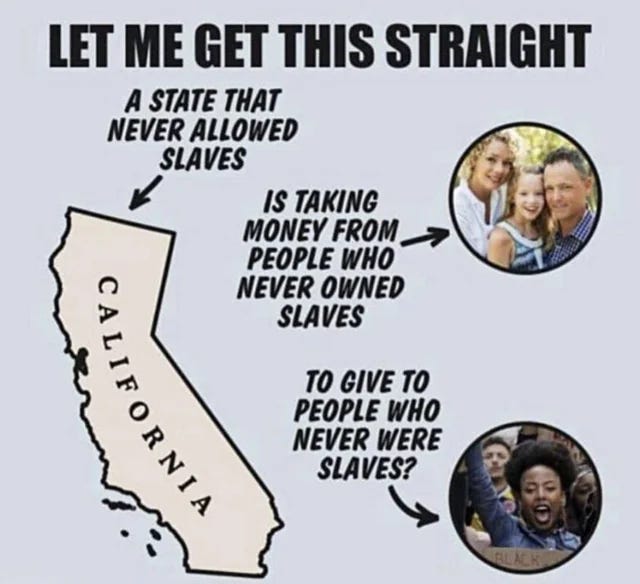
The median white household—the family sitting right in the middle with half of all American households above it and half below it—has a net worth closer to $285,000. Most of that isn’t parked in a climate-controlled vault next to the Hope Diamond, either. It’s tied up in home equity, retirement accounts, and (if you’re me) a garage full of extremely task-specific tools accumulated over decades.
Yet somehow we’ve arrived at a conversation where taxpayers are being asked to enthusiastically support payments equal to nearly three times the typical white family’s entire net worth to individual recipients. You know, because fairness. We’re told that benefits can be inherited, disadvantages can be passed down, obligations can be generational, debts can be ancestral, and moral responsibility survives long after the people who actually committed the acts are gone.

If we're going to start sending invoices across generations, we should at least be honest about what we're doing. Because we’re not repairing anything. We’re just putting a dollar figure on the apology gift.
To be fair, fans of financial atonement insist that the government owes the debt, not individual taxpayers. Which makes a nice inspirational poster, but governments don’t earn money. They collect it from taxpayers and then spend the next few years mismanaging it, losing track of it, and ultimately demanding more.
Alas, this is precisely what the left does. It takes a genuine historical wrong—and slavery is unquestionably one of American history’s shining failures—and transforms it into a permanent political currency. A moral grievance is identified, inflated, and monetized. Bureaucracies are created. Commissions are formed. Target dates are set, then missed, then extended again and again.
In New York’s case, the Reparations Commission blew its original deadline, pushed it to 2027, and has now kicked it to 2029—nearly four years past due—with commissioners conveniently protected from the consequences of whatever they decide. The machinery grows. The price tag balloons. The consultants multiply like rabbits. And the only people getting checks are the ones discussing whether other people should get checks.

What never changes is the underlying logic: that the government can and should redistribute wealth based on group identity, that the living owe debts for the sins of the dead, and that the solution to historical injustice is a fat check drawn on someone else’s account.
Democratic socialists dress this up as equity. Progressives call it repair. But stripped of the bumper-sticker slogans, it’s basically race-based punishment—which is certainly a curious way to fight racism.
Give it thirty years and the descendants of the people who were forced to pay the reparations will be arguing that they are owed that money back. That’s the problem with secondhand liability; once ancestry becomes currency, everybody eventually has a claim.

This is one of the most retarded things the left has come up with. Illogical on all fronts. Where and to whom do I send the trophy?
This constant money grubbing by today’s aggrieved democrat party patsy is just so tedious. Make it stop.