

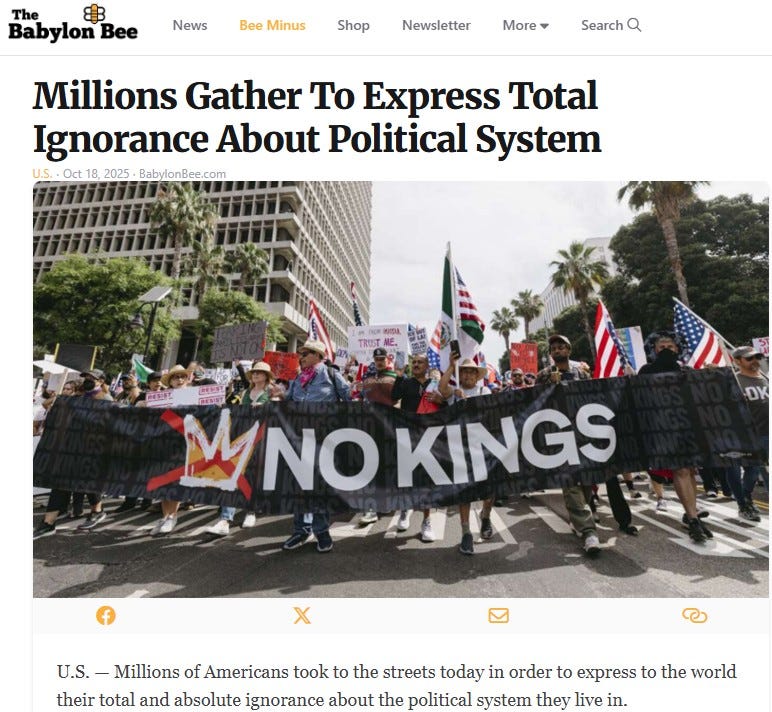
If you were looking for a masterclass in missing the boat, this weekend delivered. While the same liberals who applauded beach closures and plexiglass final goodbyes during the pandemic were out protesting a duly elected president, the World Health Organization—that international bastion of unwanted, unaccountable, generously imposed global declarations—quietly announced it’s partnering with an Asian investment firm to roll out what they’re calling “interoperable digital health wallets.” (I first read that as inoperable, and I was all in! Sadly, it’s just a stupid, nobody-uses-it word for universal.)
So that’s fun.
The branding makes it sound like something you’d use to store a coupon for kombucha or your bunion surgeon’s business card, but it’s actually a globally standardized system for verifying vaccination status, maternal and child health records, and, eventually, “broader personal health summaries” across borders.
If you wanted a more economical term for it, you’d call it a digital ID.
“The World Health Organization (WHO) and the Alliance for Health Policy and Systems Research, in partnership with the Temasek Foundation, have launched a new three-year initiative to help Member States of the Association of Southeast Asian Nations (ASEAN) transition from paper-based health records to secure, interoperable digital health wallets (DHWs),” the press release gushes. “The programme aims to strengthen national health systems, improve continuity of care and ensure individuals have trusted, portable access to their essential health information.”
It’s worth pointing out that Temasek is a Singapore government-owned outfit with deep ties to Bill Gates and Pfizer, including an early, massive investment in BioNTech. But it’s just a programme! Think MyChart, you know, but with a passport. For “trusted portable access” to our essential health information! It’s a convenience. A gift from the biotech gods, practically. It’s certainly not, like, a mandate or anything.
Except… we’ve seen this movie before. We know how it starts—“temporary,” “convenient,” “for our safety,” “just for travel.” We know the cast of characters. We know the script. And we definitely know how it ends. So forgive me if I’d rather give birth to an angry, fully grown porcupine than buy a ticket.
Sure, they don’t come out and call it the next necessary rung on the social credit system ladder. But if you were designing one of those, name one thing you’d do differently.

Literally, zip. First, you’d tie identity to something uniquely personal and verifiable—like health records. Then you’d digitize it. You’d make it portable across borders. You’d link it to access—but slowly. Start with travel (everything else in due time, pets; be patient). You’d roll it out under the banner of public health so anyone who questions it sounds like a lunatic. And of course, you’d partner with the exact same cozy little network of governments, tech platforms, and pharmaceutical companies that turned freedom into fiction under the auspices of the Covid “emergency.”
“Through our partnership with WHO, the Temasek Foundation hopes to support countries in moving from fragmented paper records to secure Digital Health Wallets that individuals can carry with them wherever they go,” the release continues. “By testing this approach in pilot ASEAN Member States, we aim to demonstrate how trusted digital tools can strengthen health systems, improve continuity of care—including for families and children—and build the local capabilities needed for governments to scale these systems nationally.”
See, they wouldn’t need to do it if it weren’t for those meddling fragmented paper records. They want to “ensure that individuals can carry their essential health information with confidence and dignity” (I mean, can we talk about the humiliation of carrying a grubby paper immunization card?). It’s for the children!
And I’ve got an oceanfront condo in Kansas to sell you.
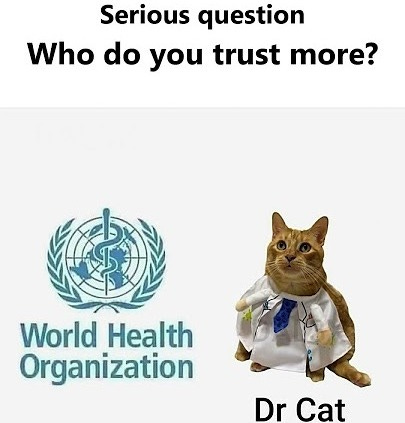
You may recall that Trump formally moved to withdraw the U.S. from the WHO in 2020—a process that takes a year to complete and which Biden promptly reversed the minute he got his decrepit fingers on the autopen. Literally on Day One. Upon reclaiming the presidency, Trump immediately resumed the withdrawal, completing the exit in January of this year and halting all funding and participation in WHO-related activities.
As wins go, it was the equivalent of getting the license plate number of the jerk who rear-ended you.
The problem is, you don’t actually need to be a member of something for it to function as a gatekeeper. Sure, you can “opt out” on paper, but if every airport, border crossing, and international system is playing by the same rules, you’re not opting out—you’re just opting to stay home. Which is cute, in theory. It might even give you the illusion that you’re sticking it to the system. Enjoy it while it lasts.

I know what you’re going to say. You’ll quit your job, burn your passport, tell your family abroad it’s been real. You’ll opt out harder. You’ll boycott that system with Ironman-level energy. But even if you swear on your TSA PreCheck that you’re never leaving the country again, you’re not exactly living in a snow globe. The World Health Organization can’t (currently) boss Americans around inside the U.S.—no one from Geneva is kicking down your door with a clipboard and a nasal swab—but that doesn’t mean you’re magically insulated from whatever the rest of the world decides to do.
We live in a country that runs on global everything: supply chains, pharmaceuticals, research, travel, commerce, the whole enchilada. So when 194 countries start moving in roughly the same direction—tightening entry rules, standardizing health requirements, aligning policies—those decisions don’t politely stop at the border like, “Oh, sorry, the U.S. opted out, carry on!” They show up here sideways. Medications get scarce. Prices creep. Products disappear. Employers, universities, hospitals, and airlines start adopting the same frameworks because it’s easier than operating in a parallel universe. It’s less “you must comply” and more “this is now the operating system.”
But, you know, at least it’s… interoperable.
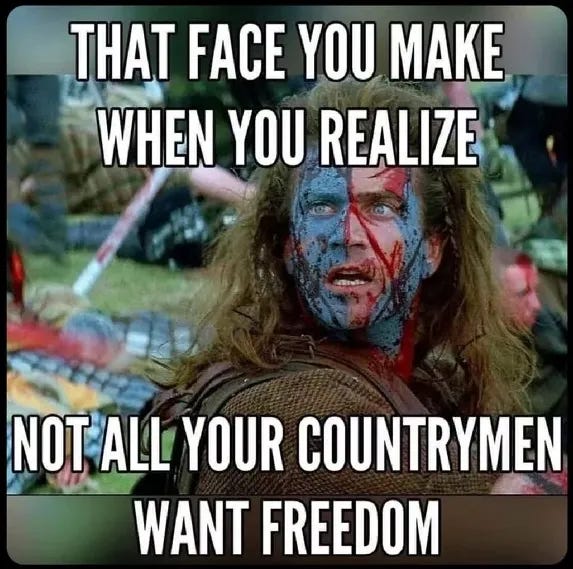
You can absolutely choose not to participate. You just can’t wish away the environment that participation creates. It’s like refusing to join a group chat that everyone else is using to plan dinner—congrats, you’re not in the chat, but you’re also not eating.
A note to the woke protestors out there: hate Trump all you want. Make the signs. Chant the chants. But for the love of all that is holy, don’t lose the plot. Because while you’re rallying against “authoritarianism,” a global autocracy is being built in the background—mostly out of sight and entirely out of reach. And for now, the only thing keeping that dystopia off your doorstep is a president willing to opt out.
Convince me I’m wrong.
Well, whaddya think? Share in the comments. :)
I’ll definitely be opting out. No one needs to know my personal health history in order for me to get into their country and spend my tourist dollars. And if they do, I’ll gladly keep my butt in the US. Plenty to see here. Great beaches. All it takes is for people to say NO. Sadly, the brainwashed masses forgot how.
We best get busy creating our parallel societies.