
DISCLAIMER: This post may not have you LingOL—well, maybe a little—but it might just save your life someday. You’re welcome. ;)
Up until about 2019, when I was obediently offering up an arm for every jab my doctor recommended like the star pupil at Vaccine Camp, I honestly don’t think I’d have been angry if someone inoculated me while I was unconscious. I mean, if I had woken up in a recovery room, groggy and still wearing surgical socks, and a nurse cheerfully chirped “Oh, we went ahead and gave you your flu shot!” I probably would’ve thanked her.
I wish I were joking.

Oh, how times have changed.
Because now—after everything we’ve seen, everything we weren’t supposed to see, and every shred of “misinformation” we were scolded for sharing turned out to be horrifically true—when I hear a nurse whistleblower say that “hospitals vaccinate people under anesthesia without consent,” my reaction isn’t “You’re lying!” It’s: “Yeah, I believe it.”
The part that turns me into a cartoon tea kettle is that this isn’t some dystopian protocol invented during the Covid psyop, either. There are decades-old reports—long before lockdowns, mask wars, or Fauci’s celebrity book tour—of nurses warning that hospitals were quietly jabbing patients without their knowledge or permission.
Why on earth would they do that, you ask?

At some point after Obamacare shoved “free preventive care” into law, hospitals and insurers quietly realized they were in a bit of a pickle: they couldn’t meet their new vaccine-quota incentives if they had to stop and get explicit consent every single time. To streamline operations, hospital networks allegedly began “updating” their intake forms, wrapping the common word vaccine into the regulatory term biologic—a word almost no normal person uses or understands. Why? Because if the form says “I consent to necessary biologics,” and you sign it, hospitals can claim you already said yes to every jab under the sun.
It wasn’t an accident. It wasn’t confusion. It was a deliberate paperwork workaround to speed up compliance and eliminate refusals. Insurance companies wanted higher vaccination numbers. Hospitals wanted better reimbursement rates. Administrators wanted fewer arguments. So they buried the consent under a word no one recognized, and voila—problem solved.
Alas, the word “biologic” is what’s known as a regulatory term of art, a word or phrase that has a precise, technical meaning within a specific legal or administrative framework and which can (and often does) differ significantly from its everyday usage. In casual conversation, “biologic” literally means “related to biology.” Think, “There’s growing interest in the biologic power of food to treat disease.” But in medicolegal contexts, the word refers to a specific class of therapeutic products (which includes vaccines, gene therapies, hormones, even blood and Botox) that are regulated under a different legal pathway than standard chemical drugs.
The concern raised by whistleblowers is that by using these technical “terms of art” (“biosimilars” and “biogenics” are others) on consent forms, the legal requirement for disclosure is met—even when the patient has zero understanding of what he or she has ostensibly agreed to.
Straight from the cast of Not All Heroes Wear Capes, enter my friend Laura Bartlett. Like me, Laura was an entirely different breed of human in the pre-pandemic days—one whose focus was making people laugh. (Laura wasn’t just a stand-up performer, but the founder and producer of Four Funny Females, a quartet of Dallas comedians hailed as the “Fastest Rising Franchise” by Theater Jones). When not on stage, she worked in public relations.
When Covid hit, Laura took a break from her day job to help her brother, Dr. Richard Bartlett, get the press to pay attention to the tremendous success he was having with budesonide as an early Covid treatment. (One interview she secured racked up five million views on YouTube before it was taken down. I know, you’re shocked.) Working with critically ill patients, the punchlines that formerly filled Laura’s thoughts were replaced with hospital horror stories: patients being ventilated needlessly, overly (or wrongly) medicated, denied alternative treatments, and actively blocked from being discharged despite everything short of a court order.
Using only her own resources, Laura launched the Hospital Hostage Hotline, a toll-free number she answered personally, at any time of the day or night, when patients were being isolated, threatened, tested, sedated, and denied food and water (among other things). She soon realized that keeping people out of the hospital in the first place had much greater odds of success (“I’ve seen and heard of things done in hospitals without consent more times than I could count,” she insists).
Serendipitously, Laura met a likeminded nurse/attorney who had created a document for herself to avoid getting “the lethal Covid protocol.” Since the nurse wished to remain anonymous, Laura volunteered to share her I Do Not Consent Form, turning it into a free, customizable, downloadable medical directive designed to protect patients from hospital tomfoolery.
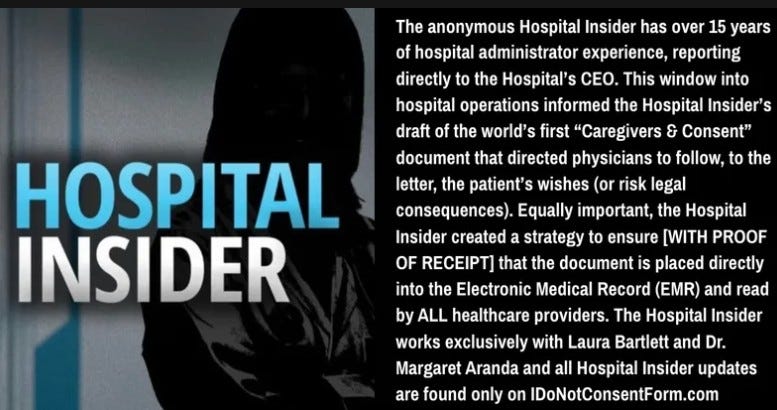
Laura soon launched a website, which she runs with Stanford-trained anesthesiologist Dr. Margaret Aranda. The site includes the form along with precise instructions for filling it out and delivering it (hint: you can’t just casually hand it to an orderly) in order to make sure it becomes a legally binding, permanent part of your medical record.
Unlike the vague, sweeping, jargon-laced “general consent” forms hospitals shove at you on admission (the ones that bury stuff you might very much care about under technical language nobody without three advanced degrees could reasonably understand), this form carves out crystal-clear boundaries that override those blanket permissions. And it works because once a request or a refusal is documented formally—delivered the right way, notarized, logged—hospitals and physicians assume a level of liability they want no part of.
“Good doctors love it because it gives them a way to push back against protocols and exercise their conscience,” Laura explains. “Bad doctors may not love it… but they know they have to honor it.”
“In a hospital, if your ‘No’ is not documented in the chart, your ‘No’ isn’t guaranteed,” adds Dr. Aranda. “The I Do Not Consent Form makes your wishes official and enforceable.”
Laura is also quick to point out that the same institutions that gave us the word “hospitality” in the most non-participatory sense possible often start treating patients with what she jokingly calls “red carpet energy” once legality enters the chat. People have used her form to sidestep unwanted immunizations, avoid protocols they oppose, and secure the treatments they do want. It’s not an advance directive (which only kicks in once you’re incapacitated); it’s a right-now directive. A way to keep your autonomy intact in a system that has repeatedly shown it’s more than willing to interpret silence as consent.
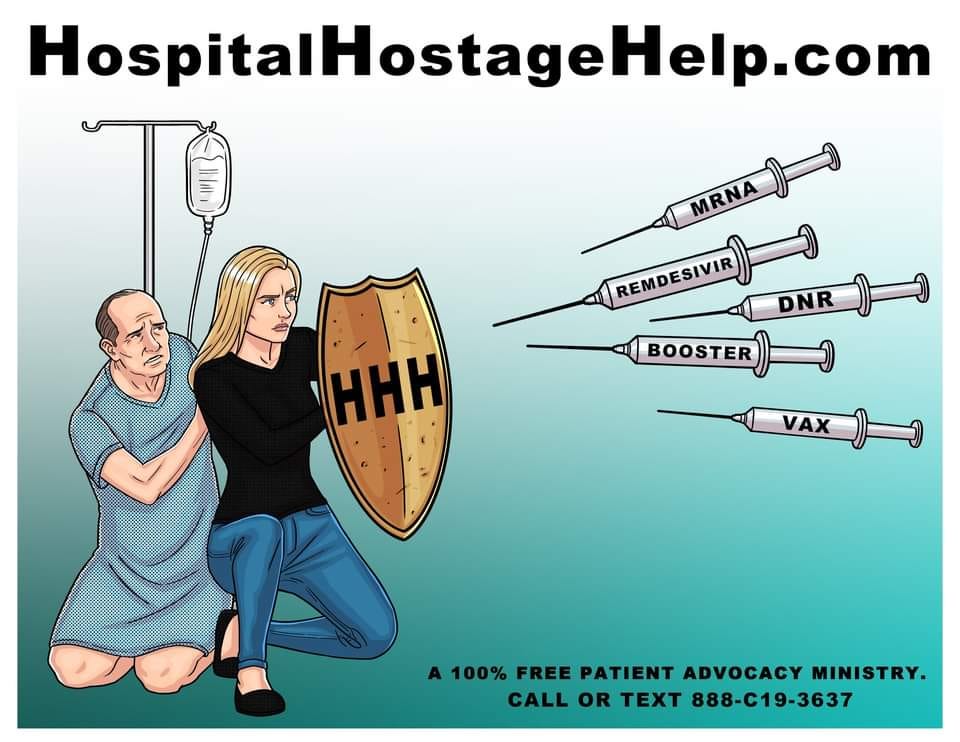
Another reason to arm yourself—early—with a filled-out I Do Not Consent Form is because chances are if you’re being admitted to a hospital, you’re not at your mental or physical best. Preparing in advance gives you the chance to intentionally select what treatments you do and don’t want when you’re in a calm, logical place—not when you’re emotionally distressed or in bodily pain.
Finally, Laura cautions folks to be careful not to believe everything you see or read online. For instance, “just print the hospital’s release form and write ‘no vaccines’ or ‘no vaccinated blood’ on the bottom!” carries about as much legal weight as stamping “send me a pony” on your mortgage statement. The reality is, hospitals don’t operate on Sharpie amendments. If it’s not formally documented, acknowledged, and entered into the chart, it’s less a directive and more a hopeful Post-it note. (On the other hand, if hospital staff did decide to honor your wishes, scribbling “I DO NOT CONSENT TO BIOLOGICS!” could actually prevent you from receiving insulin, monoclonal antibodies, stem cells, antitoxins, blood transfusions, or other lifesaving measures.)
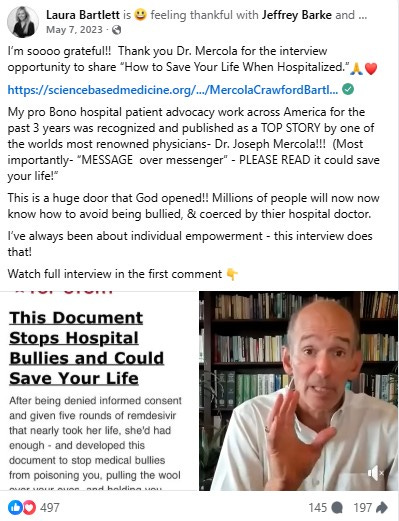
Dr. Mercola calls the I Do Not Consent Form “transformational,” adding that he’s “never seen anything like it” in terms of empowering patients. And according to Laura, it has never-not-once failed to protect a patient.
“I receive many testimonies but one of the most impactful was an elderly woman with Covid who used the I Do Not Consent Form and went home from the hospital after six days,” Laura recalls. “She didn’t get a single dose of Remdesivir, a ventilator, or the Covid vaccine. However, the physician ordered budesonide according to her wishes outlined on the Form. So not only did she NOT get what she didn’t want, she got exactly what she needed to get well.”
Sign me up. Literally.
“Biologic.” “Biosimilars. “Biogenic.” Hmmmmm. No WONDER my aunt, who is a nurse, says if we’re EVER admitted into the hospital to call her. She’ll fly across country and sit by our side every single minute. I didn’t get it. Now I do. I don’t plan to be hospitalized. But if I am. I’m definitely calling her. And I’m bringing that notarized form with me. Thank you, Jenna. You don’t know what you don’t know. And now we know.
Isn't this just word sorcery? It's absolutely insane that redefining words and having someone agree to the newly defined words without understanding what they are agreeing to is moral. It certainly isn't moral and the fact that this is "legal" makes me want to punch a lawyer.
Thanks for sharing this Jenna and thank you Laura if you are ready this! You're literally saving lives and I'll be sure to share this with our friends and family.