

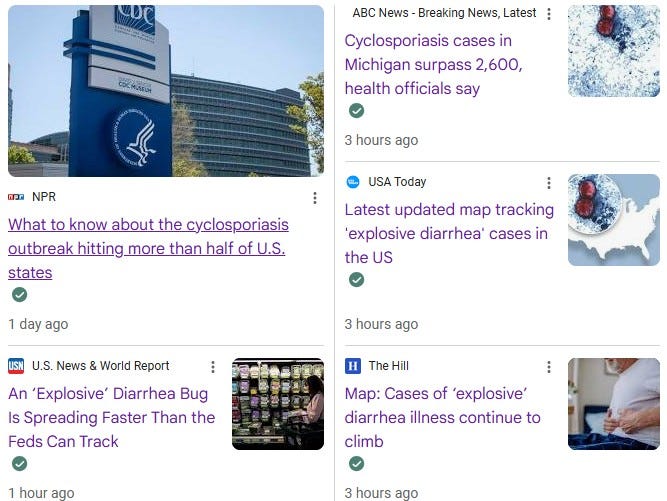
BREAKING: Health officials this week confirmed that a mysterious parasitic infection called cyclosporiasis is sweeping across the nation with all the subtlety of a TSA pat-down. Investigators say the culprit appears to be “raw produce,” though in a predictable twist, they cannot specify which fruits or vegetables are suspect, instead advising Americans to avoid “anything that exists largely because of photosynthesis.”
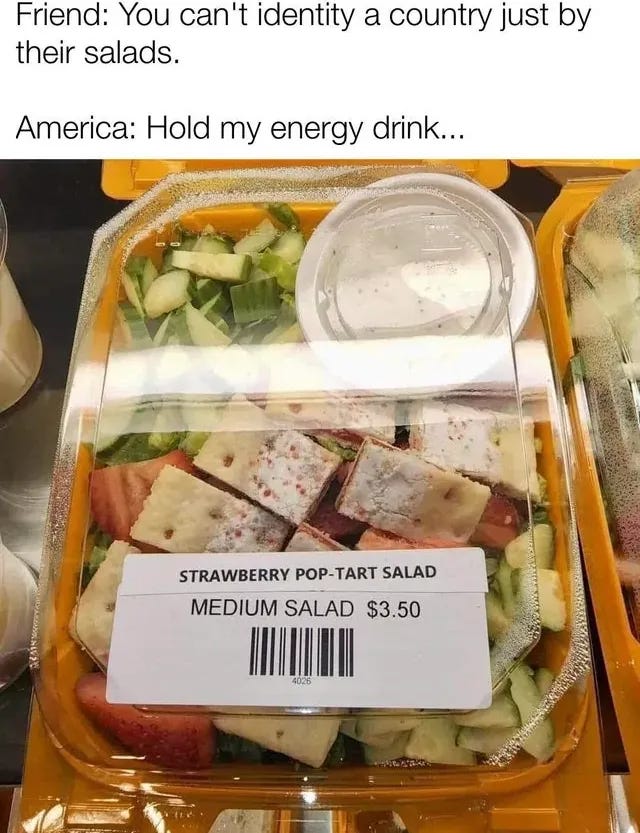
Grocery stores are reportedly responding by stocking shelves exclusively with Pop-Tarts and existential dread, while consumers grapple with the realization that “triple-washed” may just be a marketing term with no legal meaning whatsoever, like “artisanal” or “now with up to 20% less sodium!”
As of this writing, officials have tallied roughly 3,000 cases across 31 states, a number expected to rise as Americans continue their brave, foolhardy quest to consume plants.
That last part sounds both widespread and serious, until you bother to do some fourth-grade math. That’s when you discover we’re talking about something that is affecting roughly 0.0009% of the population. Even if that number doubled or tripled with underreporting, we’d still be talking about a fraction of a fraction of a percent.
To be clear, this particular bug isn’t fun. It can cause severe diarrhea (the word “explosive” is working overtime this week), stomach cramps, nausea, bloating, fatigue, and flu-like symptoms. Eighty-six people have been hospitalized, mostly for dehydration. That’s about one in every 4,089,214 Americans, or less than two in each state. There also have been a grand total of [*checks notes*] zero confirmed deaths linked to this outbreak—or any outbreak, in all of history, anywhere in the world. Cyclosporiasis is also easily treatable with common antibiotics.
But sure, let’s give this 6,789 times more media coverage than, say, vaccine injury or human trafficking.
The problem is, no single food, farm or supplier has been identified as the source, so there’s no recall. Just general, commonsense precautions: wash hands and produce thoroughly, cook high-risk items (apparently the parasite perishes the minute a food hits 158 degrees), and consider calling your doctor if Montezuma is exacting prolonged revenge on your intestines.
[I’d add: grow as much of your own produce as possible—or at least buy local—and maybe have some ivermectin on hand. Wink-wink.]
Business Insider went a bit further, advising readers to avoid lettuce until investigators can pin down the source of the illness. Oh, and cilantro. And basil. And raspberries. And green onions and snow peas and bagged salad. Basically, they suggest steering clear of any produce that hasn’t been baked, boiled, or broiled into mush. That’s the public health guidance: until we can figure out what vegetation is causing this, you should probably just skip edible foliage altogether. In unrelated news, Highway Patrol is advising all Americans to stay off the roads until police track down that Honda in Cincinnati that ran the red light.
“The other night, I found myself in the unenviable position of trying to cook a salad,” The Atlantic’s Nicholas Florko wrote. “And I mean cook a salad: I spread fresh, delicious-looking gem lettuce in a pan and watched it wilt away into a sad, heated blob.”
I’ve got to believe the guy was being dramatic for effect. Because—and this may be shocking to some folks—there are plenty of veggies that taste downright delicious when you cook them. Why would you torture yourself with stewed salad greens? That’s not a food safety tip, that’s a cry for help.
USA Today quietly blamed the outbreak on “pared-down staff at both CDC and FDA thanks to budget cuts and firings,” which probably isn’t even the first time somebody tried to pin a pandemic of loose stools on Trump. But here’s where the budget-cut narrative falls apart: cyclospora surges in the U.S. are almost always traced to imported produce—berries from Mexico, cilantro from Central America, snow peas from Guatemala. Which means this isn’t really a story about underfunded inspectors at home. It’s a story about a global food supply chain where American consumers eat whatever shows up on the boat, traceability is a joke, and let’s just say the sanitation practices in some growing regions make a Coachella porta-potty look like the Mayo Clinic. The agencies responsible for catching contaminated imports have been failing at this for decades—long before anyone in the current administration touched a budget line.

And since no public health panic is complete around here without a rousing round of “Follow the Money,” let’s consider who actually benefits by framing fresh produce as dangerous. Spoiler: It’s not the farmers. It’s the processed food industry, which would love nothing more than for you to look at a head of romaine the same way you’d look at a used needle. Make it sound scary enough and maybe you’ll replace your nightly salad with something shelf-stable, profitable, and engineered in a factory. (The chronic disease industry gets a nice downstream boost, too.)
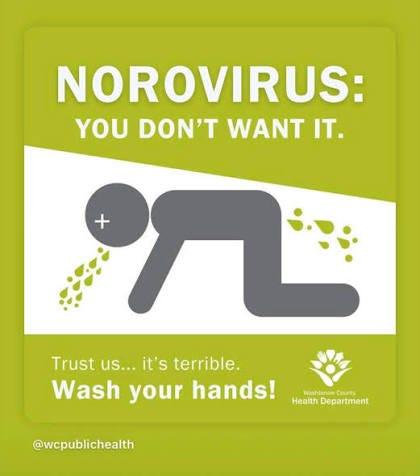
It would appear that somewhere between “wash your produce” and “cancel things that grow in dirt” lies a thing we seem to have misplaced in recent years: perspective. The CDC estimates that 48 million Americans suffer a foodborne illness every year. Forty-eight million. Roughly 128,000 are hospitalized, and about 3,000 die. Norovirus alone—the delightful stomach bug famous for tearing through cruise ships, schools, nursing homes, and family gatherings every winter—strikes tens of millions of unlucky souls in the U.S. each year, and nobody is out there suggesting we all forsake broccoli over it.
Compared with those numbers, a few thousand cases of cyclosporiasis, while worth investigating, barely registers statistically. Yet somehow the coverage manages to create the impression that your next forkful of arugula is a medical emergency in the making.
After all the warnings, the restaurant speculation, the produce blacklist, and several paragraphs devoted to urgent, Jackson Pollock-style bowel evacuation, the Business Insider piece ends with this unintentionally hilarious correction: “An earlier version of this story misattributed a Chipotle spokesperson’s statement to Taco Bell.”
Can you imagine getting that call?
CHIPOTLE SPOKESPERSON: “Are you kidding me? We’re the ones who said ‘we don’t believe the ingredients we source are associated,’ not Taco Bell! I demand a retraction!”

I’m not suggesting food safety doesn’t matter. It absolutely does. Investigate outbreaks. Identify contaminated products. Recall them quickly. Inform the public. But if we could get to a point where health coverage also includes that little element known as context, that’d be great.
Three thousand sick people is news. It’s just not “everyone burn the contents of your crisper drawer and panic” news. Sometimes people spend a few miserable days chained to a toilet. Just because the symptoms are… explosive… doesn’t mean the headlines need to be.
One thing I know you’ll never do twice after having a bout of nausea and diarrhea simultaneously is to forget to use a liner (grocery bag at minimum) in your bathroom waste baskets.
If you ever had the squirts and felt the urge to heave, you really don’t want to heave into a load of trash. Or more accurately…you really don’t want to have to clean out a waste basket full of bathroom trash that’s been heave-sauced.
Be civilized, save your grocery bags and reuse them as can liners. Your heaveself will thank you for the easy pullout.
Once again... turning off the "news" saves humanity!