

Imagine training for a marathon by eating only organ meat and organic kale, and at mile 22 someone shoves a funnel cake into your mouth and says: “Smile for the camera.”
That’s pretty much how I suspect Bobby Kennedy feels right now.
This week, Donald Trump invoked the Defense Production Act—a wartime, emergency-style executive order—directing America to crank out more glyphosate. Yes, glyphosate. The Roundup chemical. The one with tens of thousands of cancer lawsuits. The one RFK Jr. literally made part of his personality fighting. The one he helped sue Monsanto over and win $289 million for a dying groundskeeper. That glyphosate.
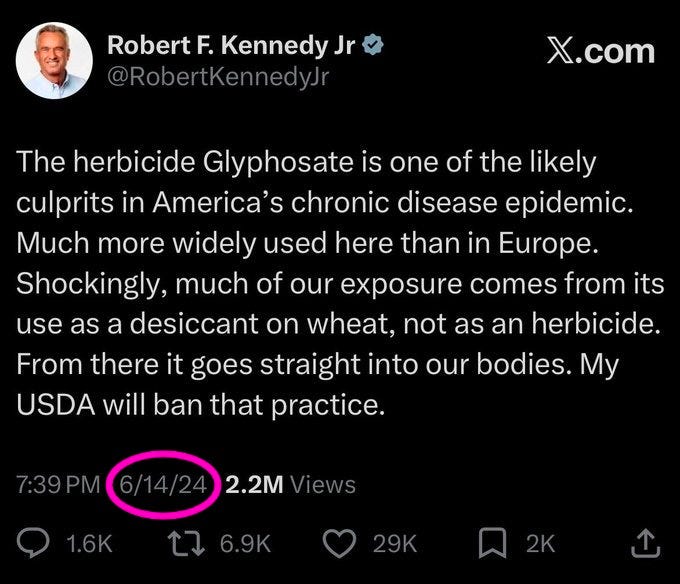
“Ensuring robust domestic elemental phosphorus mining and United States-based production of glyphosate-based herbicides is central to American economic and national security,” the order states.
You read that correctly. A toxic chemical is now a matter of “national defense,” apparently rivaling nuclear subs and missile interceptors, which is news to the farmers, lawyers, oncologists, and MAHA moms currently crying into their stainless steel water bottles.
The argument is that boosting domestic glyphosate production ensures that America isn’t dependent on foreign suppliers—namely China—for the herbicide that keeps corn, soy, wheat, and other crap crops from turning into an all-you-can-eat buffet for weeds. (Never mind that prior to glyphosate’s mass adoption in the mid-1990s, farmers somehow managed to grow food using a wild assortment of primitive techniques like tilling, rotating crops, and—brace yourselves—pulling weeds without bathing the entire countryside in poison.) If farmers suddenly lost access, the pitch goes, crop yields would plummet, food prices would spike, and our strategic backbone would crumble like a stale Chips Ahoy. In other words, the only thing standing between us and complete collapse is an herbicide.
Ostensibly because we’ll all be too weak with hunger to fight if Russia or Iran ever invade us? IDK, to be honest. I’m just reporting here. Also, calling crop-dusting our food supply with deadly, known carcinogens “a matter of national defense” seems as wise as filling your house with rattlesnakes because they’ll keep intruders away, but I’m no security expert.
The counterargument: all of this just happens to shower legal protection onto Monsanto/Bayer at the precise moment they’re drowning in lawsuits and awaiting a Supreme Court ruling on liability—making the timing look less like “safeguarding America” and more like “protecting the chemical industry with a bulletproof stars-and-stripes throw blanket.” To put it another way, it’s either about preserving the food supply… or it’s the most patriotic corporate shield ever printed on White House letterhead.
And just like that, the patron saint of wellness was forced into the world’s most awkward bureaucratic yoga pose. Kennedy issued a statement through a spokesperson that read like a man blinking SOS in Morse code:
“Donald Trump’s executive order puts America first where it matters most—our defense readiness and our food supply,” Kennedy said in a statement. “We must safeguard America’s national security first, because all of our priorities depend on it.”
Translation: “My boss just declared my mortal enemy’s signature toxin a patriotic necessity and I am contractually obligated to pretend this is fine.” It felt like less of a concession and more like a political hostage situation.
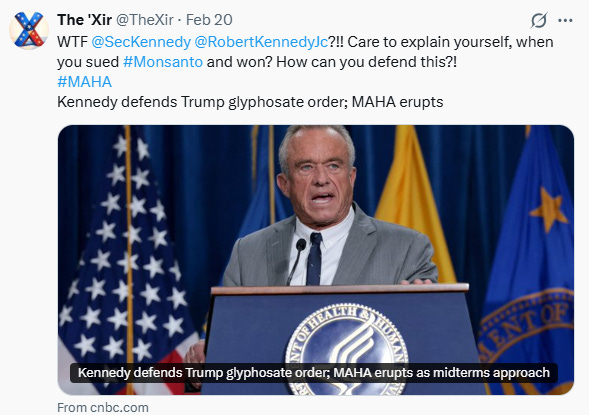
MAHA diehards are insisting that there’s no plausible deniability here. No one can ever come back and claim they were “being poorly advised” or were “kept in the dark about the dangers.” In 2020, the Environmental Protection Agency published results of an evaluation that found glyphosate is likely to injure or kill 93% of endangered species. (That is not a typo.) It’s also wide-out-in-the-open that the supposed “safety study” that “proved glyphosate was unequivocally safe” and “posed no risk to humans or animals”—the one administrations relied on for decades to greenlight unfettered use of the endocrine-disrupting death dust—was written by Monsanto.
In other news, an independent source has declared Jenna’s Side the finest Substack ever written. Also, I’m the independent source. Is that a problem?
Ken Cook, the president and co-founder of Environmental Working Group, called Kennedy’s perfunctory support of the order “a bigger middle finger to MAHA moms than anything we’ve ever seen,” which is saying something in a year where the HHS secretary cracked down on neon cereal dyes before unleashing on Pfizer. Another disgruntled health nut described the move as “a gift to pesticide and chemical industry lobbies at the expense of human health.” Not exactly the glowing testimonials they were hoping for over in West Wing Wellness World.
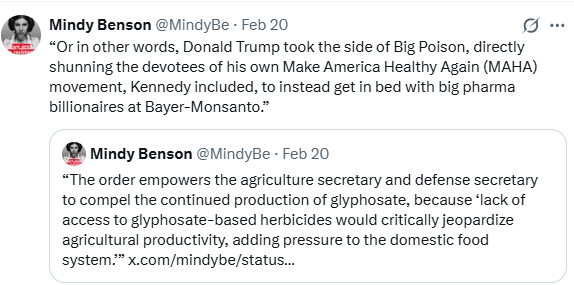
And hanging over all of it is the conspicuous legal cherry: invoking the Defense Production Act would likely shield companies from liability. Just days ago, Monsanto—now Bayer—happened to announce a tentative agreement to pay plaintiffs $7.25 billion to settle tens of thousands of lawsuits claiming Roundup caused cancer. The Supreme Court is already set to hear a case on whether pesticide manufacturers can be sued at all. And boom: an executive order arrives declaring glyphosate essential to national security, complete with language that looks suspiciously like a corporate force field. Just incredible timing. Very organic. No notes.
The whole thing leaves MAHA voters wondering what exactly they signed up for. Wasn’t this supposed to be the administration that was going to battle Big Chem? Cut toxins? Protect our kids? Clean up food? Instead, they’re watching the president use Cold War emergency powers to defend… a weedkiller. Meanwhile, Trump loyalists don’t know whether to cheer, shrug, or invoke the 5-D chess defense. Monsanto shareholders, however, are definitely sending (carcinogenic) fruit baskets.

It’s hard to defend the indefensible… but what if. What if Kennedy didn’t put up a fight because, in a weird way, Trump’s executive order strengthens his argument rather than undercuts it. After all, the EO overwhelmingly protects corn, soy, and wheat—the holy trinity of ultra-processed American cuisine and the very foods Kennedy placed at the absolute basement of his inverted MAHA pyramid. If you’re living the MAHA life, you’re not exactly chugging soybean oil and wheat thins, glyphosate or no glyphosate.
And here’s another important point to consider: Yes, Kennedy took on Monsanto and won. But Roundup isn’t just another word for glyphosate. The famous weed-eater also contains a cocktail of adjuvants and surfactants and toxic tagalongs that make the whole brew far more dangerous than the one Trump’s EO is trying to protect.
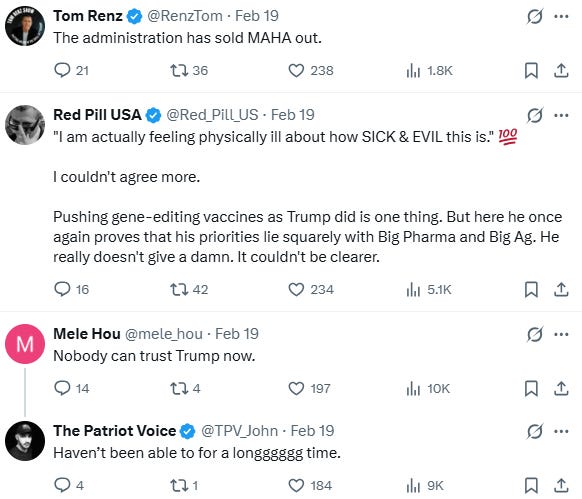
AND—this is the part nobody likes—the stuff is now so baked into our food system that yanking it overnight actually would shatter American agriculture. Most of our supply comes from China; if Beijing shut off the tap tomorrow, our crop output would crater and supermarket shelves would empty faster than you can say “where’s the beets?” There’s also this uncomfortable truth: a governor like Gavin Newsom could wake up one morning, ban glyphosate statewide, and instantly nuke every farmer in California—triggering food shortages nationwide. Like it or not, Trump’s EO blocks that nightmare scenario.
One (massive) problem is that the Frankenjuice doesn’t just stick to the corn like a polite little groupie. It lingers, it drifts, it bioaccumulates. It’s in the air, the soil, the rain, the rivers, the dust on your patio furniture, and probably doing the backstroke through your bloodstream as we speak. Even if you grow your own produce and raise your own livestock, you’re still marinating in microdoses of it. There’s no meaningful way to opt out—only hope your detox pathways are firing on all cylinders.

For anyone fantasizing that we could just “go organic” by Friday, I’d like to gently slide across the table the example of Sri Lanka. They tried a sudden, total ban on all agrochemicals—a bold move that lasted approximately 12 minutes before the country spiraled into crop failure, economic collapse, food riots, and the actual President fleeing the country. Turns out you can’t flip industrial agriculture to fully regenerative overnight without turning your nation into the world’s saddest Whole Foods.
Yes, we need a better path forward. Absolutely, the system is corrupted. No questions asked, glyphosate is a disaster. But—just like with vaccines—rapid, blunt-force change can break more than it fixes. Sometimes the revolution has to happen in slow motion, or it risks toppling the whole infrastructure. And sometimes the first step is just dragging a topic into the spotlight—getting people fired up and furious. Think about it: Who was talking about glyphosate a month ago? Now it’s basically the national group chat.
You may be wondering how we landed in this mess. Simple: the same way America wakes up in most of its chronic-health nightmares—somebody found a way to cut corners. When the EPA banned DDT—Monsanto’s flagship pesticide—the company needed a new cash cow. They soon discovered glyphosate was a spectacular weed killer. The catch? It was also a spectacular everything killer, which meant it had to be applied carefully, by hand, early in the season so the crops didn’t die too. Their workaround was… inspired, in a mad-scientist way: genetically engineer “Roundup Ready” corn, soy, cotton—basically the whole pantry—so farmers could douse entire fields like they were pressure-washing a patio. The weeds died, the crops survived, and the GMO era was born. A perfectly normal solution, if you ignore the cursed-fairy-godmother vibe of redesigning your food so it can endure chemical warfare.
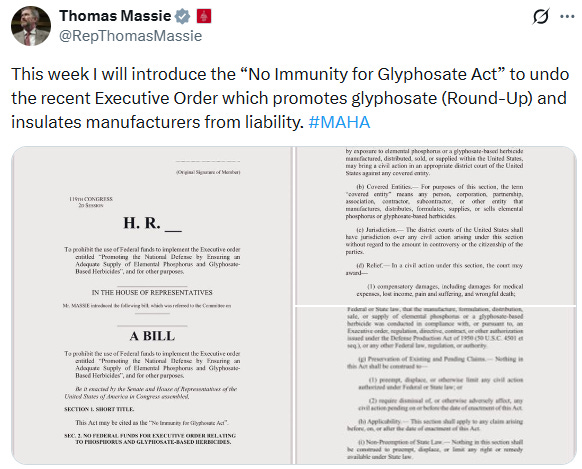
In response to Trump’s announcement, Representative Thomas Massie introduced the No Immunity for Glyphosate Act with bipartisan support. The bill seeks to undo parts of the recent executive order by preventing glyphosate manufacturers from claiming legal immunity under the Defense Production Act—basically preserving the right of individuals to sue companies for harms linked to the weedkiller. And when companies know they can be sued, they tend to behave slightly better than frat boys at an open bar. (Petitions supporting Massie’s act are cropping up like, well, weeds.)
At the end of the day, there’s no clean exit ramp here. You can’t un-poison the soil overnight, you can’t un-write fifty years of chemical dependency, and you can’t organic-farm your way out of a system that was engineered for speed, scale, and shortcuts. Maybe the answer isn’t a ban or a blitz or a miracle pivot, but a painfully slow disentangling—a national chemical cleanse done at the same pace your liver processes tequila. Not pretty, not perfect, but hopefully less apocalyptic than the alternatives.
I know that folks are fuming over this… so I suspect the comments are going to get spicy. Please be respectful (to me and to one another). Remember: THEY WANT US DIVIDED. Let’s show the world we can disagree and still be kind. :)
Good news is that there is now widespread Glyphosate awareness and a war is raging. In the meantime we need to minimize our intake of Glyphosate. Hats off to Florida for doing studies on brands of bread and cereal. This testing needs to be expanded and greatly publicized. Food manufacturers will speed up the elimination of Glyphosate when their sales crater.
"In other news, an independent source has declared Jenna’s Side the finest Substack ever written."
I thought that was universally acknowledged at this point.
PS That 8 year old appears to be 15. 😂