

In the latest installment of Things Nobody Asked For, the U.S. has announced plans to resurrect a military tradition that hasn’t been practiced since WWII: death by firing squad. And in the spirit of American innovation, it would appear we’re giving it a distinct 21st-century upgrade.
The man at the center of this grim controversy is Nidal Malik Hasan, a former Army psychiatrist (but actually) who walked into a medical processing center at Fort Hood, Texas, in 2009 and shouted “Allahu akbar” before opening fire on his fellow soldiers. He killed thirteen people and wounded another 32 before responding law enforcement officers shot him, leaving him partially paralyzed. Hasan later claimed he was trying to prevent American troops from deploying to Afghanistan and killing Muslims.
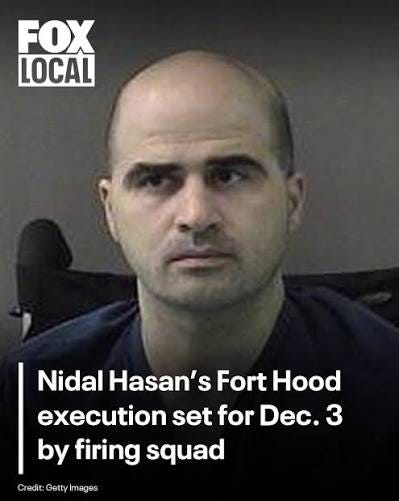
Born in Virginia to Palestinian immigrants, Hasan graduated from Virginia Tech before attending military medical school, where he managed to stretch a four-year program into six and land himself on academic probation. Suitably impressed, the Army made him a psychiatrist, a career in which “homicidal” is generally supposed to describe the patients. Despite the fact that his superiors later flagged his poor performance, increasingly radical Islamist views, and alarming comments about Muslim soldiers potentially killing their fellow troops, he was nevertheless promoted to major. Somewhere along the way, he began corresponding with al-Qaeda-linked cleric Anwar al-Awlaki. The FBI knew about the emails but didn’t consider him a terrorist threat. (I’m sure somebody got a very stern talking to after the massacre.)
In 2013, a military jury convicted Hasan of 45 counts of premeditated murder and attempted premeditated murder and sentenced him to death. After thirteen years of breathtaking government efficiency, Secretary of War Pete Hegseth announced last week that Hasan would face a firing squad on December 3—the first such military execution since 1945. The location, day of the week, and approximate time were deliberately chosen to mirror the original killing spree.
Oh, and it’s going to be livestreamed.
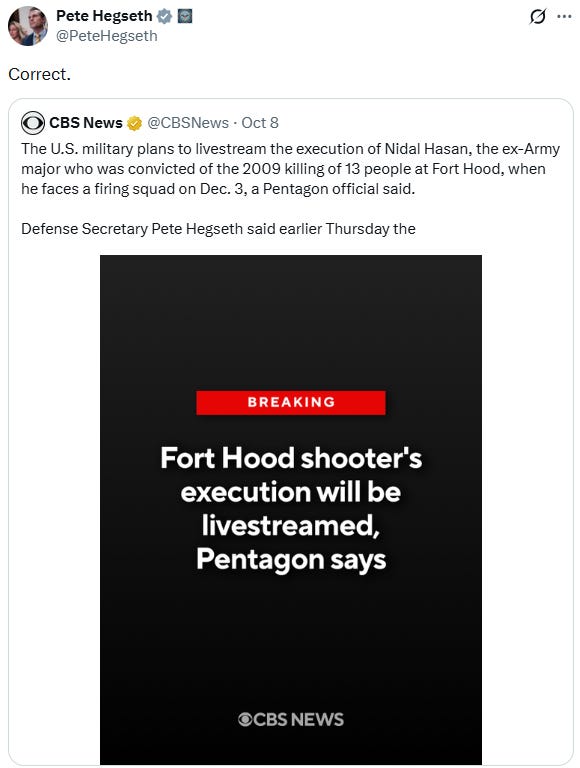
Yes, livestreamed. As in, put it on the internet. In real time. Available to anyone with a device, reliable Wi-Fi, and a stomach for recreational violence. Because apparently the only thing missing from our already wholesome online entertainment landscape was the opportunity to watch a man get shot to death without commercial breaks.
“We’ll make sure that people are able to watch it, that it’s public,” Hegseth explained. “Because people need to understand that... there are serious consequences for these types of things.”
THEM: “There are serious consequences for murdering people! Like execution!”
ME: “Cool. Good to know.”
THEM: “Would you like to watch?”
ME: “I’ll just take your word for it, thanks.”
Let me be clear: I am not here to argue that Hasan deserves a second chance, a heartfelt prison pen-pal relationship, or a Netflix documentary exploring his troubled childhood. He committed an atrocity. Hard stop. Thirteen families were robbed of their loved ones. Dozens of people were injured. Hundreds will live with trauma and heartache for the rest of their lives. But somewhere between justice being served and justice being streamed, we seem to have lost the plot.
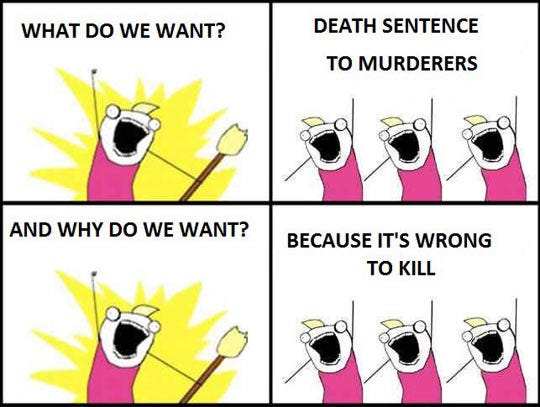
I understand the desire to make an example of someone who murdered more than a dozen American service members. What I don’t understand is why that example needs a streaming platform. What exactly are we envisioning here? A countdown clock? A virtual waiting room? A friendly reminder to enable notifications so you don’t miss the exciting conclusion?
The following execution contains graphic violence and may not be suitable for younger audiences. Viewer discretion is advised.

Will there be a comments section? A “like and subscribe” button? An influencer doing a reaction video? Someone inevitably complaining that the camera angle sucks? And while we’re at it, are we really comfortable putting the federal government in the business of producing snuff content? Honestly, I’m surprised they didn’t suggest making it pay-per-view. (“Use code DUEPROCESS for 10 percent off!”)
Historically, Americans have not needed to watch executions to understand that murder carries serious consequences. In 1936, thousands gathered to watch a public hanging in Kentucky—a spectacle that helped prompt the state to outlaw public executions. We subsequently concluded that perhaps turning state-authorized death into a community outing wasn’t civilization’s finest achievement. Ninety years later, we apparently decided the problem wasn’t the spectacle. It was the limited seating.
The legal questions are almost as bizarre as the proposal itself. Army regulations explicitly prohibit anyone under eighteen from witnessing a military execution. But legal experts aren’t sure whether that restriction extends to children watching from their bedrooms. Imagine being the government attorney assigned to argue that a twelve-year-old watching a man get riddled with bullets on an iPad isn’t technically witnessing an execution because he’s wearing SpongeBob pajamas in suburban Ohio.
The proposal has drawn condemnation from the United Nations, Amnesty International, and even some Republicans who otherwise support Hasan’s execution. Senator Thom Tillis called the livestream plan “beyond disgusting.” Republican Congressman Austin Scott was equally blunt: “Live-streaming executions is what jihadists do. America is better than that.”

Meanwhile, FCC Chairman Brendan Carr says the matter is outside his agency’s jurisdiction and he’ll defer to Hegseth. So apparently the guy in charge of regulating what goes out over the airwaves has decided this particular broadcast is above his pay grade.
Asked whether Hasan had made any final requests, Hegseth replied, “Don’t care. We’ll see him on December 3.”
Okay, then.

Meanwhile, Vice President JD Vance would appreciate it if everyone could stop obsessing over the method of execution and focus instead on the heinous crimes that were committed. He also expressed doubt that the livestream will even happen—and insists he won’t be watching if it does. So perhaps cooler heads will prevail before the Pentagon starts shopping for ring lights.
I understand that some people might want to witness Hasan’s execution—and I’ll reiterate, I am not one of them—particularly those whose lives he shattered. But allowing a limited number of people to attend in person is not the same thing as inviting the entire internet to pull up a chair.
There are valid arguments for and against the death penalty, and reasonable people can disagree about whether it constitutes justice, vengeance, deterrence, or some combination of the three. But surely we can agree that not every solemn exercise of government power needs to become an episode of America’s Got Consequences.
POLL REDUX FOR FINICKY PHONES:
Should the Pentagon livestream Hasan’s execution?
Yes. Let justice be seen.
No. We’re not barbarians.
Unsure. Will there be popcorn?
ARE WE REALLY DEBATING THIS?
*combo/unsure/other
We’ve been taking gradual steps towards degeneracy, but this is a big leap. We simply lower ourselves to the same level as the Jihadi barbarians if we go down this path. I am strongly opposed.
ARE WE REALLY TALKING ABOUT THIS? The very fact that we are tells us that this is a psychological operation. The exact purpose? I'm not sure. To continue to make things more extreme? To divide the left and right even more? To continue normalizing violence in our already overly violent society?
The real question is, who has actually made the decision to livestream a public execution? Who in the dark shadows has called the shots to make this an actual thing in reality?
This is further proof that we are dealing with spiritual warfare. We are asking the wrong questions when something like this makes it in our consciousness. Mr. Rodgers understood this very well and tried to do something about it. He would be rolling in his grave if he could see what television and screens are being used for.
“I'm so convinced that the space between the television set and the viewer is holy ground. And what we put on the television can, by the Holy Spirit, be translated into what this person needs to hear and see, and without that translation it's all dross as far as I'm concerned.” - Mr. Fred Rodgers