

Entrepreneur Steve Kirsch, founder of the Vaccine Safety Research Foundation, has publicly offered millions of dollars to anyone willing to debate vaccine safety with him. Not a TikTok slap-fight. Not a meme war. A real debate, with real questions, in front of real people with real concerns.
The latest invitee: Paul Offit—America’s most dependable vaccine cheerleader, permanent cable-news fixture, and the guy who appears whenever the public needs to be reminded that everything is fine and to please stop asking pesky, insulting questions.
Offit declined. Firmly. Repeatedly. Then he wrote a long post explaining why debates are stupid, pointless, beneath him, and basically a threat to civilization.

According to Offit, debates don’t matter. Lived experiences don’t matter. The corruption of published science doesn’t matter. Deaths don’t matter. The only thing that matters is peer-reviewed data. Translation: conversations are bad, stages are dangerous, and nothing good has ever come from two people disagreeing out loud unless a journal editor blesses it first.
Which sounds noble—until you realize this is the intellectual equivalent of saying, “I’d totally win, but having to prove yourself is for reality-TV contestants and dudes getting caught walking off-leash dogs.”
There were fewer than fifty comments when I initially weighed in on Offit’s post (as of this writing, there are 452). This one was near the tippy-top—in response to my point that “real science doesn’t fear questions”:
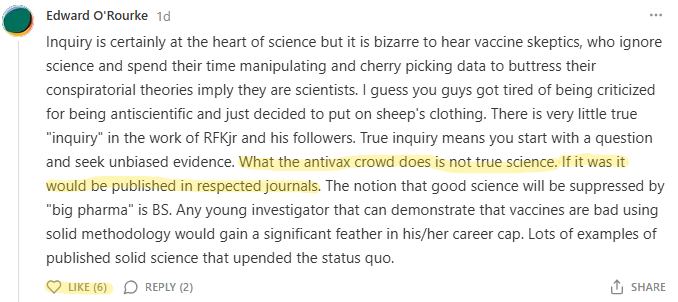
“If it were established science, it would be published” is like saying “if the house had mold, it would’ve been disclosed in the listing.” It assumes integrity in places famous for not having it.
Journals are businesses run by humans with incentives, politics, and institutional pressures—not monks safeguarding sacred truths. Publication isn’t proof; it’s approval. The press release rarely goes out before the canary dies.

In fact, a review by none other than Harvard Medicine found that an overwhelming majority of retracted journal studies were pulled not for innocent mistakes but blatant malfeasance. They wrote:
“Among the 2,047 retracted papers analyzed, the researchers found that 21 percent of the retractions were attributable to error, while 67 percent were due to misconduct, including fraud or suspected fraud (43 percent), duplicate publication (14 percent), and plagiarism (10 percent). Miscellaneous or unknown reasons accounted for the remaining 12 percent.”
Penn Science Policy and Diplomacy Group handily explained why scientists would stoop to the lowest of professional lows:
“There’s fierce competition amongst scientists to publish in order to climb the next step of the ever-shrinking academic ladder. Moreover, it is widely acknowledged that positive results have a higher chance of getting published and in better journals compared to negative ones. These factors may ultimately tempt some researchers to take the easier route to academic success by manipulating or fabricating data.”

The Global Investigative Journalism Network, a nonprofit group of independent media organizations, calls academic fraud an “absolutely huge” problem:
“Some publishers may try to pick reviewers they deem more likely to accept papers, because rejecting a manuscript can mean losing out on thousands of dollars in publication fees. Worse, some corrupt scientists form peer review rings. Paper mills may create fake peer reviewers. Others may bribe editors or plant agents on journal editorial boards.”
Countless industry insiders agree. Richard Horton, editor of the Lancet, wrote in 2004 that “journals have devolved into information laundering operations for the pharmaceutical industry.” British Medical Journal editor Richard Smith described the hand that fed him for thirteen years as “over-influenced by the pharmaceutical industry, too fond of the mass media, [and] neglectful of patients.”
But tell me again about how peer-reviewed publication is the empirical holy grail.

Offit insists that if vaccine harms are real, they’ll eventually be discovered, published, peer-reviewed, replicated, and acted upon—just like they were (so nobly! so heroically! so conscientiously!) with RotaShield, Pandemrix, and the J&J COVID vaccine when they were found to cause severe intestinal blockage, permanent wakefulness, and brain clotting (so rare!), respectively. See? Science works. Case closed. Please disperse.
This is comforting logic if you already trust the system completely. It’s less comforting if you notice that this argument boils down to: the system is reliable because the system says it is.
Also: eventually? Reassuring!
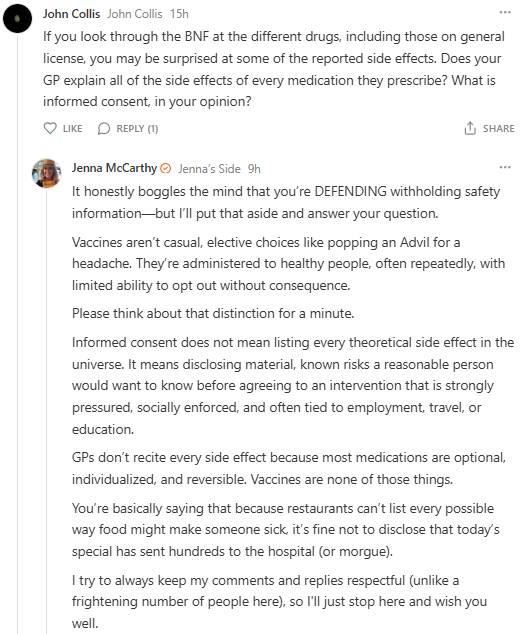
Kirsch’s claim—that COVID vaccines may have caused more harm than acknowledged—might be wrong. (I mean, we know it’s not; that’s me being journalistically generous.) But refusing to debate it doesn’t refute it. It just ensures the question never leaves the lab, the journal paywall, or the polite echo chamber where everyone already agrees.
(By the way, Kirsch wrote an extensive rebuttal to Offit’s piece, which I highly recommend reading.)
Debates are only dangerous to people who rely on status rather than substance. On a stage, Offit can’t gesture vaguely toward “the literature” and move on. He has to answer follow-ups. He has to explain why some data are dismissed as “methodologically uninterpretable” while other, equally messy data are treated as gospel. He has to talk like a human being instead of a citation index.

I went to Offit’s Substack with a mostly open mind, curious to see whether there were other dissenters (very few) or substantive rebuttals (even fewer). When I respectfully disagreed with some of his points, the response was jarring. There were no counterarguments or data—just a torrent of abuse. Sexual slurs. Name-calling. Middle-school filth.

[Delicate readers may wish to skate past these images—and definitely will want to avoid looking at the handles these lovely individuals have chosen for their online personas. I debated including them at all, but I do believe in backing up what might be considered outrageous claims—unlike, say, vaccine disciples.]

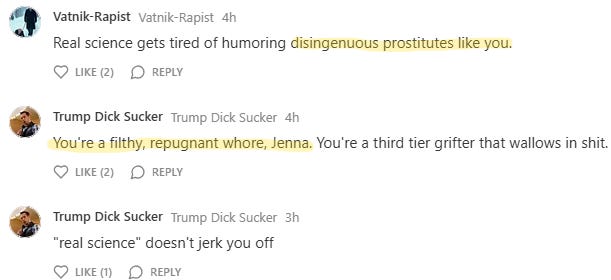

Because nothing says “the science is settled” quite like a digital mob screaming obscenities at anyone who won’t clap.
(It’s worth noting that these folks are almost certainly posting from a bot farm in Bangladesh. But still—this stuff doesn’t write itself. Someone woke up, logged in, and decided this was a meaningful way to make a buck today. And Offit hasn’t deleted their slurs or blocked them from continuing to comment.)

People confident in their evidence don’t need to outsource their arguments to unhinged paid protestors. They don’t panic at the idea of backing up their claims. They don’t insist that conversation itself is a threat.
If vaccines are as safe as advertised, if the data are as rock-solid and reproducible as Offit maintains, then a debate should be easy. It should be dull. It should be a victory lap followed by a very pleasant deposit of Kirsch’s money.
The fact that it isn’t—that the offer instead inspires lectures about decorum, warnings about misinformation, and a sudden allergy to public scrutiny—suggests that this isn’t about protecting the integrity of the scientific process. It’s about protecting the status quo. And the status quo, apparently, cannot survive a critical audience.
Do what you do best in the comments!
“And Offit hasn’t deleted their slurs or blocked them from continuing to comment.)”
Says a lot, doesn’t it.
It's startling to see the quality of 'debate' on Paul Offit's substack.
As you say Jenna "...just a torrent of abuse. Sexual slurs. Name-calling. Middle-school filth."
Seriously!!! This guy Offit has been influential on vaccination policy for years, and this is the standard of discussion he allows in his comments.
It's absolutely pathetic...
But devastating to think of how Offit has been a party to suppressing genuine discussion on vaccination policy and practice.
Now here we are - there's no authentic voluntary informed consent for vaccination, because the 'information' is so highly questionable, and voluntariness has been destroyed by pressure, coercion, manipulation and...MANDATES.
The medical profession went along with this, collaborated with this travesty.
It's a disaster.