

I don’t watch sports. I don’t play sports. I don’t even understand sports, to be honest. I can’t sit through a single match or bout or kerfuffle or whatever it’s called without wondering who came up with any of this stuff anyway. Like, whose idea was it to have two grown men in 1920s-style swimwear roll around on the floor and try to hug each other to death? Why is zero in tennis called love? (I mean I know it’s supposedly from the French word for egg—l’oeuf—because it’s shaped like the symbol for naught and all, but wouldn’t that, like, catch on in other sports?) What inspired the first dude to strap two slippery sticks to his feet and declare, “I will fling myself down this snow-covered mountain at highway speeds for fun!”?
BORED GUY 1: “Okay, first of all, we’re going to take a pig bladder and blow it up and turn it into an egg-shaped ball—”
BORED GUY 2: “Sir, balls are round inherently.”
BORED GUY 1: “Not ours. Ours shall wobble unpredictably through the air like a drunken bat.”
BORED GUY 2: “And what do you propose we do with the bladder-ball?”
BORED GUY 1: “I say we throw it back and forth to each other while our enemies try to murder us in order to keep it for themselves.”
BORED GUY 2: “How will we know who our enemies are, sir?”
BORED GUY 1: “Matching costumes, of course.”
But the Olympics are… different. You’re watching the best of the best. They’re the kids who spent their childhoods waking up at 4 A.M. to train in the dark while the rest of us were dreaming about Pop-Tarts and pretending dodgeball counted as cardio. They’re the stories of sacrifice that are heartbreaking and heartwarming—moms driving 200 miles a day to practices, dads taking night jobs to buy better skis, athletes holding their bodies together with Ace bandages and prayers, entire families living in minivans for their kid’s single shot at a 60-second routine.
The other thing about the Olympics is they’re basically the last thing humanity seems to unanimously agree on. Every four years we collectively decide, “Yes, let’s watch people sprint sideways on knife-shoes and hurl pointy sticks while wearing spandex,” and everyone on the planet accepts it without protest. We can’t agree on disputed territories, what to name entire seas, if Palestine even exists, or whether cake can reasonably be considered a breakfast food—but based on a schedule some Roman gladiator probably chiseled into a stone tablet, we universally sign off on these bizarre events, in this precise order, hosted by whichever country has proven itself willing to bankrupt itself next.
The Games have also survived world wars, hijackings, boycotts, bombings, pandemics, doping fiascos, and figure skating judging controversies that nearly toppled small governments. Still, according to the New York Times, this year’s Winter Games are unfolding “during one of the greatest periods of geopolitical turmoil since the last world war.”

We’re told that this year’s competition feels “discordant with these times,” a phrase that could be slapped on literally any Olympics ever held. Munich ’72? Discordant. Moscow ’80? Discordant. Sochi? Discordant. Rio? Discordant. Tokyo 2020 was so discordant they moved it to 2021 and still half the athletes were competing in front of cardboard cutouts. The Olympics have always been discordant because—brace yourselves—the world does not pause its regularly scheduled nonsense just because we’ve lit a big symbolic torch.
And that’s sort of the point. The Olympics don’t exist because of global unity; they persist despite a routine lack of it (while trying, arguably, to stage-manage a bit of it). “Since the 1990s,” the Times noted somberly, “the IOC [International Olympic Committee] has called on nations to pause military conflict during the Games, a call it repeated this year.”
It’s actually adorable, when you think about it. The IOC “calling” for peace is the geopolitical equivalent of a preschool teacher standing between two MMA fighters and saying, “Okay boys, let’s use our words.”
IOC: “Listen, Presidents Putin and Zelenskyy, we realize the two of you are very busy turning each other’s cities into gravel, but for the next two weeks, how about you both pause and enjoy people from around the world voluntarily sliding down an icy death chute on cafeteria trays?”
If the continuation of unrest during biennial sportsball season feels jarring to the athletes, I regret to inform them that humanity has been dealing with this exact scheduling conflict since the beginning of ever. We had wars during the London Games, the Athens Games, the Beijing Games, every ancient Olympics, and, if we’re keeping track, we canceled the Olympics three different times because of global turbulence.
The Times even quotes an Italian mayor asking whether “these Olympics make sense” in such dark times. I don’t know. Do birthday parties make sense? Do concerts? Does brunch? Should the world stop living until all the major world-stage actors hug it out? If the IOC actually made the Games contingent on peace, harmony, and unanimous climate legislation, we’d be staging the next Winter Games on Mars in 2217, sponsored exclusively by the descendants of Elon Musk.
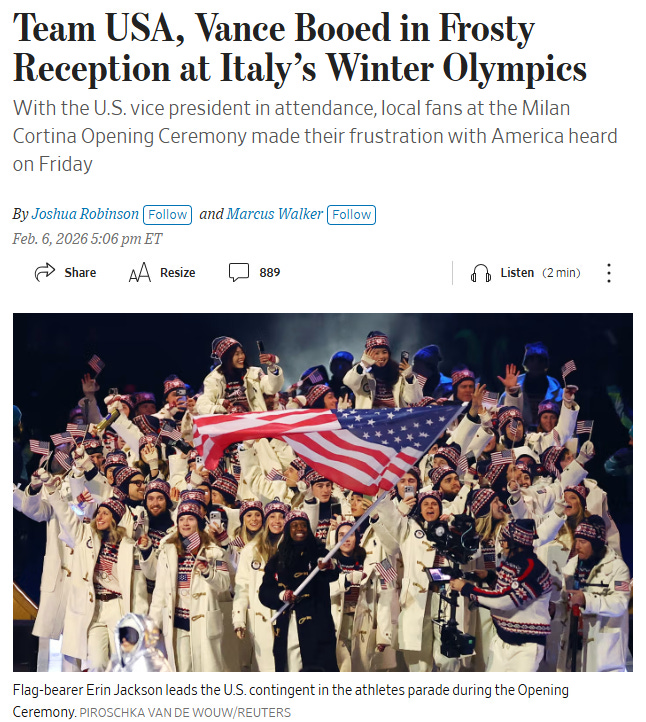
Complicating the dialogue is the fact that the United States is currently about as popular on the global red carpet as a toddler with a jar of finger paints and a kazoo.
Some Team USA athletes have even decided that representing America is optional, symbolic, or something they can opt out of like a group text.
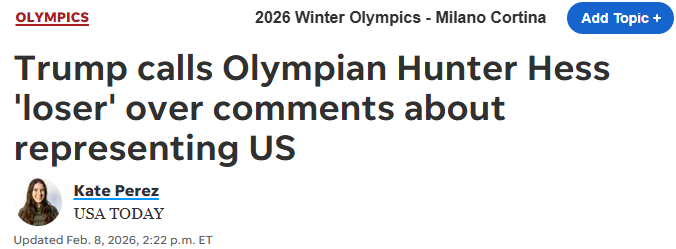
Take Hunter Hess, a 27-year-old halfpipe skier, who kicked off the discourse by telling reporters he has “mixed emotions” about wearing the Stars and Stripes. Mixed emotions. About the uniform he voluntarily applied for, trained for, and accepted. It’s like taking a job at Chick-fil-A and then telling the local news you don’t want to be associated with fried chicken.
The outrage was fast and furious. Mike Eruzione, a captain on the 1980 gold medal team, stated that the skier shouldn't wear the USA uniform if he’s only there to “represent family and friends.” Offended X users called Hess a disgrace, a heinous a-hole, and a piece of human excrement. Scores vowed to boycott the Olympics entirely—probably the ones who thought curling involved dumbbells and were only tuning in hoping to see a wardrobe malfunction during the halftime show. Naturally, Trump chimed in by labeling Hess a “real loser,” because what else would you expect?
Also taking heat is figure skater Amber Glenn, who’s spoken about “using her platform to support the LGBTQIA+ community.”
Try to hide your shock. After all, this is the modern American athlete: handpicked, sponsored, flown across the world at taxpayer expense to represent the country, then standing in front of a microphone explaining that in fact, they don’t represent the country. No, they represent “themselves,” “their truth,” “the strangers who share their sexual identity,” or whatever abstract concept feels better than owning the unpopular nationality they were assigned at birth.
Look, I get it: America is loud, messy, contradictory, imperfect. But the Olympics aren’t the TED Talk Olympics, they’re the actual Olympics. The entire premise of the Games is representing your nation, not holding a public referendum on your personal mood or the state of diplomatic drama. If you’re wearing the flag and the words “Team USA,” you represent America. Not “America except the parts you don’t like.” Not “America, kinda.” Just… America. That’s the job.
This gap between media hysteria and real-world normalcy is the funniest part. The NYT insists the Games are overshadowed by climate death, the disintegration of NATO, and ICE agents in Milan. The WSJ is breathlessly counting boos like an election-night analyst. Meanwhile, the average Italian vendor is just trying to sell a panini to a family from Missouri.
Maybe that’s why the Olympics endure. The world is perpetually chaotic, athletes are frequently angsty, and politicians are almost by definition unpopular—and yet every two years, we all still gather around our TVs to watch a new crop of contenders make history. Maybe sports don’t make sense. Geopolitics don’t either. But mash them together and throw in some sequins and an over-the-top opening ceremony and weirdly… it sort of works.


P.S. I know there’s also that other jock opera that went down last night… I’m putting this piece to bed and trying to juggle all the crazy fallout. LMK if you want my take tomorrow! :)
"If you’re wearing the flag and the words “Team USA,” you represent America. Not “America except the parts you don’t like.” Not “America, kinda.” Just… America. That’s the job." This is the gold in this article. Sick of people who have benefitted from everything the US offers and then shit on it.
After the Masked Olympics, followed by the Transgender Olympics in 2024 and now the Bad Bunny halftime last night, and the Stolen Land Grammies last week, I am pretty much done with celebrities doing anything in public. Junior high basketball, though, is looking pretty good now.