

I was raised in an era whose weight-management mantra was “calories in, calories out.” If you ate more than you burned, you got fat. If you burned off more than you ate, you got skinny. This was as simple as it was frustrating and tiresome, because eating was fun, exercising wasn’t, and thin was in. But we did what we had to do.
Fortunately, in the late ‘80s, scientists made a delightful discovery: food didn’t make you fat; Fat Made You Fat™. How had we not known this? Of course it did—it made perfect sense! It was right there in the name. All you had to do was avoid dietary fat and—boom!—move over, Kate Moss.

Back when calories made you fat, we had to actually monitor how much food we put in our pieholes. But with this exciting new FMYF™ information, we could simply focus on cutting out grease-laden goodies. You know, like steak and butter and egg yolks and salads drizzled with oily Italian dressing and all the foods that make life worth living (and also regulate appetite, maintain healthy hormone levels, support brain function, and build cell membranes, but whatever). As long as we avoided THOSE, there was no way we could blow up.
Pork chops and sauteed spinach—so fatty!—were replaced with heaping bowls of pasta drowning in tomato paste and sprinkled with low-fat, flavorless cardboard cheese shavings. Breakfast was a bagel the size of a steering wheel slathered in fat-free cream cheese that tasted like Elmer’s glue—but hey, zero fat! Why not make yourself two? Lunch could be a baked potato big enough to need its own zip code buried under a mountain of fat-free sour cream and “chili” made from ketchup and ground turkey sadness.
Of course, none of this was even mildly tasty or satisfying. Spoiler alert: when you outlaw oil, you strip all of the joy out of eating. But the FMYF™ people didn’t want us to be sad, so they made treats.
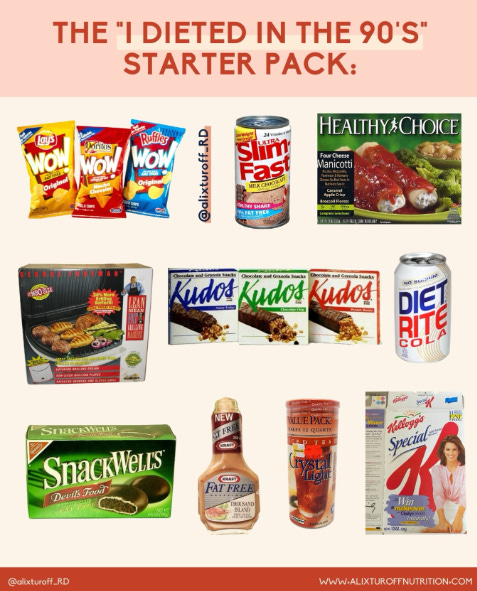
So. Many. Treats.
I’ll be honest, I’ve never been a big snacker. For most of my adult life I’ve also been pretty consistently committed to wearing the same size jeans until the day I die. But all of a sudden, snacks didn’t even count—as long as they were fat-free. I hadn’t eaten an Oreo in years, but there I was, deprived of any real food and overcompensating by inhaling SnackWell’s cookies and Healthy Choice ice cream and Lay’s Wow! chips (which warned right on the bag “May cause anal leakage” and we ate them anyway), proudly mistaking digestive distress for discipline. Sure, I might crap my pants, but I could eat an entire trough! With no guilt!
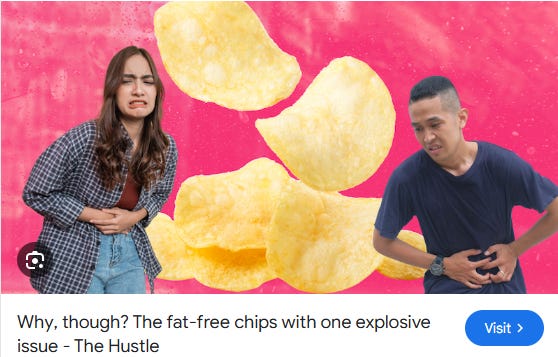
I wasn’t alone. When Joe American learned that fat was the enemy, he found solace in sugar’s loving arms. He doubled his carbs and calories, added dessert for good measure—as long as it was completely joy-free—and called it science. Guess what happened?
HE GOT EVEN FATTER.
It turned out calories still counted.

Having lived through this trainwreck (as well as the next wave of Fat Makes You Skinny As Long As You Never Even Look At Another Carb™), you can imagine why I felt a vague sense of PTSD yesterday when I stumbled across this news story:
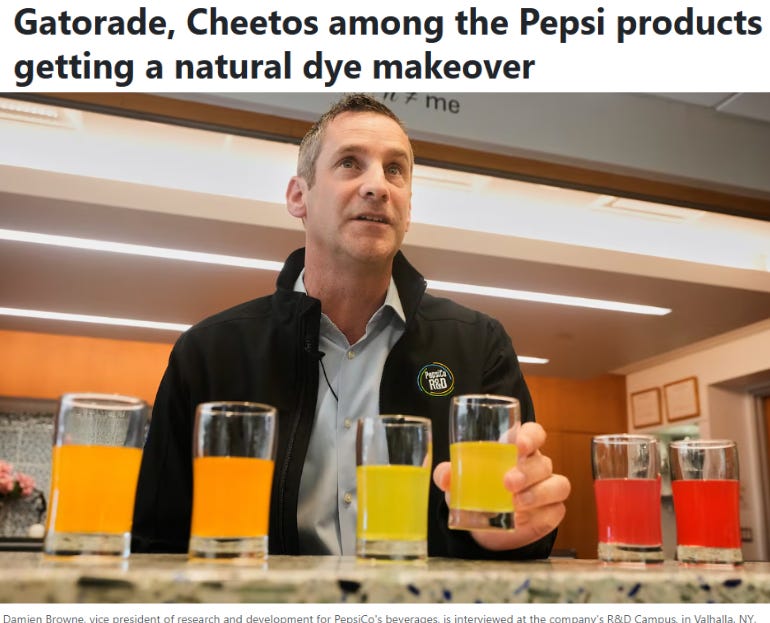
Somewhere in a sleek glass conference room, PepsiCo executives apparently had a panicked meeting about slumping sales and realized that thanks to RFK Jr., people were actually talking about junk food—and not in a good way. So the maker of fan favorites like Fritos, Doritos, Tostitos, Cheetos, Pepsi, Gatorade, and MTN DEW (did anyone else not even know about the 2008 rebrand?) decided to ride the more-natural, protein-obsessed consumer wave. The plan? Axe artificial dyes, focus on adding fiber and the trendiest macro, and drizzle some heart-healthy olive and avocado oils into their heroically processed, high-calorie, nutritionally void snack and beverage lineup.
I know, it’s what we wanted, right? This is MAHA in action! Except… does anyone really think marginally less crappy crap is the key to ending chronic disease? I worry that suddenly just because people can pronounce the ingredients, they’ll start stockpiling snacks like pandemic toilet paper. Sure, taking a little junk out of the junk we eat isn’t a horrible idea. Some protein in your bottled Starbucks coffee might be better than none. But you can already hear the national rationalization forming:
“Don’t worry, babe—they’re natural Doritos. They count as vegetables now.”

PepsiCo’s CEO Ramon Laguarta says the company is working “with a real sense of urgency” to capture “disproportionately growing” market segments. Translation: people who’ve started reading labels and realizing that their munchies shouldn’t be more flammable than hairspray.
A big part of the “refresh,” it turns out, is inspired by the Ozempic generation. PepsiCo’s new Propel Clear Protein line was literally designed in response to the “soaring popularity” of weight-loss drugs, which come with unfun side effects like muscle loss and digestive issues (not to mention pancreatitis, hypoglycemia, thyroid tumors, and cancer—but PepsiCo doesn’t have a sports drink solution for those yet). Each bottle of Propel promises protein for melting muscles, fiber for confused intestines, and electrolytes for the parched will to live. It’s genius in that deeply dystopian way only modern marketing can pull off: we broke your metabolism, but we made a partial fix! Would you prefer watermelon mint or peach ginger?
Then there’s the new “NKD” (yes, really) line of Doritos and Cheetos, stripped of artificial dyes and flavors. Sounds revolutionary, right? More MAHA winning!

Let’s consider: “Regular” Doritos are made with corn, vegetable oil (sunflower, canola, and/or corn oil), maltodextrin (from corn), salt, cheddar cheese (milk, cheese cultures, salt, enzymes), whey, monosodium glutamate, buttermilk, Romano cheese (part-skim cow’s milk, cheese cultures, salt, enzymes), whey protein concentrate, onion powder, corn flour, natural and artificial flavor, dextrose, tomato powder, lactose, spices, artificial color (Yellow 6, Yellow 5, Red 40), lactic acid, citric acid, sugar, garlic powder, skim milk, red and green bell pepper powder, disodium inosinate, disodium guanylate, potassium chloride, and sodium caseinate.
See those seven words in bold? That’s what NKD is taking out. The other 84 ingredient-words? Those stay. And yet, I have a feeling folks will be greedily inhaling family-sized bags of “clean” Doritos and feeling downright virtuous about it. Somewhere, an organic kale chip is weeping.
Alas, when your baseline is fluorescent corn dust, even “faintly less toxic” counts as innovation. Don’t get me wrong: I’m all in on MAHA. I know that change happens slowly. A little progress is better than none. If PepsiCo wants to swap paprika and turmeric for the Red 40 in my Flamin’ Hot Cheetos—a once a year road trip indulgence at most—I won’t even be mad. But let’s not pretend this is a wellness revolution in the making. It’s a billion-dollar snack empire trying to convince investors (and consumers) that modestly upgraded garbage is basically bok choy.
So yes, PepsiCo, congrats on taking the antifreeze out of our chips. Sincerely. But maybe hold off on the victory lap for a minute. Because if “cleaner junk” becomes code for “bottomless bowl,” we’re going to end up right back where we started—on the couch, orange-fingered, wondering why our pants won’t button and Googling how long does it take for Ozempic to kick in.
Am I wrong? I know you’ll LMK in the comments. (And please hit the ❤️ if you enjoyed this post.)

It's good news, but the real villain is vaccines. Starting with food is strategic; get buy-in from the public while slowly rolling out the bad news on vaccines. Nobody is against healthy food; everybody now knows that processed food is poison and you can't put lipstick on that pig. So that gains credibility for RFK and this FDA. Getting the dyes out will help marginally, eating organic food the way God made it and stop letting our children be pincushions for pharma profit will truly make America healthy again.
I remember when eggs were “bad for you”! Hilarious!