

Yesterday was a great day for life—not so much for work.
On Wednesday night I attended the Brownstone Supper Club and got to hear the amazing team that is Cyndi Collen and Mary Parker talk about the insanity swallowing the mental health world. Then—because the event was an hour away and I’m old and hate driving at night—I had a sleepover with one of my oldest, dearest girlfriends, where we stayed up way too late and drank a tiny bit too much wine.
Still I got up at my usual unholy hour (4:30 a.m., true story), drove home, worked out, and attempted to create.

It was not going well. I started a story about the latest—of many—murders allegedly perpetuated by a member of the deranged vegan trans death cult (I swear I am not making that up) known as the Zizians, and another about the 21-year-old who went mega-viral for admitting she’s perfectly content watching TikTok in bed eight hours a day. I hated them both. I scanned headlines for hours, searching for something that spoke to me. My muse was apparently taking a personal day.
When dinnertime came and went—and no, there was no nap in there—I realized I had two options: 1) publish something crap, or 2) dust off an older piece that pairs perfectly with yesterday’s discussion about the Islamification of the West. I went with Door Number 2.
Today’s post was previously behind the paywall, but I’m shamelessly hoping that giving you a glimpse of what you’re missing out on every Wednesday might gently nudge you toward your wallet. Again, this is my only job—and thankfully some people think I’m pretty good at it. :)
When my daughters were little, American Girl dolls were all the rage. They were far from cheap—back then, pushing $100 apiece, but they came with a book!—so each daughter had exactly one. Of course the clothes and accessories cost as much as full-size human gear, so I’d do my best to find those, pre-loved, on eBay.
In theory, I was all in. A doll that actually looked like the child playing with it and not an anatomically impossible pin-up girl with a lifelong commitment to stilettos? Novel. Refreshing. Sign me up! The fact that the company managed to sneak historical lessons into playtime like literary carrot muffins was a Clinique gift-with-purchase-level extra.
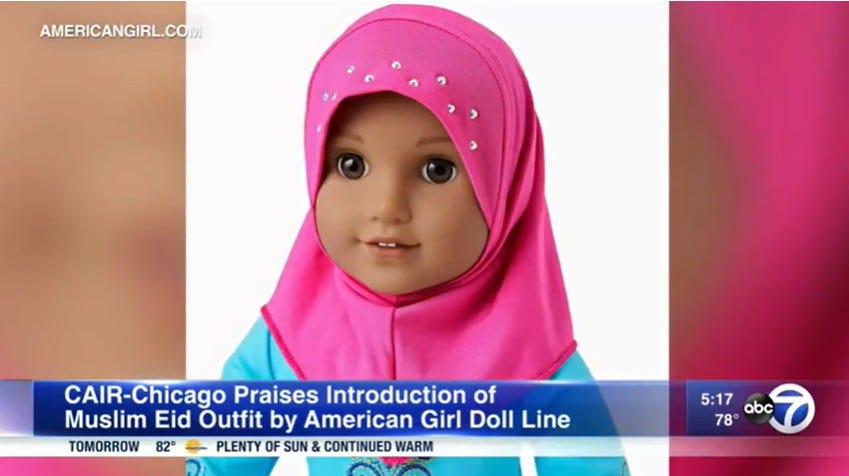
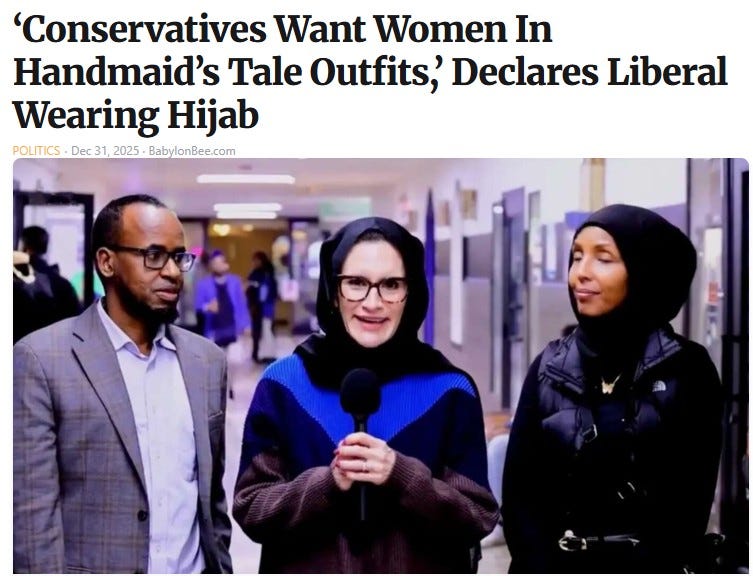
For not the first time this decade, I’m on my knees thanking the Lord that my babies are grown. Because it’s entirely possible they would have asked for the American Girl Eid a-Fitr Celebration Outfit for their birthdays—the thing comes with a hot pink rhinestone-studded headscarf, for crying out loud, of course they would have asked for it!—and then we’d be having an ugly conversation not about historical oppression, but oppression that is very much alive today and extremely busy weaving itself into the fabric of our society.
And obviously, you’re a jerk if you say that last part out loud.
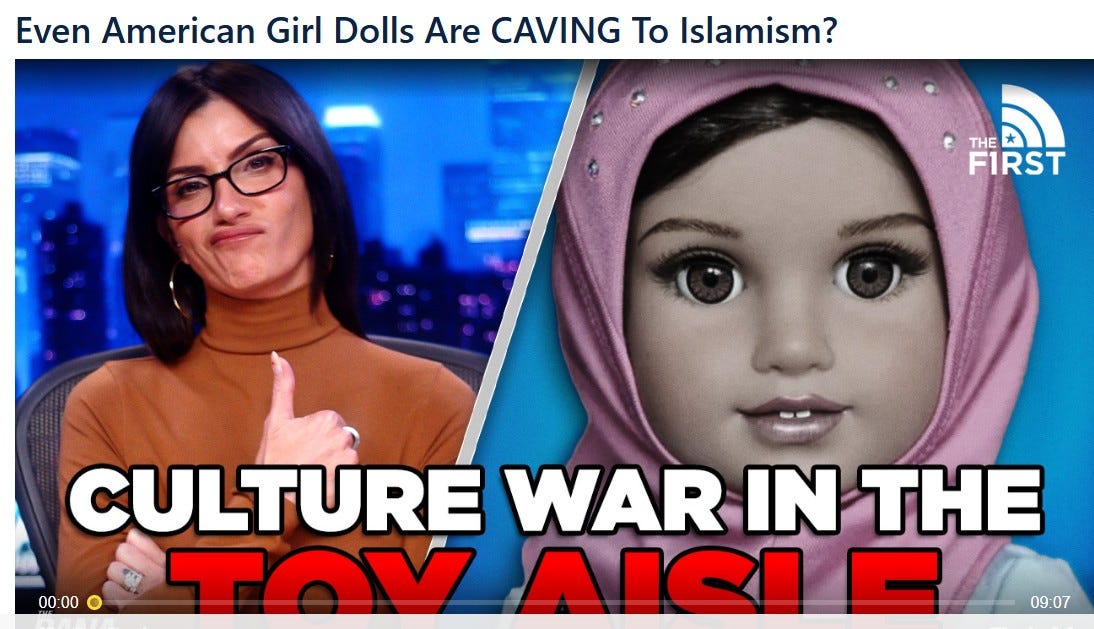
The outfit isn’t new. It actually debuted in 2021, when most of us were probably too busy stockpiling toilet paper and trying to figure out how to get our hands on some ivermectin to notice. (Or maybe Islamification just wasn’t on our collective radar yet? IDK, maybe a combo.) But this week, American Girl decided to promote the ensemble in honor of Ramadan, and the internet… noticed.


In addition to the Eid al-Fitr getup—which gets 4.9 stars, you might want to know—American Girl sells Kwanzaa, Día de Muertos, Hanukkah, and Diwali Celebration Outfits. (The Hanukkah set comes with a Star of David necklace, but you have to purchase the mini menorah and dreidel separately.)
What’s odd is that even though 62 percent of Americans describe themselves as Christians (down from 78% in 2007, thanks open borders!), the company does not sell a Yuletide or Easter Celebration Outfit. There’s no nativity scene or advent wreath or cross necklace either. There’s no First Communion veil, no baptism gown, no Ash Wednesday smudge kit, no confirmation dress, not even a modest denim skirt and youth group retreat lanyard. But looking for a bindi or a bedazzled hijab or a calavera mask? You’ve come to the right place.
For a brand literally called American Girl, it’s an interesting play.
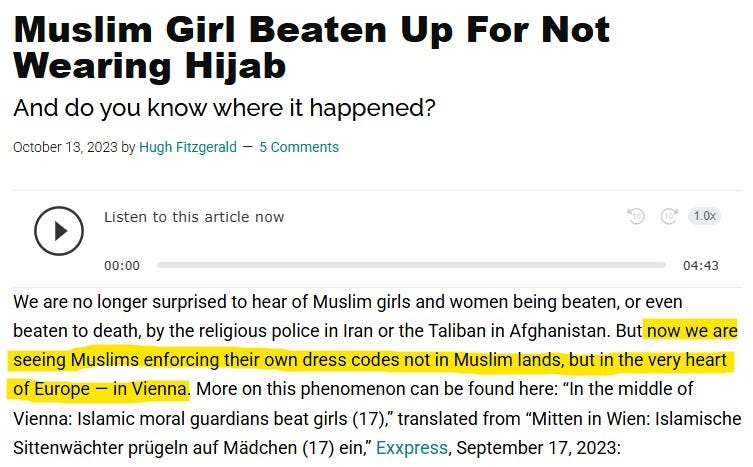
The uproar over Islamic attire isn’t rooted in xenophobia; it’s what the hijab in particular represents. After all, the primary purpose of headscarves is to minimize sexual attention. You know, because men can’t be expected to control their carnal urges, so it’s your responsibility to not arouse them. (Muslim girls generally don’t wear hijabs until after puberty—which is an interesting point, given the target demo here.)
Proponents will insist hijabs are also about humility and devotion and cultural identity… but if that’s the case, why are only the women doing all of the humbling and devoting and identifying? Why are they the ones walking around swaddled like doomsday mummies? Don’t the dudes need some way to prove their piousness and instantly recognize their Muslim brothers besides “being covered from navel to knee,” which is basically what 99 percent of men in the world do anyway?
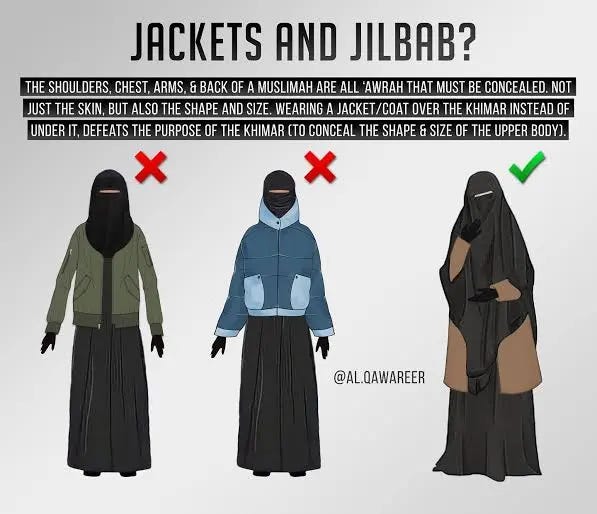
I know some women claim to cover themselves voluntarily and insist they’re simply more comfortable that way. Maybe they do and maybe they are. And many of them face harassment and discrimination for it, which is also wrong. But for countless women, the hijab is not optional—and refusing will get them arrested, beaten, or worse. But here you go, little Mary Catherine, enjoy playing with your new celebration-of-oppression outfit!
Oh, to have been a fly on the wall in the American Girl boardroom when this meeting of the minds went down.
CREATIVE DIRECTOR: “Okay, team, let’s review our cultural classics. Pioneer girl. Check. Colonial girl. Check. Polio survivor? Love her. Hippie girl—timeless. Hawaiian girl—strong, culturally rich, great visual merchandising. Anyone see any gaps?”
HEAD OF DEI: “Well, since you asked…”
CREATIVE DIRECTOR: “Yes?”
HEAD OF DEI: “It’s just that everything in our current line-up is just so… American. And frankly, America isn’t even American anymore. I mean, I have to ‘press two to hear this message in English’ when I call my credit card company. We’re diverse! We have freedom of religion right in our Constitution! We welcome all cultures with open arms—even the ones who shout ‘death to America!’ What’s more American than that?”
CREATIVE DIRECTOR: “So… what’s the product?”
HEAD OF DEI: “A hijab! Did you even know that Muslims are projected to be the second-largest religious group in the U.S. by 2040? Let’s get ahead of the curve by representing the most persecuted women on the planet. It’s iconic.”
CREATIVE DIRECTOR: “Can we make it pink and sparkly?”
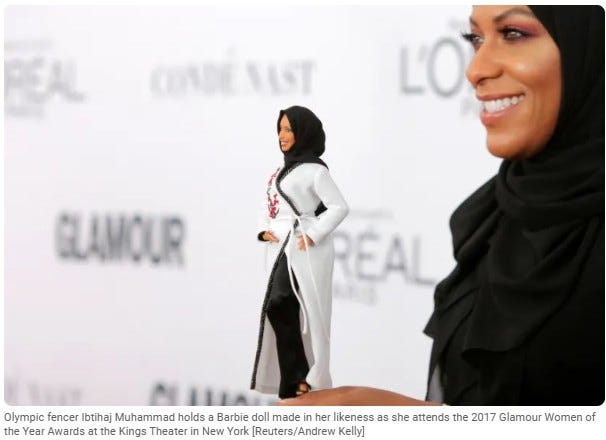
To be fair, American Girl didn’t invent this particular flavor of “representation.” Mattel has been workshopping it for years. After decades of being criticized for its ultra-thin, blue-eyed, gravity-defying Barbie, the company pivoted—rolling out “diverse” dolls, body-positivity dolls, neurodivergent dolls, Black presidential candidate dolls, and eventually in 2017, a hijab-wearing Barbie modeled after Olympic fencer Ibtihaj Muhammad. The messaging was familiar: inclusion, empowerment, visibility, expression, inspiration. And as you might expect, a lot of people applauded it.
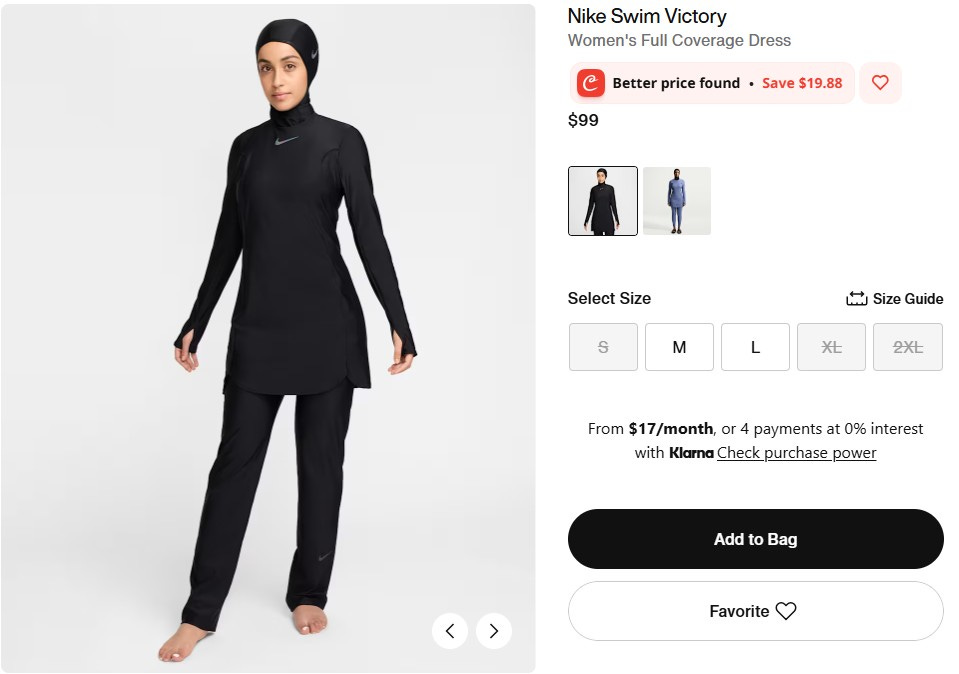
But what companies like Mattel—and Nike, and Lululemon, and H&M, and every other brand that “suddenly” discovers multicultural fashion—are really selling isn’t just a product, or even a feeling. It’s a version of reality that’s been carefully edited for retail. Whitewashed, in the most figurative and predictable way imaginable. Take something complicated, culturally loaded, and—depending on where you are—not always optional, strip out anything ugly or uncomfortable, add a little glitter, and present it as empowerment.
Now it’s not a conversation. It’s an accessory.
And that’s incredibly convenient. Because the harder questions—the ones about control, coercion, consequences, and conquest—don’t fit neatly on a hanger next to a $42 celebration outfit.
To be clear, the concept itself isn’t the issue. Dolls from different backgrounds? Great. Kids seeing themselves reflected in their toys or being exposed to other cultures? Well done. No notes. But I keep coming back to the fact that we’re asking a doll to do a lot of emotional heavy lifting here. Since when does a child’s play toy need to be made in her exact likeness? Barbie was never a mirror for any child—she was an idea. A caricature. A cartoon. Little girls also play with unicorns and dragons and sock monkeys and rubber snakes without the need to identify. You don’t exactly hear men out here demanding a ‘body-inclusive’ GI Joe with a potbelly and a podcast.

When I moved from California to Texas, I saw the same T-shirt, billboard, and bumper sticker over and over: Keep Your CA Out of My TX. And honestly? I got it. It wasn’t about hating California—it was about not wanting the policies and ideas that drove people out in the first place to follow them here. You left for a reason. Don’t recreate the same conditions you were trying to escape. Pretty basic concept.
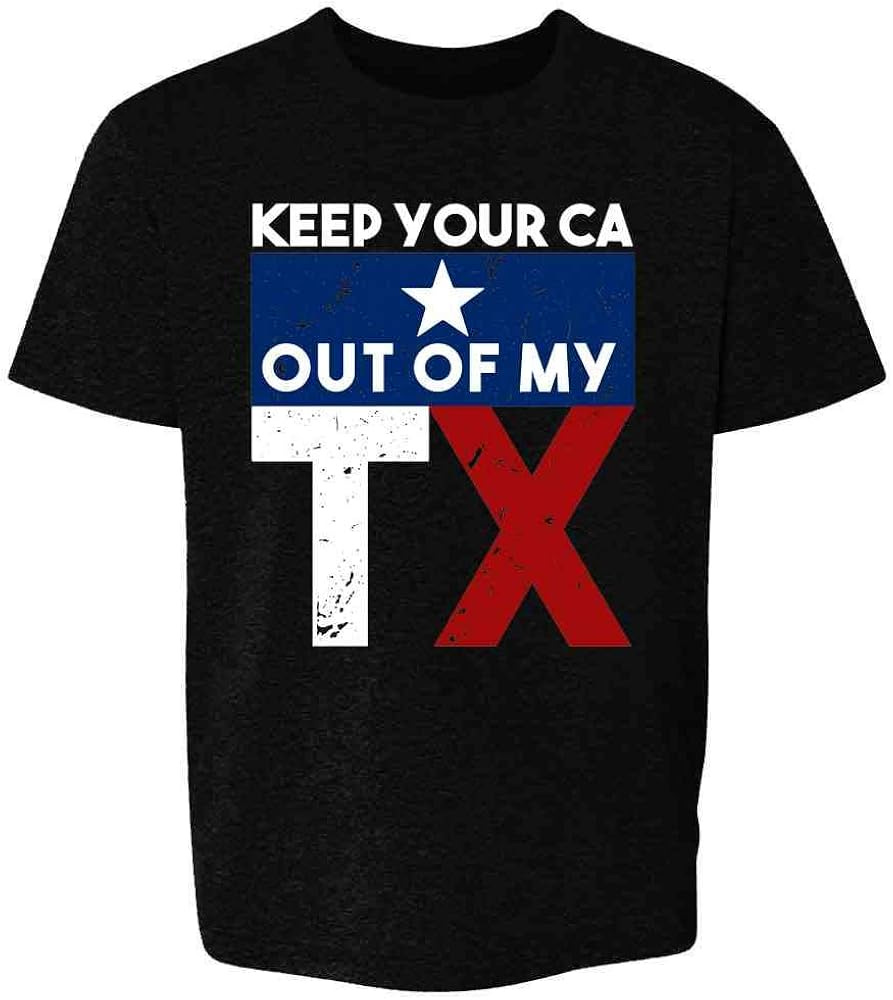
And that’s precisely the point people are dancing around here. I support religious liberty—truly. Practice what you want, wear what you want, believe what you want. (*I do draw the tolerance line at “Death to America,” I won’t lie.) But there’s a difference between individual freedom and normalizing ideologies that don’t extend that same freedom back. You can call it representation or diversity or inclusion, but at some point I think it’s fair to ask whether we’re celebrating something, capitalizing on a cultural moment, or pushing a terrifying agenda.
Don’t hold back! Do what you do best (respectfully, OFC) in the comments. :)
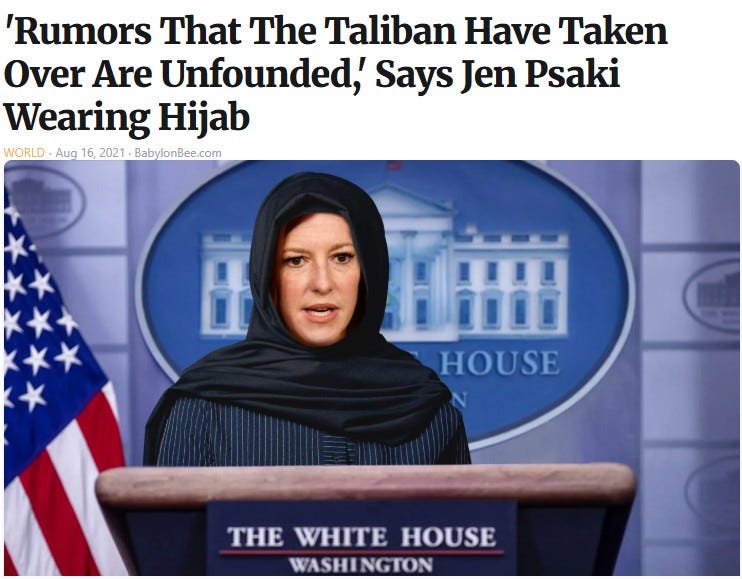
My Dad , RIP, WW 2 Vet …. Let’s just say I miss him terribly but glad he is not here to witness the internal invasion of our country. 😪
I hear there Is a muslim pull string talking doll out there, nobody knows what It says, everyone Is afraid to pull the string.