

If you need further proof that Americans can and will argue about absolutely anything, I present to you the controversial concept of the deadline. While half the country understands this to be—by its literal dictionary definition—“a date or time before which something must be done,” the other half thinks it should mean “you know, if you’re close, you probably tried, so you’re good.”
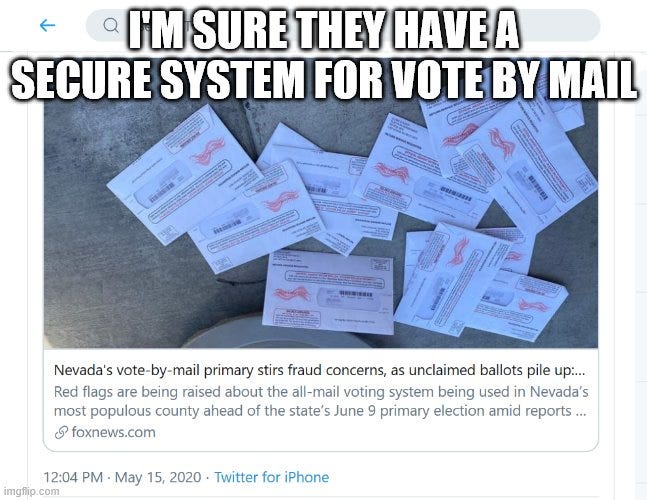
You’ll never guess which side favors the flimsier definition when it comes to voting by mail.
(Interestingly, the word “deadline” originated during the American Civil War, when it referred to a literal line that prisoners couldn’t cross without being shot dead by a guard. Not really a lot of room for interpretation there.)
Anyway, this week, the Supreme Court heard arguments over whether mail-in ballots that show up a few leisurely rotations of the Earth after Election Day should still count—as long as they were dropped in the box on time—prompting several justices to ask, in so many words, if the deadline is actually the deadline plus five days, isn’t that just a new deadline?
Conservatives believe ballots need to be received on or before Election Day. Period. Not “my assistant swears she mailed it on Monday.” Not “floating somewhere in the USPS abyss with good intentions.” Received. By the day we have collectively recognized—since 1845—as Election Day.
Liberals are acting like this is a shocking new development rolled out by MAGA to disenfranchise as many voters as possible. A cruel and unusual burden. An impossible standard. “What if there are mail delays?” they cry, as if the United States Postal Service just sprung into existence last week and we have absolutely no historical data on how long it takes to get a piece of mail from Point A to Point B. “What about early voting?” they gasp, because clearly the concept of a voting window that closes at a specific, predetermined point is just too complex to wrap their heads around.
You know what else has deadlines? Everything.
Your mortgage. Your credit card bill. Homework. School enrollment. Tax filings. Airline check-ins. Hotel check-outs. College applications. Vehicle registrations. Subscription free trials. Amazon returns. If you miss those, no one shrugs and says, “Well, she meant to pay her Visa bill on time, so let’s just go ahead and count it.” No, you get a late fee, a penalty, or a polite-but-firm “too bad.” Because that’s how deadlines work. They are, fundamentally, not suggestions.
But with elections, we’re supposed to pretend time is a loose concept. “Well, it was mailed by Election Day!” Sorry, doesn’t count. Should’ve mailed it earlier. This is not a surprise party. No one is sneaking up behind you on November whatever-it-is yelling, “Gotcha! It’s voting day!” We know when it is. We’ve always known when it is. It’s the Tuesday after the first Monday in November. Has been for nearly two centuries. Worried about your vote arriving in time? Here’s a thought: Build in a buffer like a functioning adult.
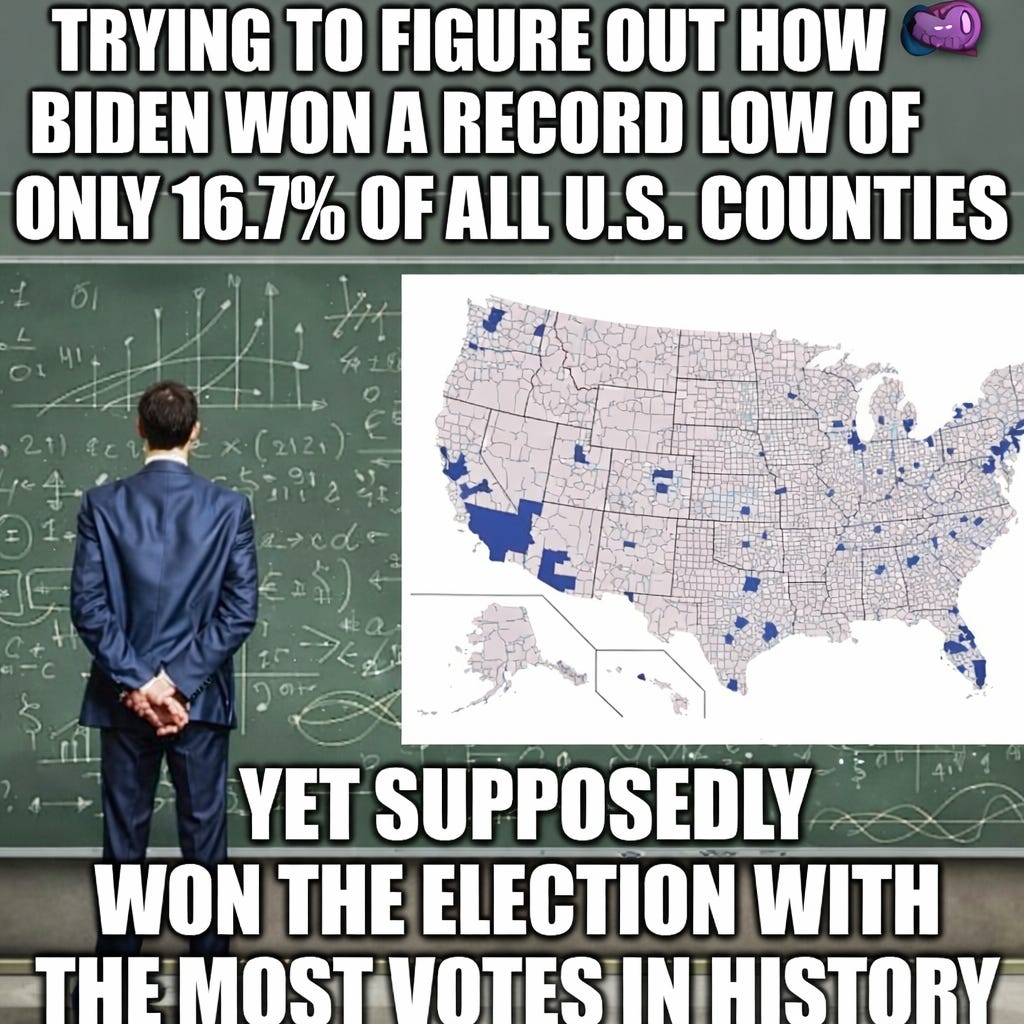
Republicans are not floating some radical new restriction here. Mail-in voting wasn’t designed for procrastinators. It started during the Civil War so that soldiers—who were, you know, actively on battlefields—could still cast their ballots. Over time, states expanded absentee voting to people who were genuinely unable to show up in person: the elderly, the ill, those traveling, overseas military. You had to request a ballot. You had to have a reason. And—brace yourself—you had to plan ahead. It worked just fine.
Over the years—almost always in response to “wartime necessity”—the system got stretched. First it was mainly for active military. Then anyone “vulnerable to attack” who might be afraid to leave home on Election Day. Then traveling salesmen and railroad employees. As people became more mobile, rules loosened. Exceptions multiplied. Deadlines blurred. And then Covid hit—remember how they constantly compared it to a war?—and we were all supposed to pretend the virus would kill us all if we stood in line together to vote (but not if we were positioned on a little yellow arrow in a grocery store six feet away from the next shopper, sitting maskless in a crowded restaurant, or part of a BLM protest). In other words, what started as a practical accommodation turned into a postal free-for-all that election scholars will be debating until the sun burns out.
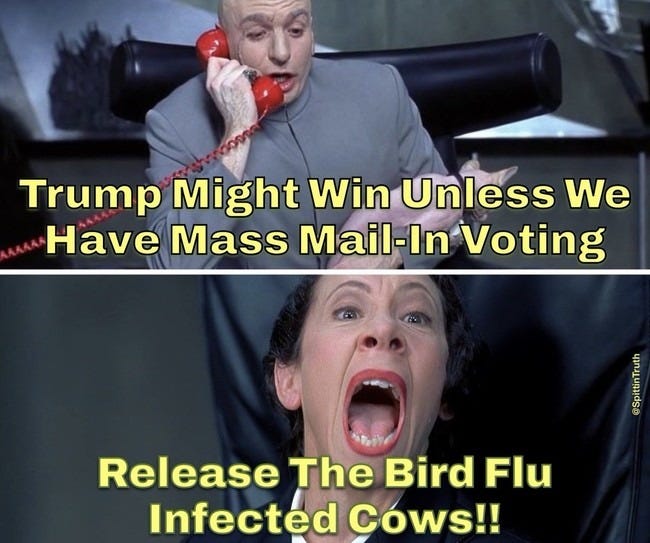
You may recall Election Night in 2020, when Trump had a solid lead over Biden in several key swing states. By morning, supposedly as mail-in ballots were counted, all four states—Pennsylvania, Michigan, Wisconsin, and Georgia—had flipped. “Republicans vote in person and early!” the left shouted. “Nothing to see here!” Legit or not, the whole mess left lots of Americans with exactly zero faith in election integrity. (Except the Vees of the world, who lost that ages ago and refuse to partake in the puppet pageant at all.)
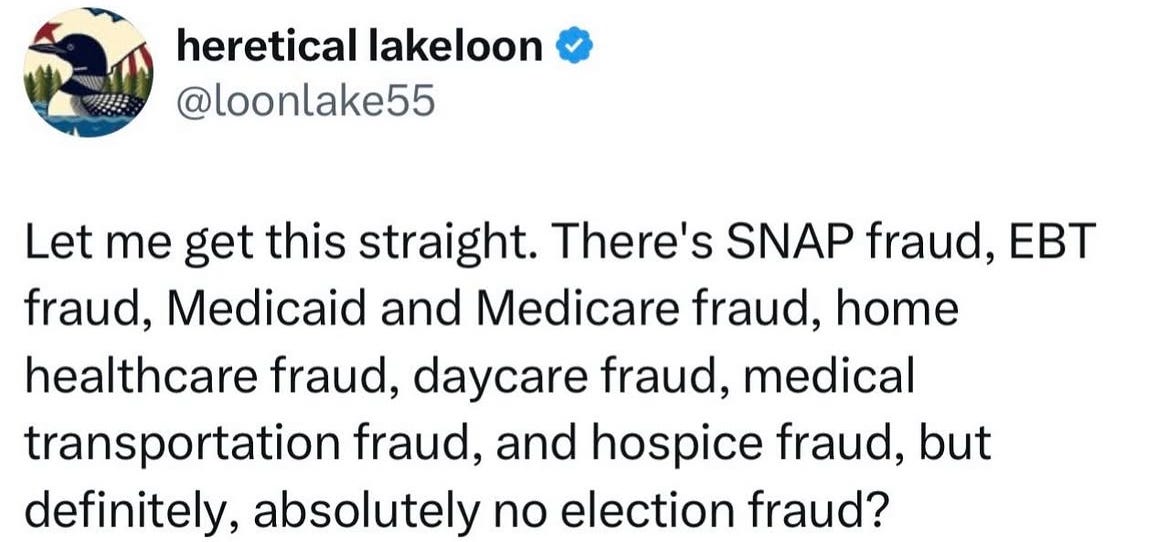
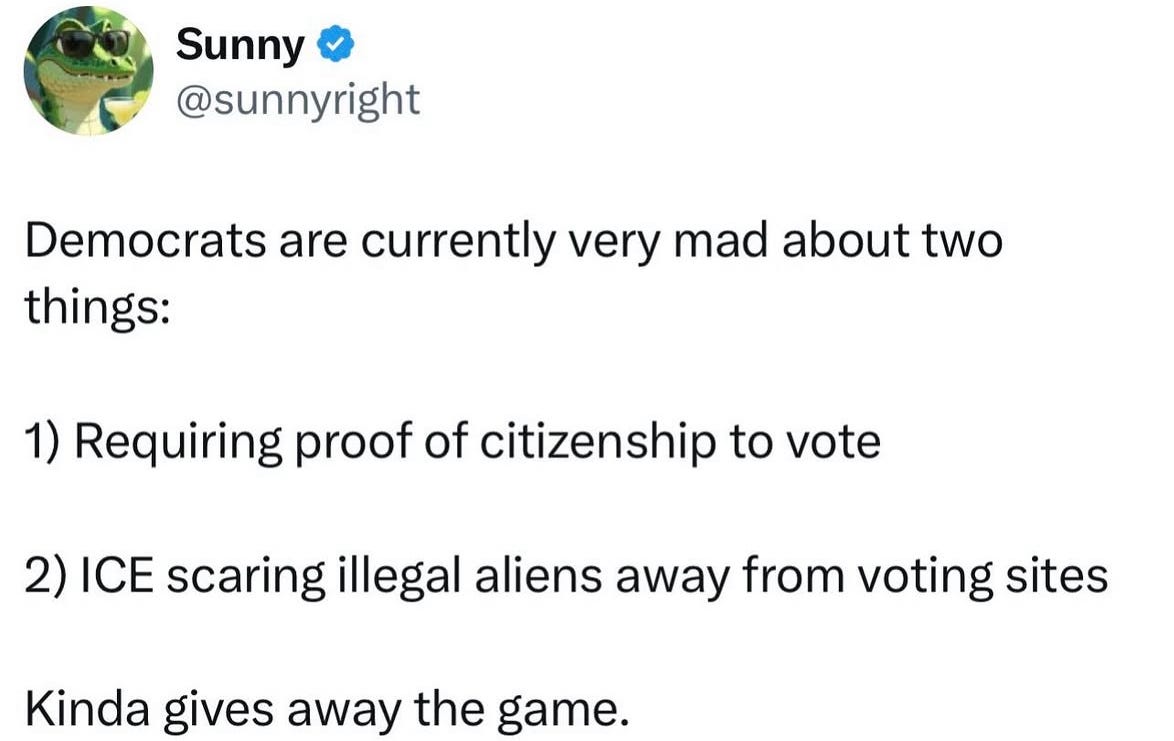
Call me crazy, but what if we went back to what actually made sense: in-person voting as the default. If you can get to the grocery store, Target, your kid’s soccer game, or the gastroenterologist’s office for your colonoscopy, you can get to a polling place. Make it a national, PTO holiday. For those who genuinely can’t (see above) appear in the flesh, absolutely, allow exceptions. But make them actual exceptions. Apply in advance. Get approved. Mail your submission back by a clear, firm, not-even-close-to-the-deadline date so we’re not all sitting around waiting for ballots to casually wander in like dads in Home Depot.
This is not voter suppression. It’s basic organization.
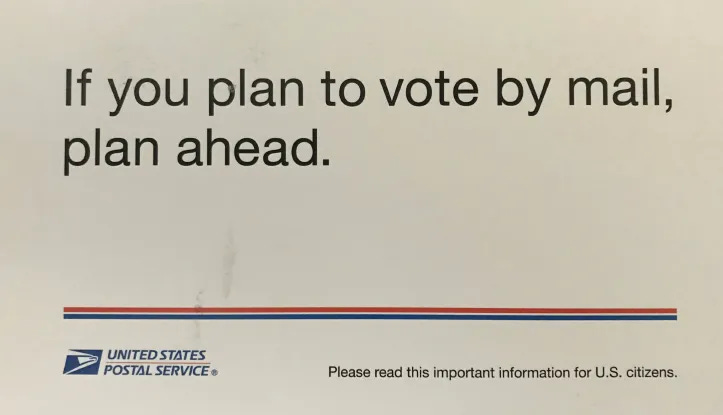
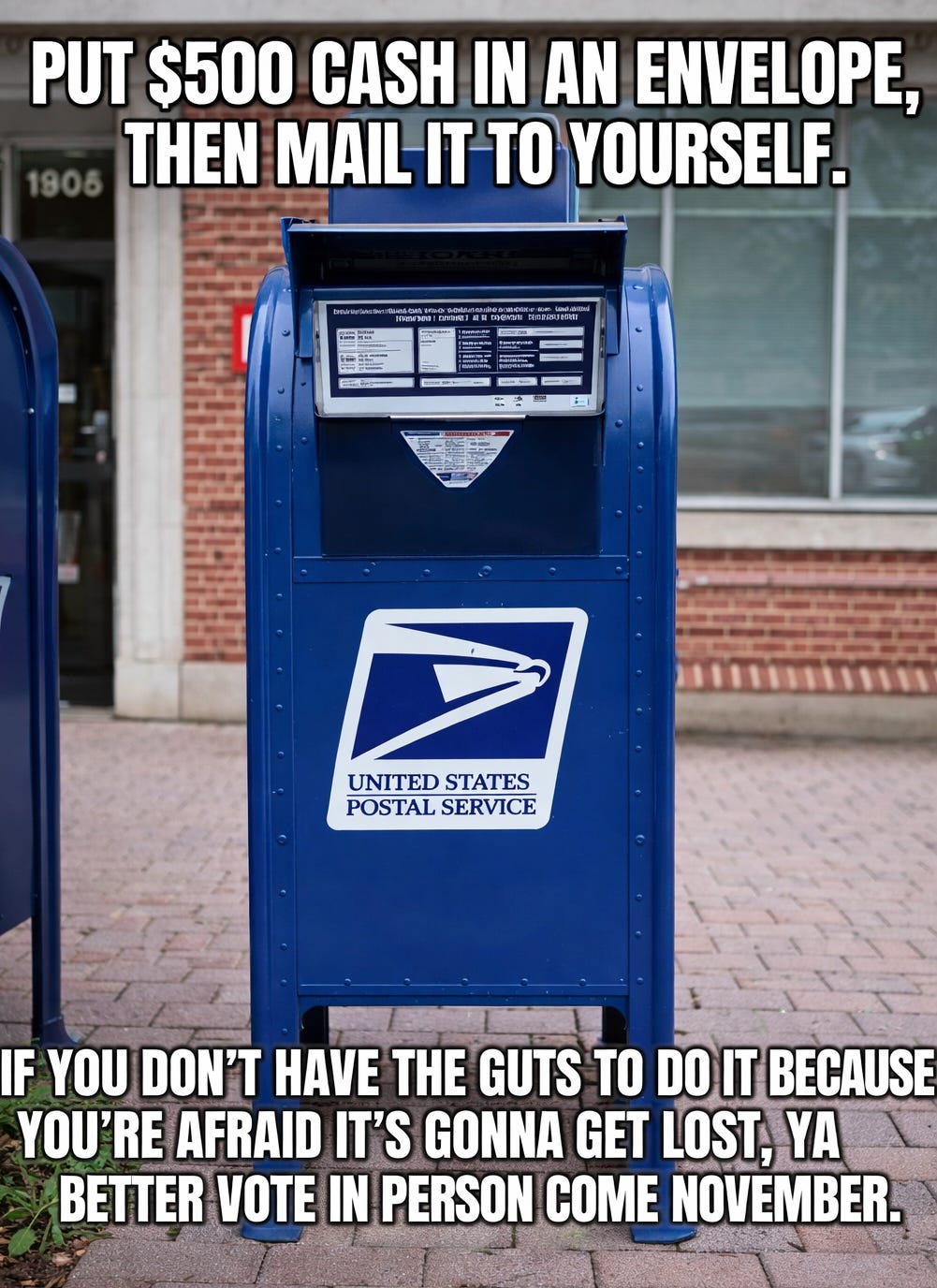
We are capable of astonishing logistical feats in this country. We can track a $7 Amazon package in real time as it makes its way from a warehouse in Denver to a front porch in Poughkeepsie. We can file taxes electronically, transfer money instantly, and order sushi from our phones at a red light. But asking people to mail a ballot a week or two early? Suddenly we’re all helpless Victorian orphans at the mercy of the Pony Express. I’m going to tiptoe right out on a limb here and say that deadlines only work if they mean something—and Election Day is hardly a moving target.
Here’s the best part: we may not even know what the rules are until June. As in, months before the midterms. States are already scrambling to prepare for a system they don’t fully understand yet, trying to explain it to voters who, according to election officials themselves, need to hear something a dozen or more times before it sticks. So we’ve managed to create a process where the deadline is negotiable, the rules are fluid, and the instructions are TBD… but we’re all supposed to feel extremely confident in the outcome.
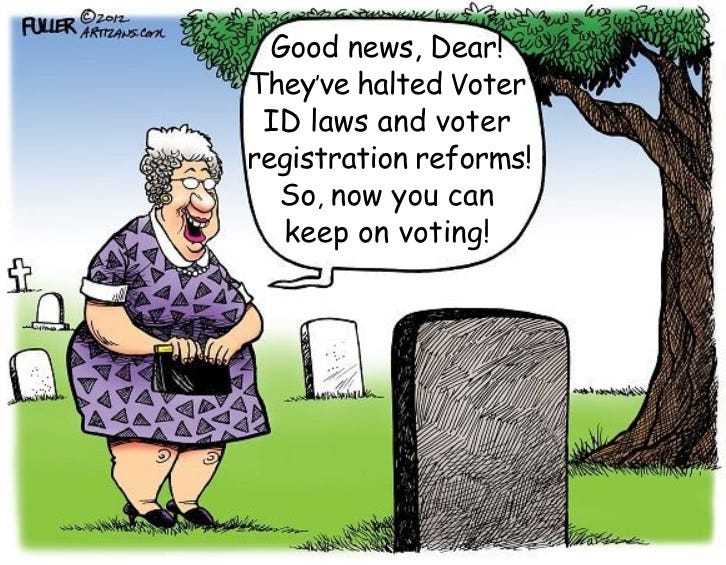
Good luck with that.
Can’t wait to hear your collective thoughts! :)

Democrats continue to live by the mantra, "Rules for thee, but not for me." But they're not anarchists or duplicitous, come on man! I am in complete agreement with Jeff Childers' statement on this subject yesterday, "I would prefer one single Election Day, paper ballots, inkstained fingers, IDs, and that’s it."
I wonder if the IRS is “fluid” on taxes?