

Val Kilmer just wrapped shooting on his new film As Deep as the Grave, set to release later this year—and Hollywood is kvetching like a five-year-old with a bent juice-box straw.
The wrinkle: Kilmer has been dead for more than a year.
Yes, really. (Apparently, the grave isn’t that deep after all.)
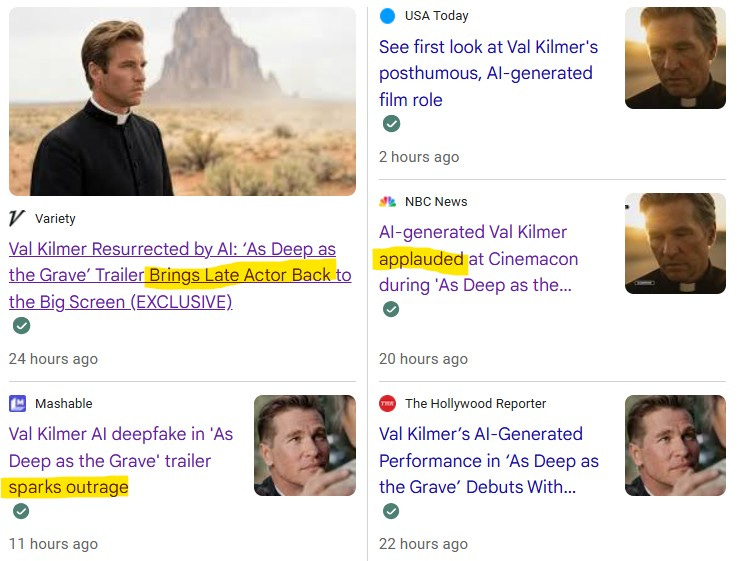
In what sounds like the plot of a Black Mirror episode written during a writers’ strike, the late actor “stars” as Father Fintan in the upcoming historical drama—despite never shooting a single scene. Though he was cast when he was actually alive, health issues and production delays kept him from the set; his entire performance has since been reconstructed using archival footage, AI voice tools, and family-provided images.
The words “terrifying” and “disgusting” are working overtime.
To be clear, his children signed off. SAG-AFTRA signed off. The lawyers signed off. The contracts were followed. The boxes were checked. Nevertheless, the audience is preemptively offended.
We’re talking outrage. Hair-on-fire hysteria. Existential dread. Because apparently, the line has finally been crossed. Not when actors were routinely being de-aged into waxy, uncanny mannequins. Not when stunt doubles’ faces were digitally replaced. Not when entire scenes were stitched together in post-production using green screens and lighting tricks and a small army of VFX artists. No, now we’re replacing dead people who once pretended to be other people with… actual pretend people. Obviously, we’ve gone too far.
You have to admit, it’s sort of funny.
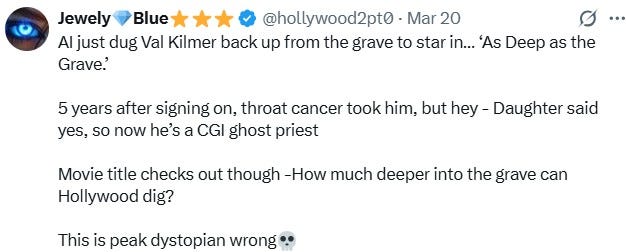
This isn’t the first time AI and Tinseltown have locked horns. Last year, the illusion factory lost its lunch over Tilly Norwood, a 100% CGI “actress” who’s already huge in the UK and was, at the time, searching for an agent. The A-list reaction ranged from “Bring it on” to “Good Lord, we’re screwed.” (My own response was, “Oh, boo hoo for the red carpet class. AI is threatening your jobs? Welcome to the party. Leave it to you to be fashionably late.”)

“Hollywood is deeply, deeply concerned about Wi-Fi wizardry taking over human roles,” the collective “he” said—from a driverless car, while promoting a film shot almost entirely on a green screen, his skin digitally smoothed, his stunts performed by someone else, his voice enhanced in post.
But the Val Kilmer story, we’re told, is different. This isn’t about showbiz staples fearing for their roles (yeah right). It’s about respect. About legacy. About the sanctity of performance. Which would land a lot harder if this weren’t an industry that has been recycling, rebooting, reimagining, and resurrecting intellectual property for decades like it’s a competitive sport.

Apparently it’s deeply offensive to “bring back” a dead actor using technology—with the full consent of his family and estate—but perfectly fine to have a random British guy play him in a biopic ten years from now.
That’s respectful. It’s ethical. It’s art.

The irony is almost too perfect. An industry built entirely on illusion is drawing a moral line at illusion.
“What if they cash in on me after I die?” is not the concern, of course. It’s the fact that once you accept that a performance can be recreated, extended, or even originated without a living actor physically standing there delivering lines, the entire premise of the industry starts to wobble a little.

The film’s producer calls it “breaking new ground” and insists that “Val Kilmer influenced this performance.” I suppose that’s one way to put it.
The reality is, this ground has already been officially broken. Studios have been playing Weekend at Bernie’s with their actors for years. They reverse-aged half the industry elite into Botox-on-steroids versions of themselves in The Irishman and Captain Marvel, stitched Paul Walker back into Furious 7 after his death more than a decade ago, and digitally resurrected Peter Cushing in Rogue One like it was a Pixar side project. Adrien Brody even picked up an Oscar after AI gave his Hungarian accent a little glow-up. And somewhere in there, studios were casually licensing Michael Caine’s voice and floating the idea of casting James Dean in a brand-new movie decades after his death.
But this? It’s creepy, weird, and indecent.

The funny part is, in some ways the technology isn’t a threat—it’s a perk. Not for audiences—who have been watching fake things presented as real for decades and probably don’t care whether the performers are people or pixels—but for actors. Oh, you don’t want to leave your family for six months to go shoot in Iceland? No problem—license your likeness. Don’t feel like spending 14 hours a day in a corset under studio lights while someone yells about continuity? Great—your digital twin’s got it. You want to be in three movies at once without ever leaving your house? Congratulations, you just became your own franchise.
Maybe when Hollywood figures out they can actually exploit AI, they’ll stop whining about AI exploiting them.

And the award for the most realistic reincarnation of a dead person in a major role goes to….
….drum roll….
THE BIDEN “PRESIDENCY”!
Give him a hand everyone. Now let’s have his facelift doppelgänger shuffle up and say a few words. Mind the sand bags.
What about the (meaningless) Oscars? What if AI Val is nominated? What category? Best Performance by a Dead (AI) Actor? Who accepts the Oscar if AI Val wins?