

Imagine you’re a bouncer at a casino. It’s not your dream job, but it pays the bills and you get a free steak dinner once a week. Over the years you’ve noticed several odd coincidences, like the same guy wins at roulette six nights a week. The dealer at table three hits an unusually hot streak every time an ultra-high-roller sits down. In a decade you’ve seen nine people strike slot-machine lightning—and eight of them work there.

The pit boss insists the place is “routinely subject to rigorous independent oversight,” but one day you discover that the oversight board is just the dealers in different jackets. You point this out to a manager and are promptly informed that if you enjoy Ribeye Fridays, you should stick to checking IDs.
Now imagine someone new buys the casino and announces that, going forward, the dealers will be audited by people who don’t work for the casino. Not saints. Not cops. Just people whose paychecks don’t depend on the roulette wheel hitting red more often than physics allows.
The “oversight committee” naturally loses its mind. “You’re undermining trust in the entire gaming industry!” “This is an abuse of power!” “Keep your politics out of my gambling!”
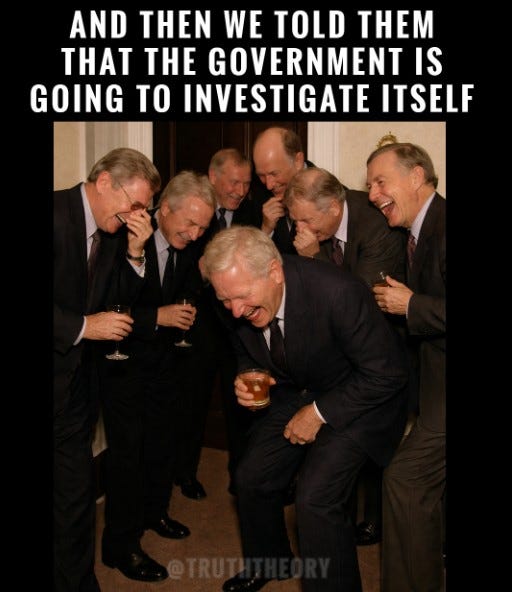
Replace ‘casino’ with ‘federal research funding’ and ‘oversight board’ with ‘everyone who’s been feeding at the government funding trough,’ and you’ve got the reaction to the White House Office of Management and Budget’s new grant reform proposal. The document—all 412 pages of it—is essentially a user manual for how the government spends your money, and the short version is: badly.
The report details the OMB’s background and regulatory history, exposes dozens of scandalously wasteful and blatantly unlawful practices under previous policies and administrations, and outlines an overhaul of exactly how the national piggy bank is managed. Think less policy memo and more surprise colonoscopy for Washington’s grant ecosystem.
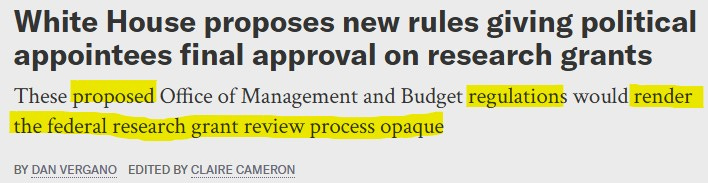
As you likely can already guess, the liberal mediasphere is in the fetal position over this “attack on independent science.” So let’s review some of the proposed reforms that supposedly threaten the very future of evidence-based study.
For starters, OMB wants to give political appointees the freedom to cancel grants that don’t serve national interests. (Actually, the exact words are “federal funds will no longer be used to promote a ‘woke’ policy agenda.”) Peer review of such grant proposals—long treated as a sacred, scholarly ritual—would become “advisory.” Which means the professors who’ve spent decades deciding which projects deserve taxpayer money would no longer have the final say. They can still give their opinions, but the people signing the checks might ask whether American citizens should really be funding studies on workplace drag performances in Serbia or climate anxiety among transgender Bolivian alpaca farmers.
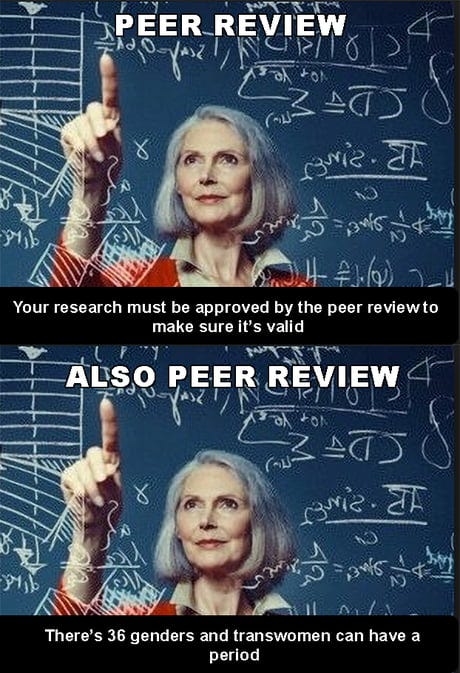
Under the new system, conference travel and publishing fees would also require actual justification. International collaborations will get a harder look, too. In other words, “We’re sending millions of dollars overseas to study something” may be met with something more than a distracted smile and a blank check. Someone might have to survive the harrowing ordeal of explaining what the money is for.
The updated framework, also not surprisingly, is being treated by academia as roughly equivalent to the burning of the Library of Alexandria.
“We warned of this exact form of government overreach in science a year ago,” Colette Delawalla, founder of the science advocacy group Stand Up for Science, told Scientific American. “It replaces expertise with political appointees, globally decouples the U.S. and completely guts our scientific ecosystem.”
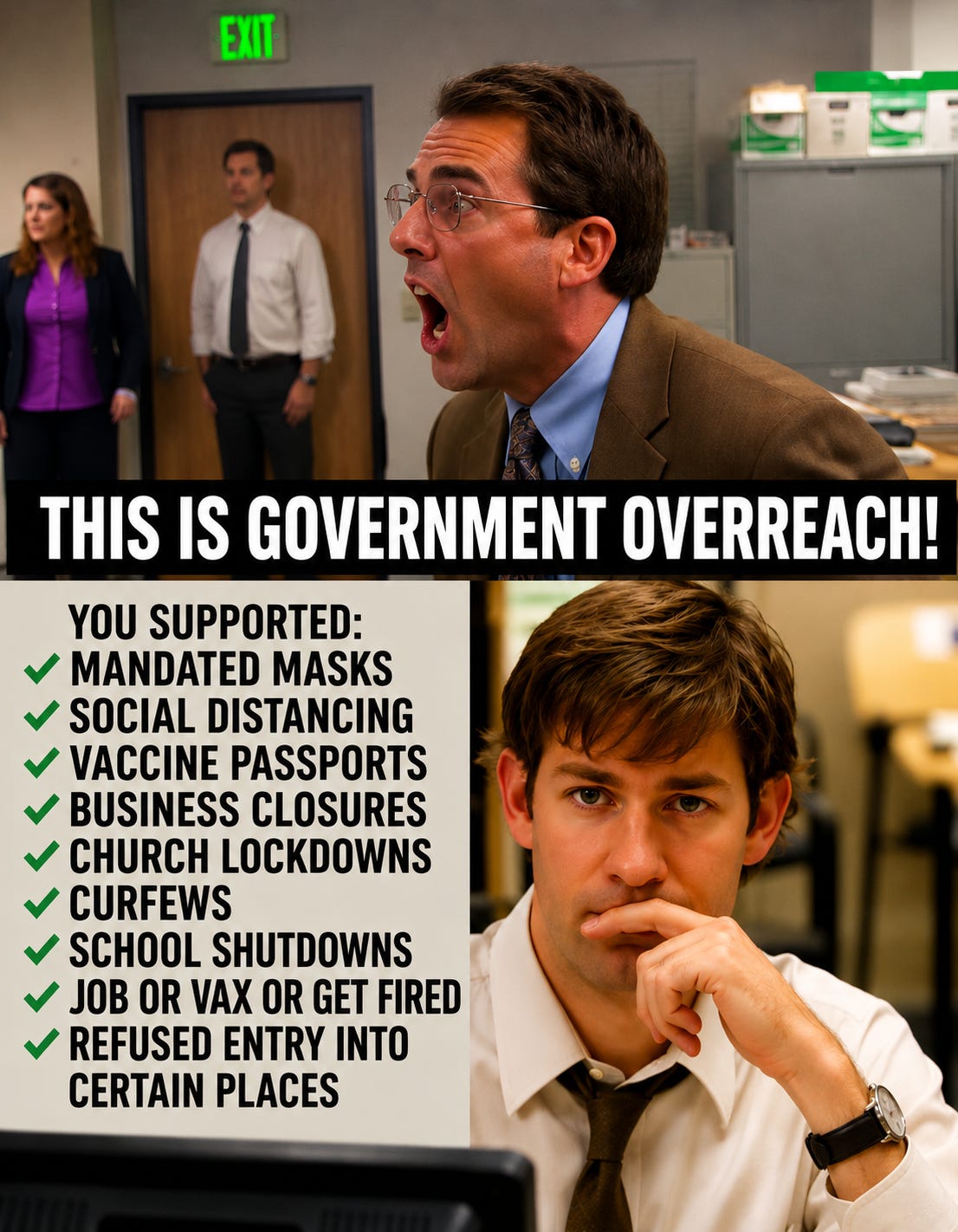
That sounds alarming—especially that global uncoupling business, which sounds like something Gwyneth Paltrow would suggest for realigning your geopolitical aura—until you remember that political appointees don’t actually perform the science. They don’t run the experiments, collect the data, write the papers, or review the results. What they’re being given is oversight of where taxpayer money goes. The question isn’t whether politics will enter the process. The question is who gets to exercise judgment over billions of public dollars: elected officials accountable to voters or an unelected network of academics, bureaucrats, and grant recipients who have largely been accountable only to one another. One’s a funding process; the other is a roommate group chat with a Venmo button.
To be clear, the system these people are fighting to protect is the same one that spent decades distributing federal funds through the famous revolving door between universities, nonprofits, consultants, advocacy groups, and government agencies that all somehow kept concluding more money should go to each other. It funded endless conferences, reports, initiatives, partnerships, and awareness campaigns, many of which produced little beyond recommendations for additional conferences, reports, initiatives, partnerships, and awareness campaigns—like a sourdough starter that somehow learned how to feed itself. The people administering the system call this scientific stewardship. From the outside, it looks more like an incestuous little gift exchange.
“The newly proposed regulations specifically require political appointees to fund only ‘gold standard science’,” the New York Times fretted (because apparently “Sorry, but you can no longer fund and publish junk,” is an offensive MAGA construct). “That is a reference to an executive order signed by Mr. Trump last year that prompted many researchers to express outrage about the politicization of their work and the attempt to undermine scientific independence.”

The uncomfortable part that none of the mainstream media can bring itself to print is that federal research funding was already political. It was just political in a way they agreed with. The NIH grant committees weren’t neutral. They were the same twenty people who’d been reviewing each other’s work for decades, sitting on each other’s panels, citing each other’s papers, attending the same conferences, and deciding which ideas were respectable enough to deserve funding. Cozy would be an understatement.
Especially amusing is the panic over language requiring grants to “advance American interests and avoid promoting anti-American values.” Read the coverage and you’d think the administration was proposing loyalty oaths and mandatory flag tattoos. In reality, critics are most concerned about losing funding for DEI initiatives, gender ideology programs, activist nonprofits, voter-registration campaigns, and a collection of advocacy organizations that reliably align with one side of the political aisle. Apparently asking whether taxpayer dollars should serve actual Americans rather than ideological pet projects is the right’s latest attack on democracy. Which tracks, in the sense that a shopping cart with three broken wheels tracks.

The old system gave us a pandemic where cheap generics got mocked and a drug so dangerously toxic it shut down entire trials was made the standard of care. It gave us eggs-are-deadly and ivermectin-is-for-horses and a food pyramid that made half the country diabetic. So please spare me the funeral for “independent science.”
And while you’re at it, spare me the shock that the same people who ran that system are now calling every attempt to fix it “fascism.”
DOGE audits a few line items and finds billions in fraud? Fascism. RFK Jr. wants to study whether vaccines and autism are connected? Fascism. Nick Shirley walks into an empty daycare with a camera and asks where the kids are? Obviously, fascism. Someone proposes that maybe—just maybe—the people voters actually elected should get a look at what the NIH has been funding all these years? You guessed it: fascism.
The pattern is as predictable as a Hallmark Christmas movie. The grift gets exposed. The grifters call the exposure political persecution and issue a press release. The media runs the press release verbatim. And anyone who points any of it out gets their steak dinner revoked.
As always, LMK how you voted in the comments!
Better question:
Why does “federal research money” exist at all?
It should not.
It is exactly because 1) we have the obfuscating federal reserve, 2) lack the requirement for an annually balanced budget, and 3) have confiscatory taxes in the double-digits, that they were able to run up a $39 trillion debt, most of which went to grift, theft, and pointless programs that don’t benefit anyone.
We need to get back to none of the above, get taxes under 5%, and reassess what’s truly necessary to run a country.
I was told that my ex-husband never paid his taxes.
Perhaps he was smarter than I ever thought he was.