

I’m old enough to remember when a 7-11 Big Gulp was actually big; when the idea of a thirty-two ounce soda was more ridiculous marketing stunt than excessive thirst-quencher. I mean, nobody was going to drink that much carbonated sugar water in one sitting, were they?
Hahahahaha the ‘70s were cute.
Within a decade, we had the Super Big Gulp (44 oz), followed swiftly by the Double Gulp (64 oz), and eventually—because moderation has never been our national superpower—the Team Gulp (128 oz), which as of this writing is considered “the largest fountain offering in the world.” We see people lugging around Stanley cups that look like someone glued a handle to the office water cooler jug and don’t bat an eye. If it fits in the car’s cup holder, it barely qualifies as a beverage anymore.
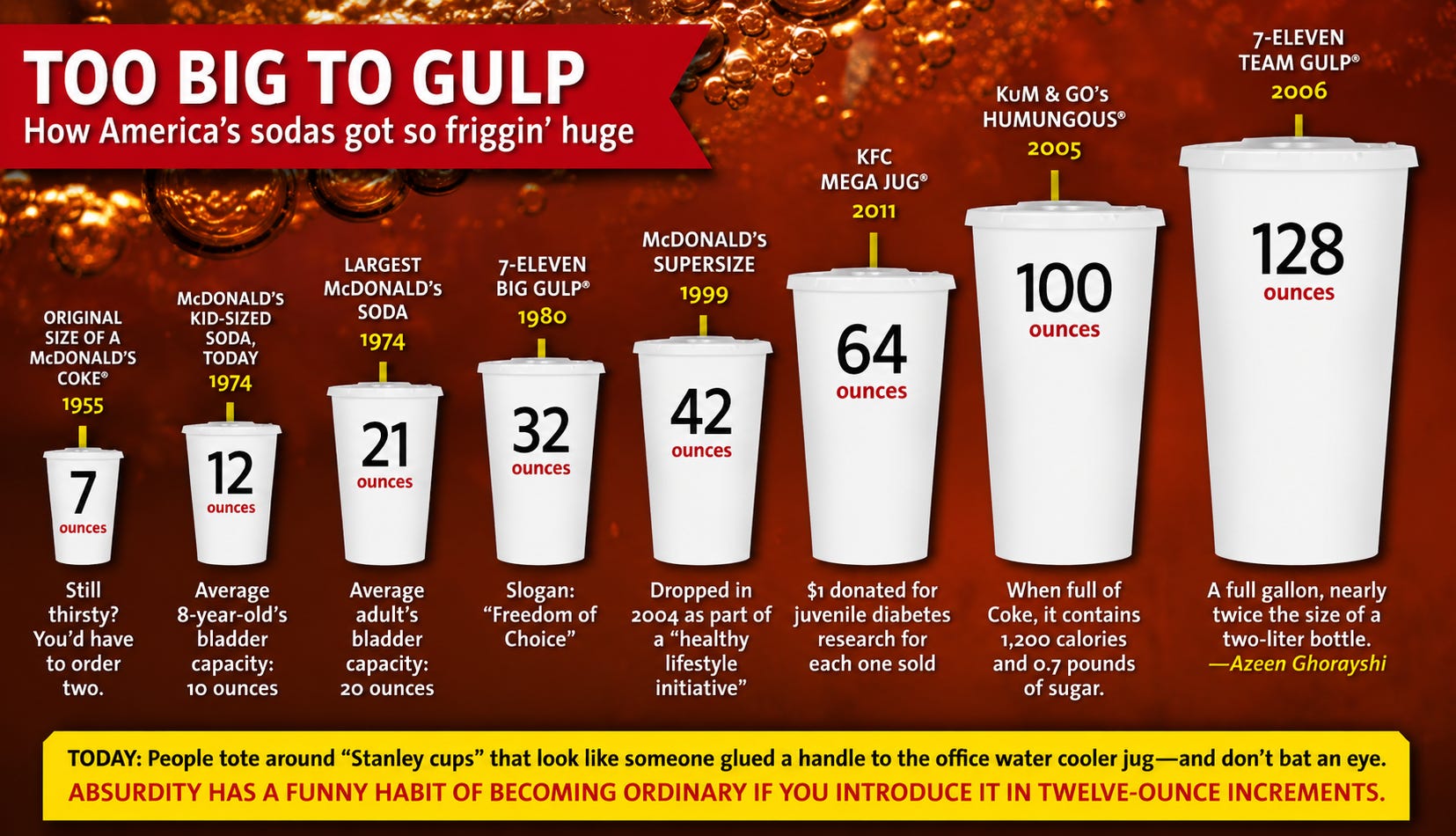
Absurdity has a funny habit of becoming ordinary if you introduce it in twelve-ounce increments. After all, nobody announced the gallonification of soft drinks in advance. There was no national press conference. No executive stood behind a podium and said, “Good afternoon. We’d like to inform you that our definition of ‘ridiculously large’ has increased by another 37 percent.”
The standard just shifted. Slowly. Incrementally. And everybody adjusted.
In case you hadn’t realized it, the news cycle works basically the same way.
There was a time when a hurricane warning was alarming. Then it had to be a historic hurricane. Then a once-in-a-generation hurricane. Then a civilization-threatening hurricane making landfall in a rapidly intensifying pattern while a deadly storm surge slams a vulnerable coastline. I mean, if it’s not way bigger and scarier than last year’s armageddon cyclone, how are you supposed to get anyone to care?
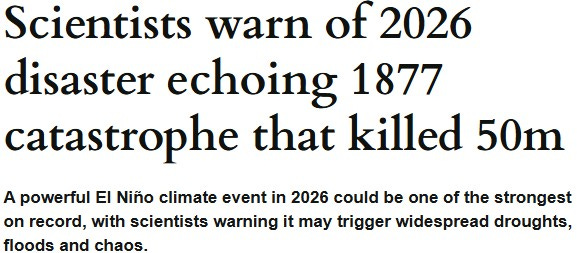
In the past few weeks, virtually every major news outlet has run some version of the same story about El Niño, the wind-driven phenomenon that temporarily warms the Pacific Ocean and disrupts weather worldwide. But make no mistake: this isn’t your mother’s El Niño—this is a Super El Niño, the likes of which we haven’t seen since 1877 when a similarly calamitous weather event wiped fifty million people off the map. Fifty. Million. That’s a lot of people. I’m surprised they didn’t name this one a Trenta El Niño or an XXX-Treme El Niño.
*LATE BREAKING ADDITION*
I just found one article that dubbed this year’s event a “Godzilla El Niño,” which I admit does have a theatrical, God-summoning ring to it.
Most El Niños come and go with relatively little fanfare. Think of a typical one as a toddler throwing a tantrum; a Super El Niño is when he flips the dining room table on the way out. The designation is generally used when Pacific temperatures climb by more than 2°C, which can cause droughts, floods, crop losses, and other agricultural disasters. But so can a regular El Niño, a La Niña, or no Niño at all. Nevertheless, every bit of current coverage feels like it was focus-grouped by a committee whose only instruction was: “Can we make this sound more like the Book of Revelation?”

Before you cancel your summer travel plans and start hoarding bottled water and ramen again, it’s worth considering what else was true in 1877. Germ theory was new enough that most doctors still weren’t sure whether washing their hands between plague patients was strictly necessary. The telephone had just been invented and required a human switchboard operator and a dedicated power supply. The average life expectancy in the United States was around forty years. Irrigation was a bucket and a prayer. There were no early warning systems, no weather satellites, no international food aid infrastructure, no synthetic fertilizers, and no refrigerated shipping. The global response to a crop failure was essentially: good luck.
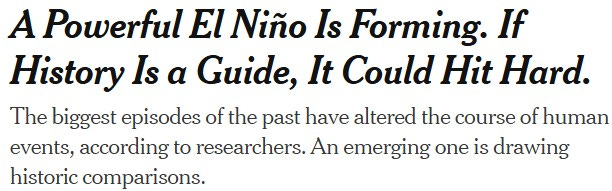
Today we have oceanic sensors that track El Niño in real time. We have advanced detection systems that give governments months of advance warning. We have international humanitarian organizations whose entire purpose is responding to exactly this kind of cataclysm. At some point in nearly every article, the author admits—usually in paragraph twelve, after twenty-two reading minutes of prolonged droughts and fertilizer shortages and global catastrophe—that “a large-scale famine is not anticipated.”
Hilariously, 1877 wasn’t the only or last Super El Niño humanity has survived. We had one in 2015 and maybe I was busy trying to figure out what to make for dinner every night for the rest of my natural life, but I don’t remember a planet-wide famine or stepping over dead bodies on my way into Trader Joe’s.
Probably the headlines should read: Thing That Exterminated Millions Back When We Had No Tools to Deal May Happen Again And Also We Now Have Tools To Deal. Otherwise, they’re roughly equivalent to warning people that cholera still exists and can be fatal (it does and it is) without mentioning that we no longer drink from the same river we dump our sewage into.

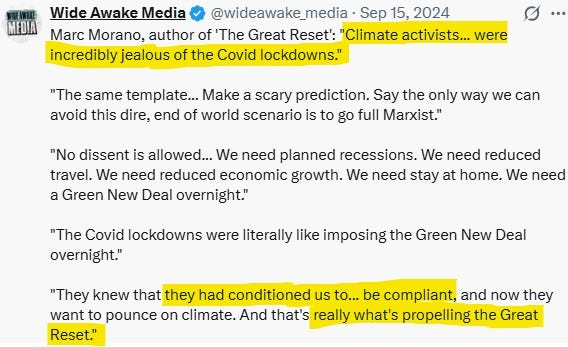
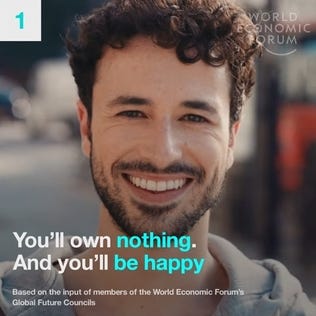
If you were the kind of person who keeps a corkboard full of red string and suspects that somewhere in Davos there’s a binder labeled “Agenda 2030” with a chapter called “You’ll Own Nothing and You’ll Be Happy”—oh, wait—you really couldn’t script a better setup than this.
Think about it. The UN crowd has spent decades conditioning the public to accept that every weather event is an increasingly dire five-alarm apocalypse. Every storm is unprecedented. Every heat wave is civilization-threatening. Every El Niño is an unstoppable, radioactive, skyscraper-sized iguana hell-bent on destroying everything in its path.
They’ve trained an entire population to react to “climate emergency” the way they’d react to “active shooter in the building.” The language has been weaponized so thoroughly that questioning the framing doesn’t make you a skeptic—it makes you a conspiracy theorist. A science-denier. A threat to democracy.
The pump thusly primed, one day—it’s really just a matter of when—some slimy, billionaire, unelected technocrat with no actual knowledge of environmental science will stand at a podium and say, “Given the unprecedented nature of the current climate emergency, temporary restrictions on movement and consumption are necessary.” (Remember last year’s test run in Canada?)
And half the population won’t flinch. Because they’ve been drinking from the Double Gulp of climate alarmism for decades. Twelve-ounce increments. No shock. Zero awe. This is just where we are.
The beautiful part—and I mean this sincerely, not cynically—is that it probably won’t work. Because here’s the thing about people who’ve watched the boy cry wolf through half a century of “once-in-a-generation” doomsday scenarios that turned out to be bad weather with a PR team: eventually you notice the pattern. You realize that the same agencies that spent the 1970s warning about a coming ice age, then pivoted to global warming, then rebranded to climate change, then upgraded to climate emergency, then launched full-scale existential climate crisis mode are the same people who told you margarine was heart-healthy, eggs were killing you, and Covid vaccines were safe and effective.
The institutions that can’t get a weekend weather forecast right want us to trust their hundred-year climate models with absolute certainty. The modelers who call for light rain right before an entire region gets power-washed off the map expect our blind and enduring trust. The same experts who lie to our faces about the existence and impact of chemtrails want us to believe their meteorological science is beyond question. You’ll forgive us for checking the fine print.
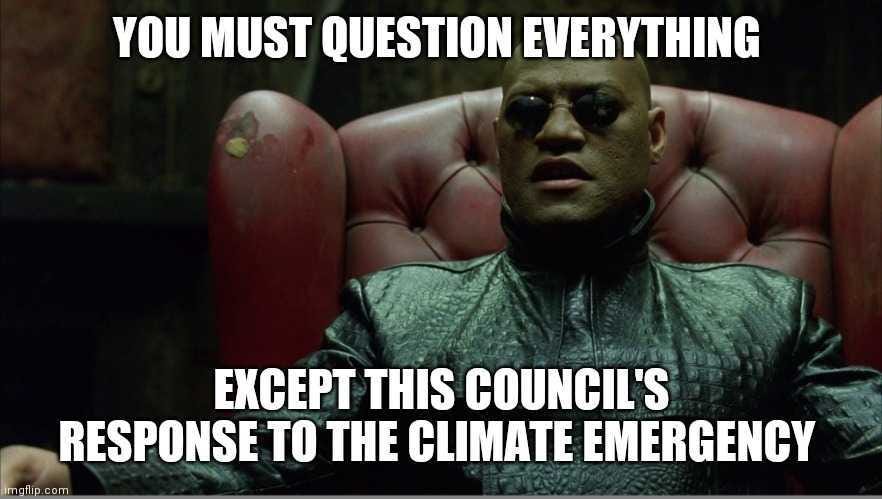
This isn’t apathy. It’s not partisan. It’s just that after years of emergency declarations, contradictory guidance, expert reversals, censorship battles, and endless catastrophe marketing, you start to treat apocalypse warnings the same way you treat extended warranties: like somebody is trying to sell you something.
Excuse my Climate Change skepticism but, this feels like a Gain of Function El Nino is on the way.
“…you start to treat apocalypse warnings the same way you treat extended warranties: like somebody is trying to sell you something.” The ones who are actually paying attention (because they read Jenna’s Side and Coffee and Covid 😜) know that they probably are.
Bad ass, Babe. 🤬🍑😘❤️