

If you’re the type of person who feels uneasy about the ever-increasing surveillance state we live in, congratulations. Because while your friends were gently teasing you about being paranoid, Israel was apparently busy hacking into Iran’s street cameras—the ones installed to monitor the public and enforce compliance—and using them to find and eliminate the very people who put the spy system in place. Which is not, from a design or security perspective, ideal.
(Is it exhausting being right all the time? Asking for a friend.)
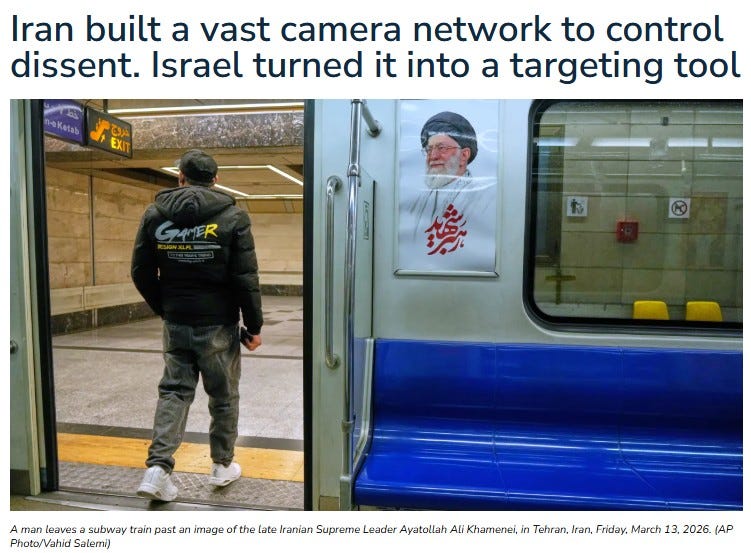
It’s a terrifying thought. After all, Iran is not some digital outlier under extreme scrutiny. Here in the U.S., we’ve got cameras in classrooms, at checkouts, on intersections, outside stores, inside elevators, in neighborhoods, on front doors, over our babies’ cribs, in parking garages, on our computers, in our hands, and sometimes strapped to our faces virtually 24/7. We are, at this point, a species that has collectively decided to film itself from every conceivable angle and then upload it to the cloud like that’s a completely neutral decision with no possible downstream consequences.
We’re cute.
What’s funny (in the way a carbon monoxide leak is funny) is that the Continuous Tracking™ brochure frames our nonstop documentation as a feature. A security upgrade. Another way to keep us “safe.” It was bad enough when we only had to worry about what our own corrupt government was doing with all of our data; now we’ve got to plan around hijackers, too?

With all due respect, of course we do! On what planet is “if you’re wearing a KICK ME sign, someone’s going to take you up on it” a shocking revelation?
Because in reality, we’re not talking about some elite, impenetrable, sci-fi surveillance grid here. We’re talking about millions of internet-connected cameras—many of which are, according to actual cybersecurity experts, “trivially easy to hack.” As in: not Ocean’s Eleven. More like your nephew after two YouTube tutorials.
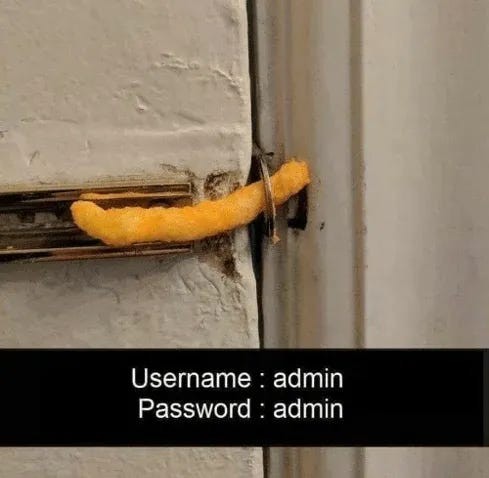
What’s almost impressive—in a deeply concerning way—is how often unauthorized access doesn’t involve some sophisticated, high-tech tool or elite-level training. Instead, it relies on something both simple and abundant: laziness. Outdated software. Default passwords. Permissions handed out like party favors. Entire networks of cameras basically sitting there like, “Hi, welcome, please enjoy this live feed of everything.”
“Companies have advertised cameras hooked up online, accessible with cellphones, with feeds easily diverted by hackers,” NewsNation wrote. “Many are installed with minimal security by unsophisticated users who fail to set up passwords or install security patches. Securing cameras takes constant vigilance, but hacking them takes identifying just one exposed vulnerability, such as an outdated system or a generic password like ‘1234.’
One expert literally described vulnerable feeds as “fish in a barrel,” which is not the phrase you want associated with your national security strategy.
And just to make things extra efficient for the cyber intruders, we’ve layered AI on top of all of it, so instead of being forced to painstakingly review footage for weeks, now anyone can just… search it. Instantly. People, patterns, vehicles, routines—pulled up like you’re summoning a restaurant reservation.
In other words, this isn’t just a wartime problem. This is a “we built a global, always-on, poorly secured camera network and then acted surprised when someone used it” problem. War just happens to be the moment when the stakes got high enough that everyone suddenly noticed.
The issue isn’t that cameras exist. At this point, that ship has sailed, circled back, and installed three more cameras on itself. The issue is that once the system is in place—once everything is recorded, stored, and searchable—you don’t get to decide who ultimately accesses it.
Which brings us to the part where everyone starts wondering what, exactly, we’re supposed to do with this information. And the answer is: probably less than your most anxious instinct is telling you (throw your phone into the nearest lake and move to a yurt in the forest), and slightly more than your most relaxed instinct would prefer (tell yourself, “I’m boring, nobody’s watching me.”). In other words, it’s less panic immediately and more maybe don’t set your password to password and call it a day.
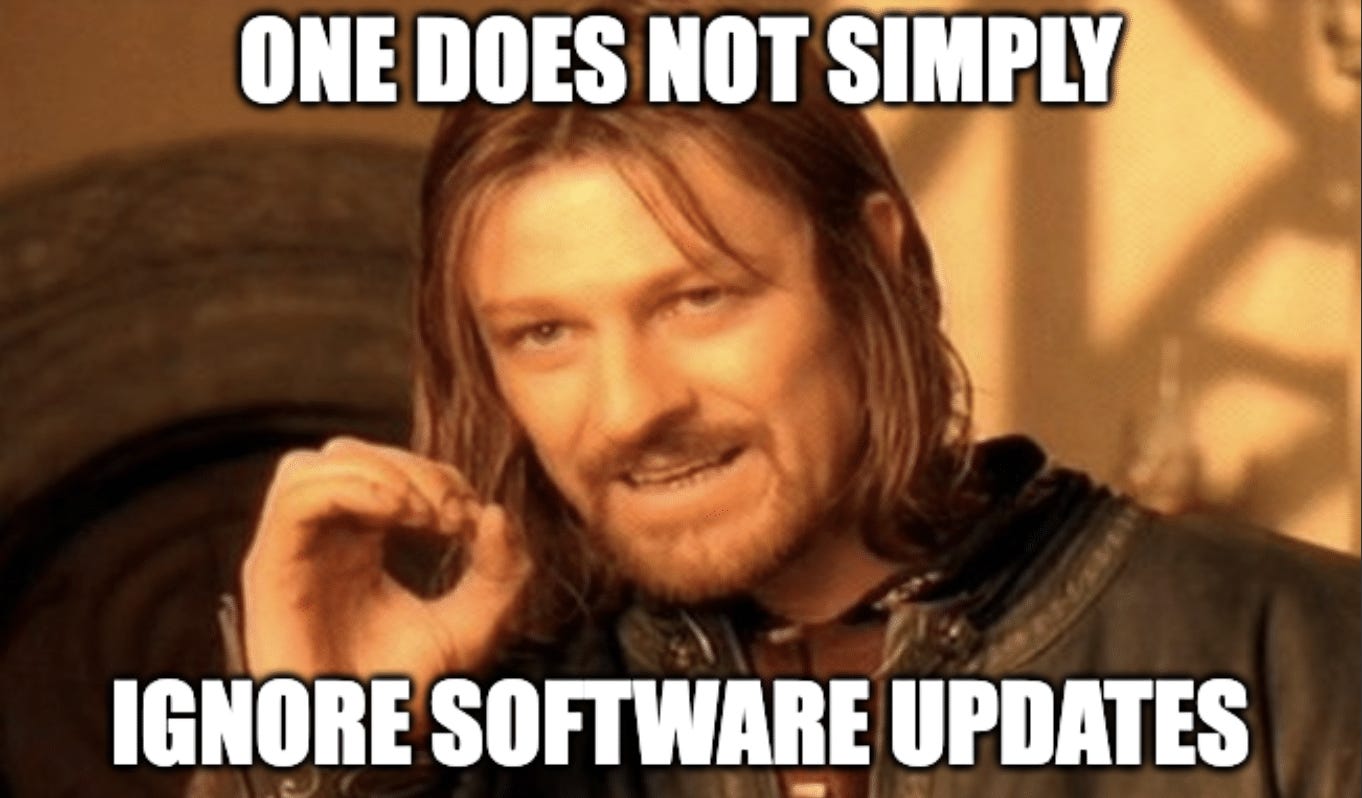
You don’t need to install a moat and fill it with alligators to protect your home—you just need to not be the easiest house on the block to break into. Putting up a few motion lights, closing the garage door, and not “hiding” a spare key under the doormat will likely send ninety-nine percent of perps looking for an easier target. Your digital life isn’t all that different. If you leave the front door unlocked, don’t be surprised when someone lets themself in.
So, yeah. Cover your camera when you’re not using it. Suck it up and set up the annoying two-factor authentication. Take five minutes and see what apps actually have access to your camera and microphone. Update your security software like an actual grown-up. Replace that password you’ve used 2,386 times since 2004 with something that’s not your dog’s name or your date of birth. Stop clicking “allow” like it’s a SKIP TO RECIPE button and ask yourself if the app in question really needs to know your location. Try to be just a little less… hackable. You’re not paranoid; you’re paying attention.
As always, LMK how you voted in the comments!

lol I wish I could just throw my phone into a lava pit! My modern day IT job has me on a digital leash.
Data is and has been the new oil for a very long time. Default and weak passwords are just the tip of the iceberg. If a product and/or service is not designed with security in mind, then it will undoubtedly be hacked. These flock cameras that are popping up all of our cities are accessible to anyone and everyone who is curious enough to try accessing these devices. https://youtu.be/vU1-uiUlHTo
The best thing to do, if you haven't already fallen into the convenience trap, is to use little to no smart devices in your house, car, and on your person. If the device is accessible to the internet, then it has the potential of being compromised. Ring cameras, front door locks, baby monitors, nest devices, Google devices, alexa devices, smart watches, smart TVs, smart whatever, etc. Smart is just a synonym for hackable.
The plan is to put us into a digital prison with the help of these huge datacenters and the use of AI. Project Stargate is Project Prisongate. The less data that you give to these systems, the better. At this point, it seems almost impossible to stop, but it can be with massive non-compliance. Say no to the Real ID, stop letting TSA and other agencies take your pictures, remove the digital internet connected front door lock that you were crazy enough to put their in the first place, and stop feeding these cloud environments all of your data in the form of pictures, videos, and browsing history. Massive non-digital compliance Rosa Parks style! Let's go!
Turning their camera technology against them is on a par with their "safe" pagers blowing up in their faces (and hands, and guts) only more lethal. Let's see. . . what other technology in our world can we think of that could turn against us? Hal? Hal, are you there?