

Craig Spencer is an associate professor at Brown University School of Public Health in Rhode Island and a self-described “pro-vaccine clinician.” That’s honestly probably all you need to know about him, but I’ll go ahead and add that his writing has appeared in outlets including The New York Times (“We May Have Only a Few Months to Prevent the Next Pandemic”), The Atlantic (“The Diseases Are Coming”), and The Washington Post (“What It’s Like Being a New York ER Doctor During the Pandemic”), and that his professional expertise includes global health, humanitarian response, and pandemic preparedness. Because of course it does.
This week, STAT News ran an essay by Dr. Spencer, who clearly thought he was embarking on a brave act of field journalism. In it, the Good Samaritan recounts his daring journey into the Children’s Health Defense ‘Moment of Truth’ conference in Austin this past weekend—a gathering of the medically unwashed, the data-defiant, and, apparently, the deeply misunderstood.
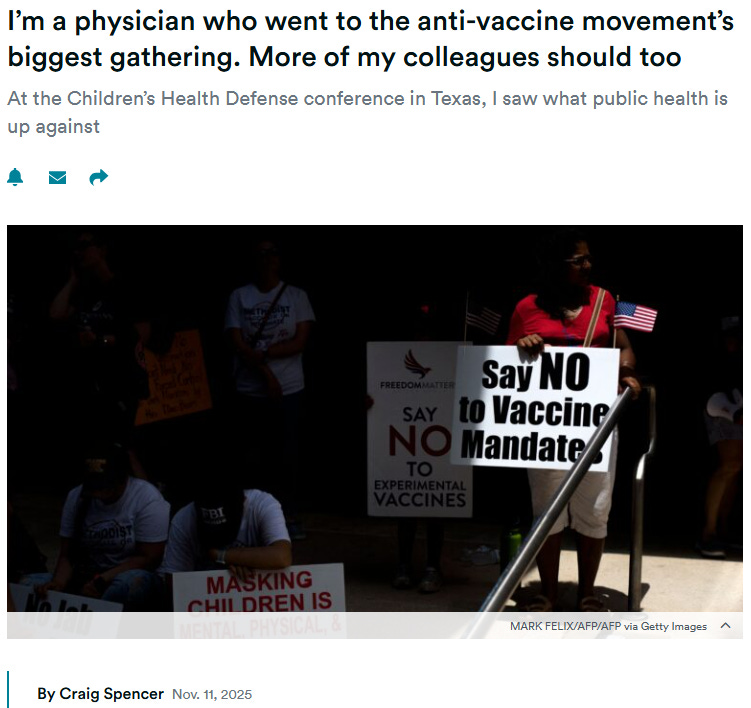
An earnest but baffled Spencer entered the event like Jane Goodall wandering into a jungle of the unboosted, clutching his N95 and a trough of preconceived notions. He came “out of curiosity,” he explains, as if he were visiting a remote tribe that still barters with ivermectin. And yet somehow, despite his anthropological bravery, he managed to miss the entire point of the pep rally.
“As I stepped into line to pick up my badge for the Children’s Health Defense (CHD) conference last weekend in Austin, Texas, a gregarious man approached holding two tall plastic tubes he said contained ‘clots’ from Covid vaccinated bodies,” Spencer says by way of an opening. “After 36 years in the Air Force, he told me, he’d been pushed out for refusing the shot. Now in retirement, he calls funeral homes and surveys undertakers to document alleged vaccine harms.”
He’s obviously talking about Tom Haviland, regular reader Laura “Clotastrophe” Kasner’s partner in (exposing) crime. Was Spencer shocked by the clots? Overcome with curiosity? Prompted to ask any follow-up questions? Nope. Ostensibly he just blinked politely, scribbled “alleged” in his notebook, and moved on with the nonchalance of a man who’s just been handed the Ark of the Covenant and decided it was a knockoff.

Spencer notes, with dutiful alarm, that the first speaker (Del Bigtree) proclaimed “God is an anti-vaxxer,” and another (Gavin de Becker) proudly declared, “Ich bin ein antivaxxer.” It’s shocking—almost like people have stopped apologizing for being skeptical of an industry that’s been manufacturing and monetizing disease and calling it healthcare for decades.
The author’s real gasp moment came when a grieving father showed photos of his daughter who died “after contracting measles.” Spencer carefully mentions that she was unvaccinated—because that fits the narrative—but conveniently skips over any actual details about her death and the drama that surrounded it. Complications? Conflicting opinions? Context? Nah. She’s a prop in his morality play now. (Also, if I died tomorrow, it would be technically true to say I died “after being vaccinated for measles.” In nineteen seventy-one. Could one of my survivors please make sure that makes it into my obituary? Thanks in advance.)
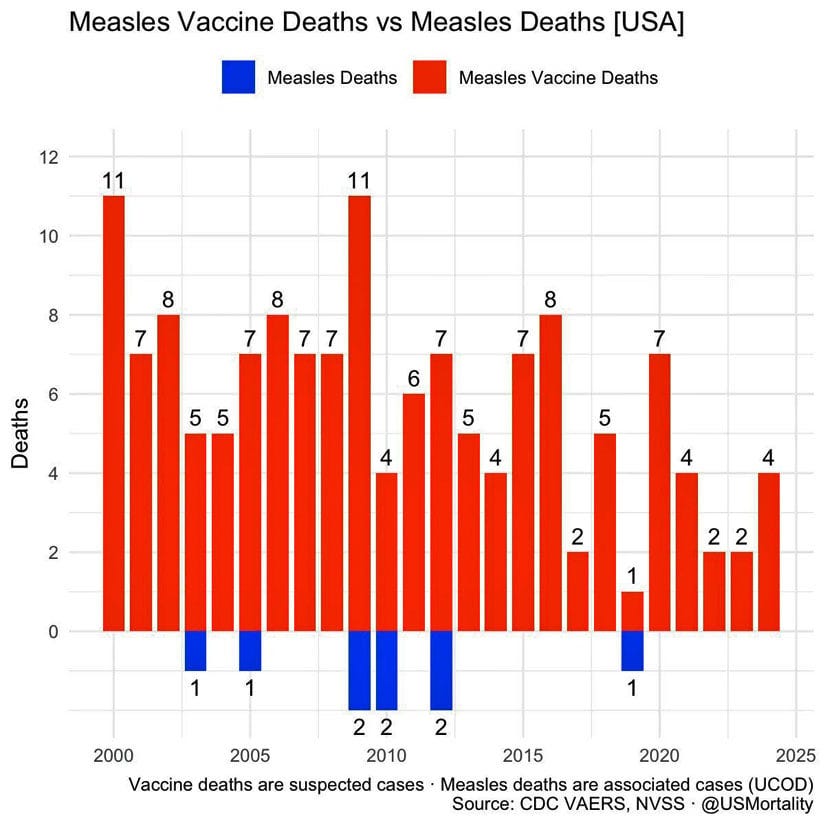
Spencer describes the crowd as “older, mostly white, and very energized.” Cute demographic breakdown (although he spelled “out-of-touch, privileged boomers” wrong), but he left out a key descriptor: not buying it anymore. These people aren’t fringe conspiracy theorists; they’re his former patients, his colleagues, his neighbors—the ones who remember when science wasn’t a subscription service. He calls the CHD mission “a movement in ascendence,” as if it’s Heaven’s Gate having an especially successful membership-drive month and not exactly what happens when the public health establishment moonlights as Big Pharma’s pimp.
If there were a Least Self-Aware Person on the Planet Award, this guy would give Bill Gates a run for his money.

My favorite part of the essay—one that could only come from a man who wears institutional arrogance like cologne—is this gem: “For the scientists and officials they accuse of causing an endless litany of health harms, there were no olive branches on offer… no attempt to reach across the aisle.” First of all, I’m guessing CHD didn’t expect many folks like Spencer to show up demanding absolution. And second of all, no attempt to reach across the aisle? When one side has been firing doctors, censoring studies, forcing compliance, ignoring the injured, and gaslighting bereaved parents for the better part of the pandemic, I’m pretty sure we’re light years beyond white flags and awkward reconciliation selfies. What exactly does he expect—the people he’s made a side-gig out of calling dangerous lunatics to invite him over for tea and budesonide?
Note to Spencer: Your side already tried floating the pandemic amnesty idea. Remember? That whole golly-we-were-all-hoodwinked-weren’t-we-so-let’s-just-forgive-each-other-and-have-a-nice-group-hug appeal that showed up unexpected and dripping in liberal denial? It was not well-received. (Also, no way! The author of that piece is your colleague at Brown? The serendipity of it all!) You don’t “reach across the aisle” when the people on the other side are still holding loaded syringes and have yet to apologize for maiming your boss or murdering your best friend. That’s not bipartisanship; that’s Stockholm Syndrome with better PR.

Spencer says that although “the roller coaster rhetoric resonated with the nearly 1,000 people packed into the sprawling Marriott ballroom… the conference lacked data.” No, Craig. The people who were there are the data—the injured, the censored, the silenced, the fired, the grieving, the gaslit, the ones your camp likes to pretend don’t exist. Also, I’m sure Brownstone Fellow Jessica Rose, PhD, MSc, BSc. (who has five post-secondary degrees in Applied Mathematics, Immunology, Computational Biology, Molecular Biology, and Biochemistry) didn’t bring any facts at all, and Karl Jablonowski, PhD’s presentation on the “alarming rise of turbo cancers” was a live version of one of those fluff pieces you’d see in People—sandwiched between ‘10 Ways to Feel Grateful’ and ‘The Pandemic Made Me Love My Air Fryer.’
“In addition to pushing to change policy, CHD has shown itself adept at using media to evangelize its message,” Spencer writes. “Anyone following the organization’s social media quickly recognizes how well-organized it is, offering interviews on its platforms nearly every day. Polly Tommey, the CHD.TV program director and producer of the viral anti-vaccine video ‘Vaxxed,’ reminded everyone in the room, ‘We have to become citizen journalists … we need to become the media.’ This strategy is already paying dividends for CHD.”
Hahahahaha using media to evangelize its message? The collective press corps has dedicated a grand total of zero minutes and not a single column inch of coverage to CHD’s events, lawsuits, or reporting. And the daily content dig? He might as well have written, “For a bunch of redneck tractor dads and essential oil evangelists, they’re remarkably prolific and professional.”

If you really want to get a good laugh, get a load of this paragraph:
“At the conferences I typically attend, microphones are set up around the room or passed among attendees before panels end. But not at the CHD conference. Though speakers implored us to ‘question everything,’ there was never a chance to ask questions. But there didn’t need to be. Everyone in the room seemed united in purpose.”
The irony apparently lost on our intrepid observer is that the CHD audience has been asking questions—loudly—for years. That’s the whole reason they were there. He frames their “unity” as proof of messianic conformity, when his entire existence is based on bowing to the church of consensus. The whole paragraph reads like a man who went looking for a cult, found a community, and decided to call it hypocrisy because nobody asked for his opinion.

I’ll give the guy this much credit: He realizes that RFK Jr. is popular because people see him as a truth-teller, and insists that public health needs to “reclaim [RFK-level] moral authority.” The part he patently doesn’t grasp is that moral authority isn’t something you recover like a lost luggage tag; it’s something you earn—you know, by not lying, shaming, or threatening people’s livelihoods over their medical choices.
Until then, Craig, no one’s signing up for your “rebrand trust” tour—least of all the people who had to build their own media just to be heard. After two full days surrounded by doctors, parents, and scientists explaining exactly why they no longer have any faith in your institutions, the only thing you seemed to learn was, “Holy crap, we underestimated these people.” You didn’t meet the fringe—you met the fallout. And you still think the problem is “messaging.”

Hi Jenna, thanks for sharing my piece with your readers!
And honestly this was hilarious. You might be surprised to know we feel very similarly about many things.
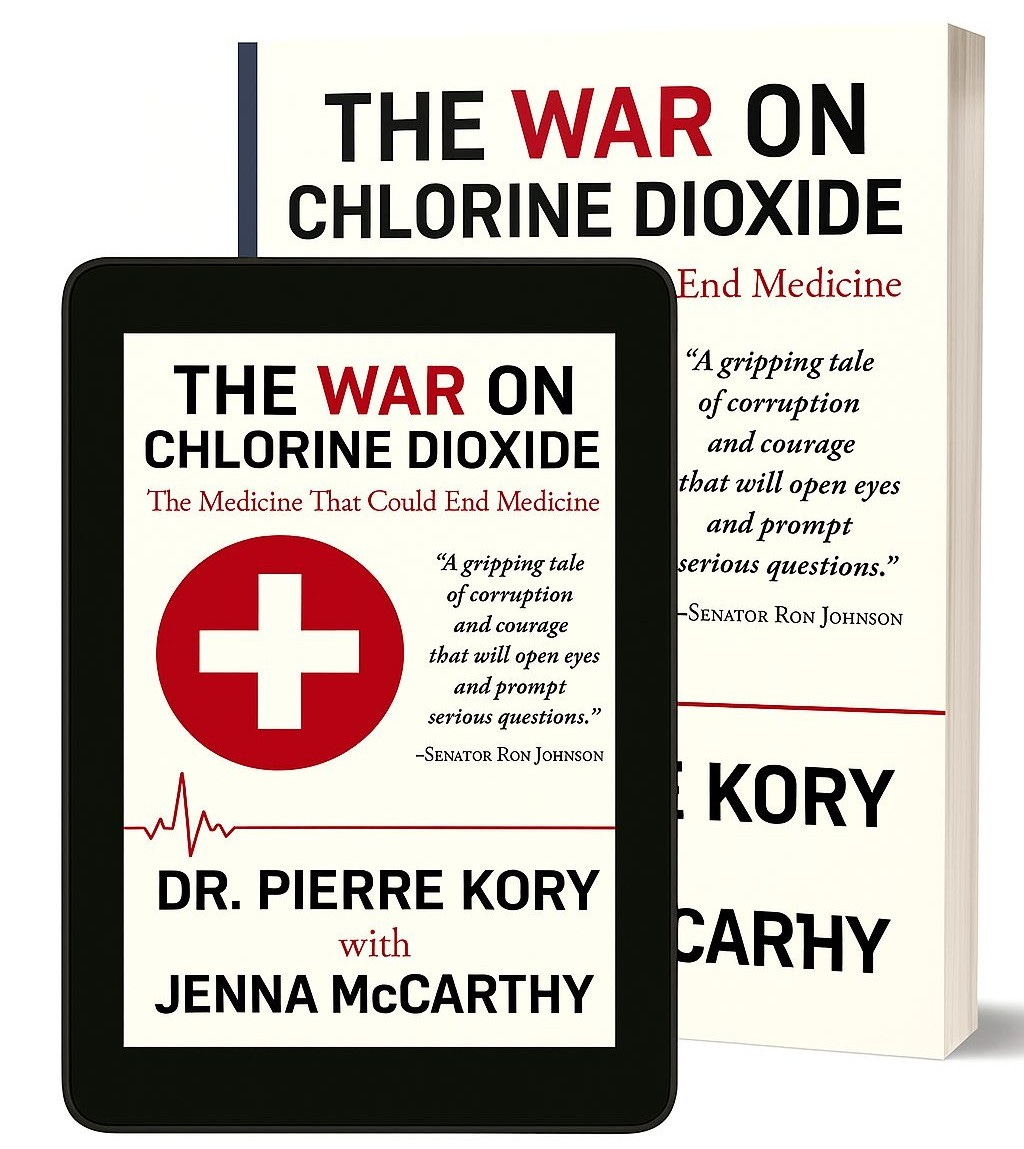
I also wanted to point you and your readers to a conversation I had with Pierre Kory and Bret Weinstein while at CHD. It’s on the Why Should I Trust You? podcast. Bret called it “great” and “productive”. Pierre said “We need more conversations like this.” If you have trouble finding it, it’s pinned to Pierre’s Twitter profile.
Tom Haviland makes me so proud 💪💪💪💪💪💪💪
Craig’s article made me realize something. They have no idea the power we have and the minds we’ve changed. And NO ONE is going over to “their” side. Our ranks are growing. And I want to assure everyone here, we are WINNING.