

I’m old enough to remember Google when it was, well, the best thing since the internet. Before that, if you wanted to locate a piece of info on the ever-expanding World Wide Web, you had a host of mediocre search options. My go-tos were Excite (like a toddler; colorful but not great at finding things), Yahoo (excellent if you needed nothing more complicated than a phone number or an address), and Ask Jeeves (novel and made ‘ya feel fancy—“I’ll just ask my British servant, please hold”—but super short-lived because the Q&A format was clunky and inefficient and not at all keyword-friendly).
And then along came Google—the Lamborghini of web crawlers. She was sleek and sophisticated; simple to run; a joy to navigate. She got you exactly where you wanted to go, every time. And boy, was she fast.
Unfortunately, she started falling apart before we even drove her off the lot.
Before long, that shiny Lamborghini had morphed into a dull, self-driving Prius that locked the doors and then decided where it thought you should go. Instead of showing you a full map of the messy, glorious internet, it began handing you neat little TripTiks with only curated stops (approved by the Dashboard Dictators), scrubbing entire destinations right off the atlas, and slapping a “results are changing very quickly” detour sign on anything remotely controversial. Google went from “I’ll take you anywhere” to “We’ll let you know where it’s safe for you to go, sweetie.”
If only that was as bad as it was going to get.

Now, Google is rolling out AI Mode—a flashy new feature that replaces your familiar, old-fashioned buffet of blue links with a single, “conversational” answer. Sure, it might be sprinkled with two or three links—but you’ll ignore those because the “answer” already gave you what you came for. It’s basically ChatGPT—but with even less accountability and all the charm of a chatbot that just went through a corporate compliance seminar.
And if you’re a news site, a retailer, or anyone else whose business depends on people clicking on your link? Well, good luck, because Google just built a velvet rope around their content and decided you can stand outside. Want traffic? Sorry. Maybe try TikTok?
The cherry on this dystopian sundae: They haven’t even decided how authentic or legitimate their single response is going to be.

Translation: “We’ve built a machine that answers your questions with one tidy paragraph… but don’t bother asking if it’s accurate, unbiased, or complete. If you search for ‘best chocolate soufflé recipe,’ we will give you… something. Could be the result of complex data mining, could be an ad. Don’t like it? Build your own search engine.” Somewhere out there, a food blogger is crying into her ramekins, mumbling, “I used to be somebody on page one.”
The impetus for this revolutionary dumbing-down of a once mighty search tool? As Rosa Curling of Foxglove put it: “What the AI summary now does is makes sure that the readers' eyes stay on the Google web page.”
Rhetorical question: Who’s just hanging around Google for shits and giggles?

Indeed, a Pew study found that web users only click a link once every 100 searches when there’s an AI summary at the top. One in a hundred! So if your business depends on traffic from Google? Sorry, kid, your website just got relocated to a ghost town with a virtual Starbucks.
Here’s the most terrifying aspect: Google will even decide what it is you’re searching for for you (and then refuse to let you search anything else). Case in point: THIS SUBSTACK. I searched simply “google ai mode” to see what news stories it would produce; it automatically and persistently deferred to “Google launches AI mode for search in the UK” and would not cough up any results that weren’t specific to the UK.
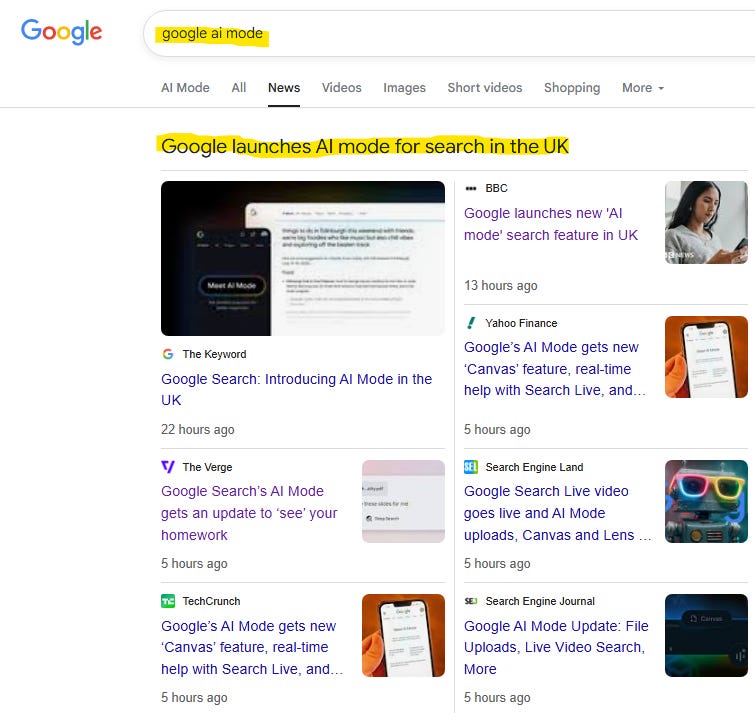
With ChatGPT, at least, you can argue. You can call it (her? him? have we decided?) out for bias and as often as not, it will acquiesce and apologize. With Google AI, not so much. It’s not a discussion, it’s a sermon. A vending machine that only serves lukewarm Diet Dr. Pepper. A last-call clearance sale: one size, one color, no returns.
Here’s another real-world example of Google AI in action: Out of morbid curiosity, I typed in simply “Bill Gates.” Now, I’d imagine that even Google knows that there’s some controversy swirling around our buddy Bill. (He’s been accused of questionable conduct with employees, his company was literally found guilty of running an illegal monopoly, he had an undeniably shady relationship with Jeffrey Epstein, and he is currently being sued in a Dutch court for misleading the public about Covid vaccine safety, to name just a few examples.) So if an internet aggregator were going to provide a single page, balanced synopsis of the man, you’d think that some of that might warrant even a tiny, passing mention. Alas, it does not.

And even when you lead the witness, it redirects you to Gates’ own website as irrefutable proof of his bottomless virtue and integrity.

From the looks of it, there’s nothing Google AI can’t do (except converse, concede, or self-correct). Students can upload photos of their homework and it’ll help “dig deeper into what they’re learning.” It has a “live search” function where you can point your camera at anything you’d like and get more info about it, because that’s not scary or invasive. There’s “help me shop in AI mode” (for people who are just really, really bad at picking out and paying for things, I guess?), and the scariest one of all, their experimental Project Astra, which “allows the company’s AI chatbot to ‘see’ everything in your camera feed, so you can have an ongoing conversation about the world around you—asking for recipe suggestions based on the ingredients in your fridge, for example.”
For example.

Oh, and all of this digital digging and regurgitation requires massive data centers that use up power and water at a scale that could probably cool three planets. But don’t worry. Google says it’s “committed to sustainability.” (And Bill Gates is “committed to global health.” Gotcha.)
For now, in most countries, AI Mode is optional and appears both as a tab and an option within the search box itself. But we all know how quickly choices can be taken away. If AI Mode becomes the default, Google Search becomes a single-answer oracle that controls what everyone sees—and, crucially, what everyone doesn’t. We’re one step away from this:
Q: Hey Google, show me a dissenting opinion.
A: Sorry, your search violates our community guidelines.
I know Jenna’s Side readers are already wise to the fact that Google is basically a compromised swamp creature in a server farm and have long since defected to alternative browsers. I still use it occasionally—not for real research, but for “research” as in, “What would a person who still trusts Google and probably thinks Snopes is a legitimate source see if they typed this in?” (For actual searching, I’m a Yandex girl—sometimes Brave—but I’d love to know what my tribe is using.) Because as we inch closer to a full-blown, live-action reboot of Idiocracy, I think it’s important to know what we’re up against out there. LMK what you think in the comments!

😪 This is why my "Thymus Organ Removal in infants During Heart Surgery" pages are no longer visible on Google recently. They used to be at the top. Now thymoma articles pop up on people who have cancer...or Myasthenia Gravis. They don't even show the articles where adults who have their thymus removed for these conditions end up with immune defects. Its all about how great it is to have your vital immune organ taken from you.
You will own nothing…
(Not the right to choose your own search terms, not the right to choose your own search results, not the right to see our search criteria, etc.)
…and you will be happy.
(Really. We insist.)
(Points CBDC gun at digital wallet)
Now get back to digging. You haven’t met your lithium quota yet.