

Kyle Mattingly is a 28-year-old accountant in Kansas City, Missouri, who lives and breathes baseball. He’s the proud collector of more than 3,000 trading cards, can rattle off the batting average of every Major League player in history, and will happily explain the infield fly rule to strangers without being asked. Recently, Mattingly tried out for the KC Pee-Wees, the local elementary school league created expressly for the seven-and-under crowd. Cruelly, he didn’t make the cut.
“All my friends are on that team,” Mattingly told reporters, kicking at a clod of dirt. “It’s not fair. I just want to play my favorite sport.”
It’s heartbreaking. I mean, what’s next? Division I basketball recruiters refusing to even consider second-graders? The Boston Marathon banning electric scooters? NASCAR discriminating against blind drivers?
Oh, right. Competitive sports have rules. There are qualifications. Standards. Minimum requirements. That’s sort of… the entire point.
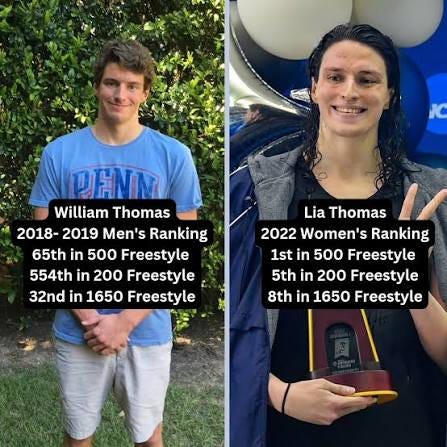
This week, the Supreme Court ruled that West Virginia may continue limiting girls’ school sports to… girls. The response from much of the media was exactly what you’d expect: another heartbreaking story about a transgender child who “just wants to be herself and play the sport she loves.”
The poster child du jour is Becky Pepper-Jackson, whom I will hereafter refer to as BPJ because I refuse to spend the next seven paragraphs playing Pronoun Twister. BPJ is a 16-year-old transgender girl (i.e. biological male) and—according to the adults who have made BPJ the public face of a federal lawsuit—“a leader in the fight for trans kids’ civil rights.” (While BPJ is quietly relieving cis girls of theirs. Peak leadership.) When the future “mostly peaceful” protest organizer was 11, legislators passed a law blocking biological males from participating in girls’ scholastic sports. BPJ sued the West Virginia State Board of Education, seeking to overturn the measure and compete on the middle school’s girls’ cross-country and track-and-field teams. Last week, the Supreme Court sided with the actual, assigned-female-at-birth girls.

Judging from the coverage, you’d think the court had ordered the removal of the tampon machines from the boys’ locker room or something.
I’m genuinely confused by the outrage. Nobody said Pepper-Jackson couldn’t run. Nobody confiscated any track shoes or outlawed wind sprints. The dispute wasn’t whether this student could participate in sports. It was whether s/he could compete in exactly one specific category whose defining criteria s/he did not meet. In a stunning act of common sense, SCOTUS said no.
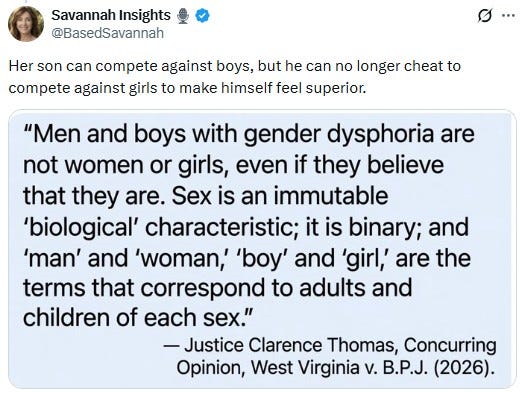
What’s never even hinted at—let alone acknowledged—is the fact that sports are built entirely around competitive categories. We separate athletes by age. By weight. By skill. By disability. By sex. You can’t box a featherweight if you tip the scales at 323 pounds. You can’t play Little League if you shave. You can’t suit up for varsity swimming at nine years old because you took an online emotional IQ test that pegged you as 17. Nobody calls those restrictions “hate.” They’re called... sports.

Imagine the op-eds.
“My son simply wants to play football with his friends.”
He’s 63. His friends are the Kansas City Chiefs.
Or this:
“My daughter has dreamed of Olympic gymnastics her entire life. The judges savagely informed her that her inability to perform a cartwheel was an automatic disqualification.”
Or perhaps:
“My eight-year-old was denied the opportunity to compete in the Senior PGA Tour despite having an absolutely delightful backswing.”
Every athletic competition on Earth has eligibility rules. Not because organizers hate anyone, but because without them, competition stops meaning anything. What’s noteworthy isn’t that rules exist. It’s that only one of them has been successfully rebranded as bigotry.
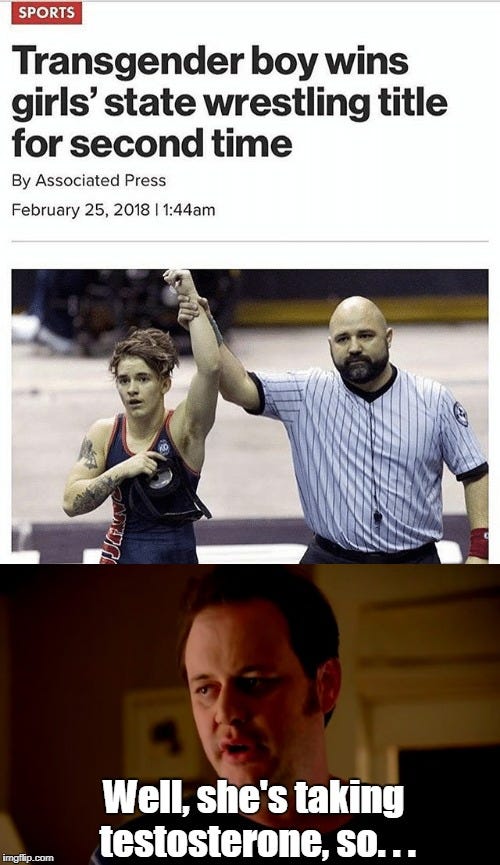
Nobody argues that able-bodied athletes should be allowed to compete in the Paralympics just because they’re having an off season. Nobody accuses the NCAA of height discrimination because there aren’t any 5’1” centers. Nobody suggests eliminating age groups so kindergarteners can experience the character-building opportunity of being flattened by high school linebackers. But sex? Apparently that’s the category we’re all expected to pretend doesn’t exist.
It’s not the legal arguments that interest me so much as the language. So-and-so has been “banned from sports.” His/her “athletic dreams have been crushed.” He/she has been “denied the chance to play.”
Actually, no. They’ve been deemed ineligible for a single division. Refusing to cast a 55-year-old Black man as Annie on Broadway isn’t an act of prejudice. It really isn’t. There are probably at least a dozen other roles homie could land—but the freckled fifth-grade ginger isn’t one of them.
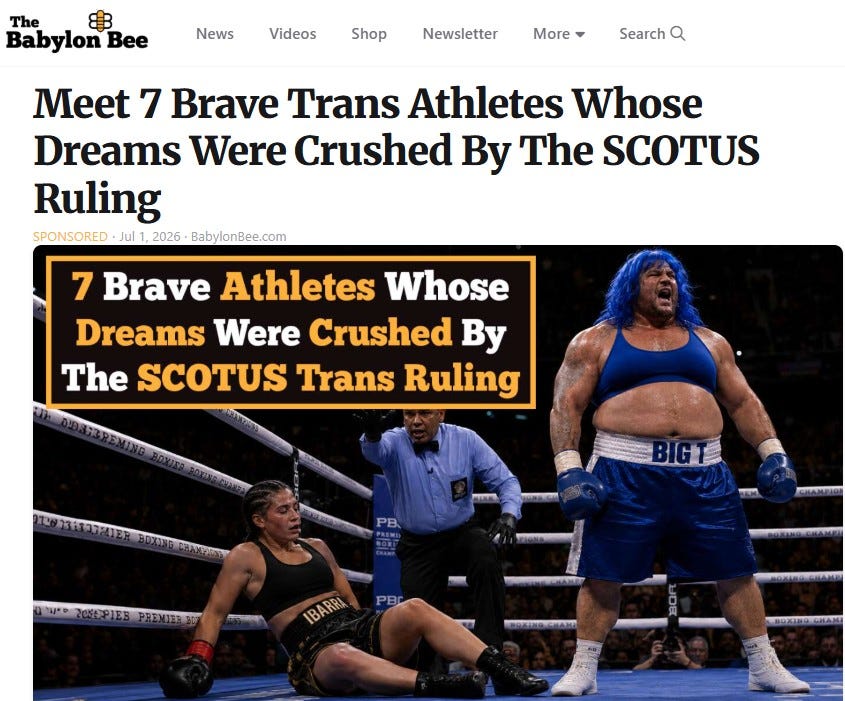
If the PGA rejected my application to compete on the Champions Tour tomorrow, nobody would report, “Local Woman Prohibited From Playing Golf.” They’d write, “Lady Who Was Once Kicked Out of Golf N’ Stuff for Accidentally Hitting the Birthday Kid Displays Admirable Self-Confidence.”
You know what you never see? A seventeen-year-old girl demanding the right to compete on the boys’ cross-country team. Yes, girls have historically fought to play with the boys—when no girls’ program existed. When moving up to a more physically demanding category, at a clear competitive disadvantage, was better than not playing at all. Everyone understood the distinction, and no one pretended the biological differences didn’t exist.

 Tiktok failed to load.
Enable 3rd party cookies or use another browser
Anyone who’s been reading me for more than five minutes knows I’m not a monster or a hater or a transphobe. I genuinely sympathize with any child caught in the middle of a national culture war—even more so, one whose parents enthusiastically embraced puberty-blockers in fourth grade. That can’t be easy. But I also deeply, achingly sympathize with the girls who spend years training and sacrificing only to be repeatedly pushed off the podium by athletes who couldn’t cut it in the boys’ division. The girls whose entire category exists for reasons rooted not in bigotry but in the basic biological fact that males and females do not compete on equal physical footing after puberty. That’s why women’s sports were created in the first place. Not to exclude boys. To include girls. If we’re going to rewrite the rules, let’s at least be honest about which rule we’re rewriting.

Because this was never about whether sports should have categories. It was always about whether one category still counts. Every other difference gets its own lane—age, weight, ability, experience—carefully defined so competition means something. Gender isn’t a suggestion. It’s an objective reality, and it’s the foundation of women’s sports. You don’t get to blur it out of existence. If you want additional classifications, create them. Build a new lane. Call it the Open Division. Call it Mixed Club. Call it the Nonbinary All-Inclusive Harmony Party. But the female category isn’t up for revision. Because that’s not inclusion. It’s subtraction.
P.S. If this topic is important to you and you’re not following Sey Everything, you’re going to want to fix that. Besides founding XX-XY Athletics, Jennifer Sey is smart, funny, fearless, and one of women’s sports’ loudest and most unapologetic cheerleaders.
The founders, from their graves: "The supreme court is deciding 'WHAT?!?'???"
Do they really think they are girls, or do some portion of them just want to get into the girls' locker room and be voyeurs, or do they hate women so much that they want to physically hurt them?