

I wasn’t going to write about the Karmelo Anthony verdict because, frankly, there’s nothing even remotely funny about a teenager ending up dead or another one spending decades in prison. Two families have been shattered. A community is at war with itself. There are no punchlines hiding in any of that. But there is something darkly fascinating—and sadly familiar—about what happened around the case, so I felt compelled to weigh in.

For lucky readers who avoid all lamestream media and are blissfully unaware, last year, 17-year-old Karmelo Anthony fatally stabbed fellow teenager Austin Metcalf during a confrontation at a Texas track meet. Anthony is Black. Metcalf was white. You can guess where this is going.
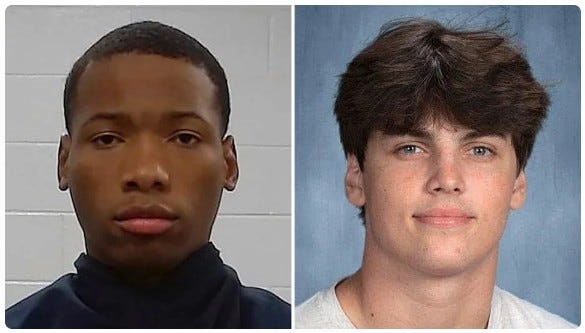
Anthony claimed self-defense. Metcalf’s family—and dozens of witnesses—called Anthony the instigator. What followed was less a criminal case than a full-contact national psychosis involving cable news panels, social media prosecutors, racial narratives, competing fundraisers, and approximately 47 million people who somehow knew exactly what happened despite possessing none of the relevant information.
This week, after hearing the evidence, listening to the witnesses, and deliberating for several hours, a jury convicted Anthony of murder and sentenced him to 35 years in prison.
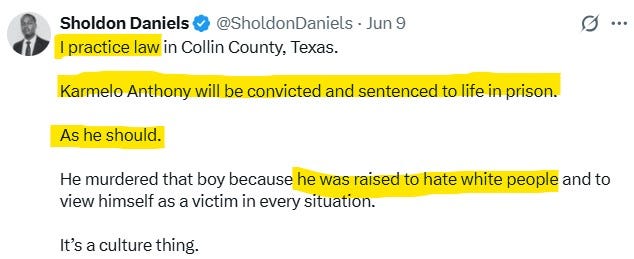
The internet, meanwhile, reached its verdict sometime around lunch the day the story broke. Within hours, everyone had chosen a team.
There was Team Self-Defense. Team Murder. Team Race Explains Everything. Team Race Is Irrelevant. Team the Media Is Manipulating the Facts. Team the Other Team Is Hiding the Truth. And, because this is 2026, Team GoFundMe. Actually, scratch that. There were multiple GoFundMe teams. Even the fundraising became a proxy war, with people debating donations, legal fees, representation, relocation expenses, and what financial support supposedly reveals about guilt, innocence, and societal decay in general.

One side—which included an outraged Cardi B—insisted the outcome would have been completely different if the races had been reversed. The other argued that race was being used to obscure the facts. Some saw a frightened teenager defending himself. Others saw a teenager who brought a knife to a school event and used it. Was the jury representative enough? Why was the jury suddenly the story? Every question immediately generated two competing answers, each delivered with near-religious conviction by people whose legal training consisted primarily of watching a few seasons of Law & Order.
At some point, the entire tragedy started to feel less like a criminal case and more like a football game where half the stadium is wearing one color and the other half is wearing another, except instead of arguing about penalties, people were arguing about race, fairness, identity politics, privilege, accountability, and every other cultural fault line we seem incapable of discussing without teeth coming out.
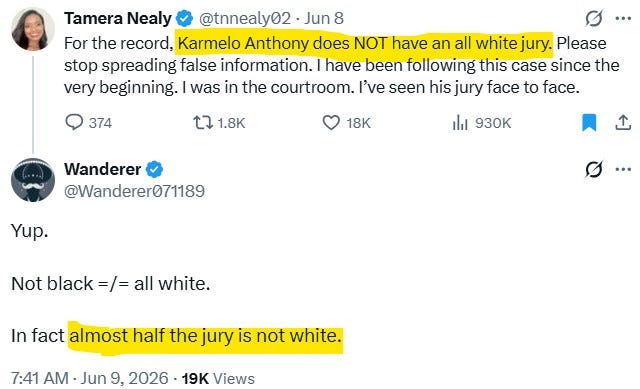
Here’s the part that doesn’t fit neatly into either team’s narrative: when I typed just Karmelo Anthony into X after the verdict, my feed wasn’t filled with white conservatives celebrating the conviction. It was filled—and I’m talking overwhelmingly—with Black users saying race had nothing to do with it. Like her. And her. And him. And him and him and him and him and him and him and him and him.
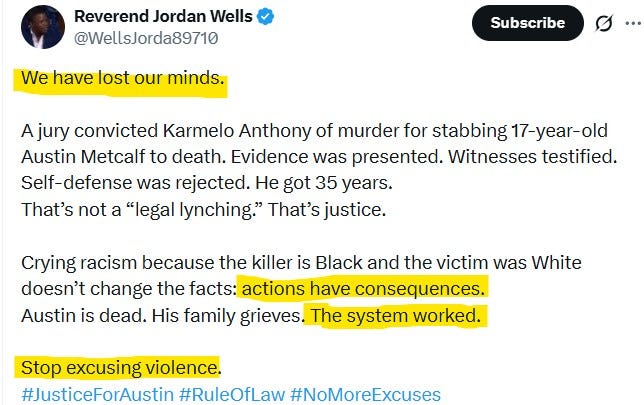
Black users calling Anthony a killer. Refusing to be “bullied into supporting a cold-blooded killer simply because we share skin color.” Insisting that the people making the murder about race in the first place are the actual racists and condemning them for celebrating the death of a white kid. Calling the “anti-white-attack-trend-in-the-name-of-Karmelo-Anthony (yes, it’s a thing) “sick”. Calling for justice for Austin Metcalf. In other words, the actual conversation was far more complicated than the version being peddled by the professional outrage merchants, who always seem eager to sort 330 million Americans into two tidy little newsprint-colored camps and call it analysis.

(Of course, there was also Jasmine Crockett, who looked especially pretty while pointing out that the knife that was used to kill Metcalf was small and that Anthony only stabbed him the one (fatal) time! This is an actual congresswoman. Lord have mercy on us all.)

The prosecution didn’t have to prove Anthony stabbed Metcalf—Anthony admitted it. Witnesses confirmed it. Four Black witnesses testified that Anthony was the aggressor, directly contradicting his self-defense claims. The real question was whether a push during a brief argument justified pulling a knife and driving it into someone’s chest. The jury concluded it did not.
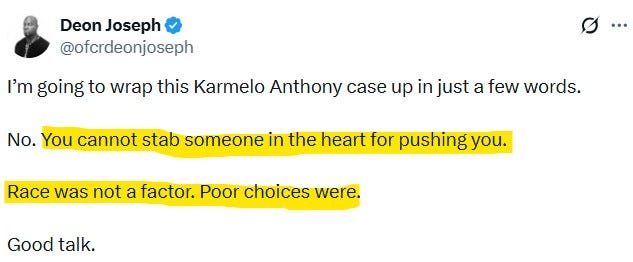
Nevertheless, long before a single witness testified, millions of Americans had already decided the case from the comfort of their couch, phone, toilet, or wherever constitutional scholars gather these days. And the truly remarkable part is that the majority of them managed to maintain unshakable certainty after ignoring most of the trial. The jury deliberated for a few hours. Social media has been deliberating for more than a year. The official verdict, when it arrived, changed literally nobody’s mind.
People who believed Anthony was a cold-blooded killer before the trial believed the exact same thing afterward. People who believed he acted in self-defense before the trial believed he acted in self-defense afterward. People who thought race was the central issue were still positive race was the central issue. People who thought race was a distraction were still convinced race was a distraction.

It’s almost enough to make you wonder why we bother spending millions of dollars on courtrooms when everyone already has a fully operational legal system in their pocket. Because the modern American justice process increasingly looks something like this:
Breaking news.
A handful of facts.
An avalanche of certainty.
Months of tribal warfare.
A trial.
A verdict.
Millions of people discovering that none of the evidence changed their opinion.

We’ve seen this before—George Floyd, Trayvon Martin, Michael Brown, Kyle Rittenhouse, Ahmaud Arbery. With each new tragedy, the online trial was louder, faster, and more definitive than the real one. This isn’t just about one case. It’s about what happens when the public’s legal system is built on clips, captions, and outrage cycles that never end. The courtroom becomes a formality, and the real trial is the one that lives forever online.
Within a day of the conviction, Anthony had already filed an appeal. He now claims he’s a “penniless, destitute, and indigent person, too poor to employ counsel to represent me on the appeal,” despite crowdfunding more than $625,000 prior to trial. His supporters will continue to support him. His critics will continue to criticize him. And the two sides will spend the rest of eternity arguing whether he was a victim or a killer.
If it’s not too much trouble, could you please like and share this post? The algorithm gods look kindly on those things. :)
P.S. Incredible thanks to Filipe Rafaeli for this wonderful review of The War on Chlorine Dioxide! (Please check it out and give Filipe some love, too. :)
There is big money and political power to be grifted from race baiting. It is reassuring to read that the Black community on X was rejecting the race baiting complex.
I'm sad for the black grandparents that lived and fought through the horrors of the civil rights movement and now stare in shocked disbelief at these black teenagers who have no common sense or decency. If someone pushes you, push them back... heck give them a bloody nose... bite their finger... but murder??! Doesn't even make sense...