

BUT FIRST! I had the loveliest lunch yesterday with regular reader KatWarrior, who is exactly as funny, feisty, and all around fabulous as she is in the comments section, in case anyone was wondering. I got home to a DM from another reader favorite lamenting how hard it is to meet like-minded people in her city (Philly), and I thought… maybe this is a sign that I need to create some kind of Jenna’s Side social club. I’m still researching logistics, so if you have ideas, send them my way—but to be clear, this is less “I tour the country hosting events” and more “I help you find your people so you can plan your own trouble.” Last week’s Brownstone Supper Club was a perfect example—turns out putting folks who speak the same language in a room together actually works. (I’ll definitely be going back, so if anyone wants to join, that can be the Austin meetup spot.) Do we like this idea? LMK!
Approximately a million years ago in college, I minored in French. My final project was to debate capital punishment—in French, I probably don’t need to point out—which meant I spent an entire semester conjugating verbs and arguing about the morality of state-sanctioned murder while trying not to accidentally say something like, “I’d kill for a croissant” on the debate stage.
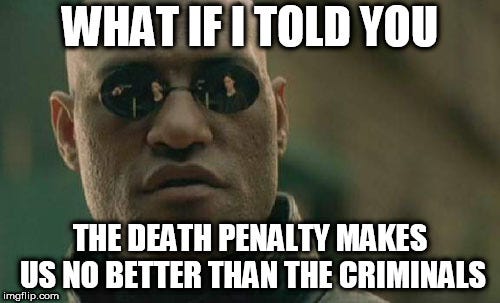
Back then, the research was pretty clear: la peine capitale was not a proven deterrent. People had very strong feelings about the practice, obviously, but the data didn’t exactly scream, “Yes, this is what’s keeping society from unraveling.” Fast-forward a few decades, and it turns out, that hasn’t really changed. What’s more, the whole “saving money by not having to house a criminal forever” argument was and is a fallacy; it costs far more—we’re talking 2.5 to 5 times, or up to $3 million per case—to execute an inmate than to keep him or her in prison for life.
Nevertheless, some guys with clipboards and security clearance have apparently decided that the issue isn’t whether the death penalty works, but if we’ve been offering enough options. So now, the U.S. Department of Justice has directed federal prisons to expand extermination methods to include firing squads, gas asphyxiation, and electrocution in addition to lethal injection (the go-to protocol since the early ‘90s). It’s good to know that the DOJ has federal law enforcement so aggressively under control they can focus on curating a more expansive catalog of off switches.

In a 48-page report, officials explained the gruesome new execution menu will “strengthen” the death penalty by deterring barbaric crimes, delivering justice, and providing closure. Which might be reassuring if this was a thoughtful, data-driven policy and not the equivalent of inventing a new-and-improved guillotine—now with sharper blades!—and trying to market it as a VIP upgrade.
To be clear, this isn’t exactly a “pick your poison” situation. At the federal level, inmates don’t get handed a laminated menu and asked for their preference—the government decides, usually based on whatever method is legally available and logistically doable. Some states do offer limited options (South Carolina, for example, lets inmates choose between lethal injection, electrocution, or firing squad), which is how we ended up with the deeply unsettling concept of “default settings” for executions. So no, it’s not quite a choose-your-own-adventure—but it’s also not not that.
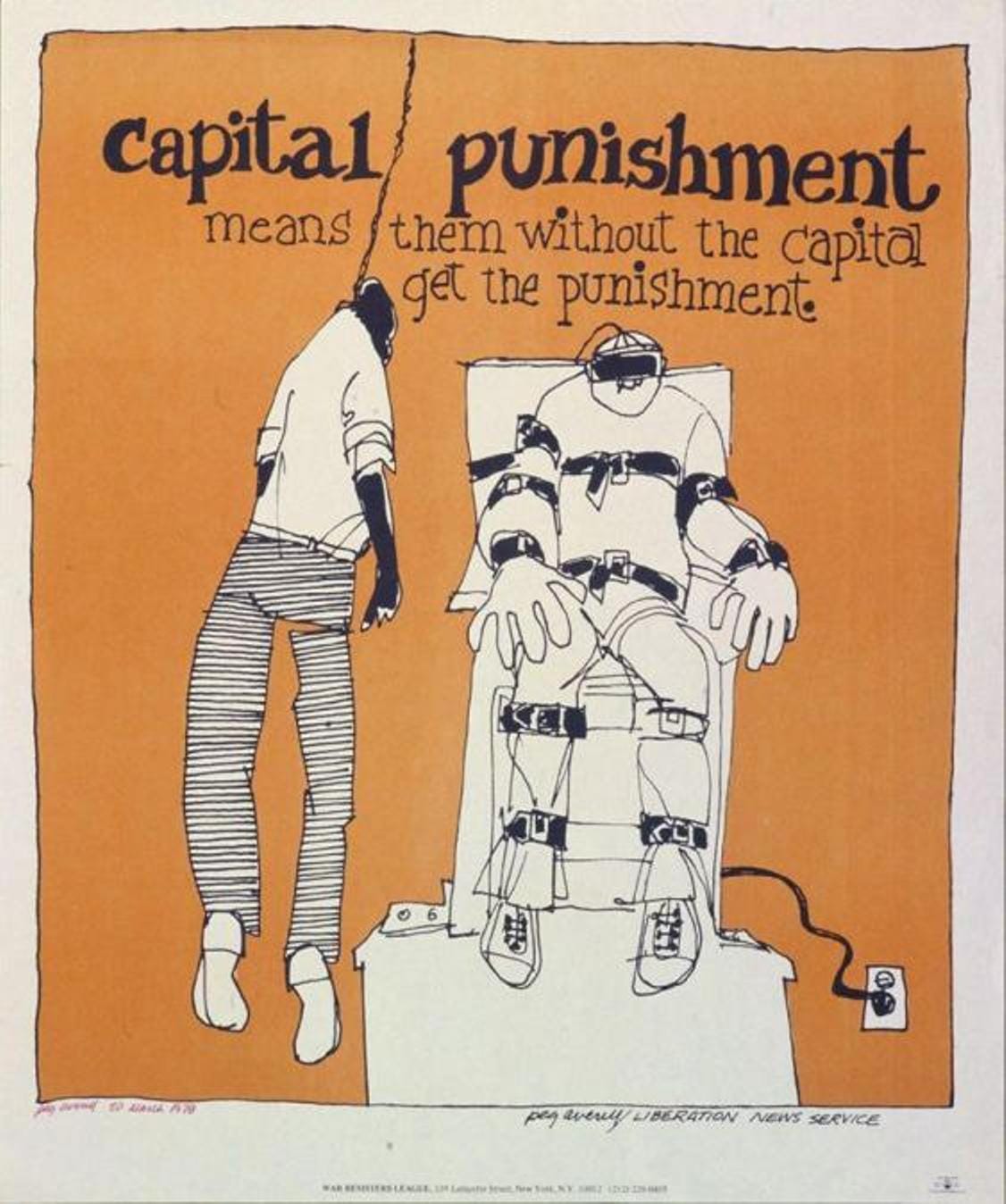
I understand the argument, at least theoretically. There are crimes so horrific that “life in prison” feels less like justice and more like an extremely expensive timeout. When you’re talking about terrorists, child rapists, serial killers, people who commit acts so brutal they barely register as human, it’s not crazy to think, “No, this person forfeited their right to exist among us.” As the saying goes, well, well, well. If it isn’t the consequences of my own actions.
But this isn’t should the practice exist? It’s how can we make it even more horrific? And what exactly is the point of that? People don’t commit violent, unthinkable crimes after calmly weighing the pros and cons and concluding, “Well, I would bludgeon this family, but I certainly don’t want to be electrocuted.” These are not rational, spreadsheet-driven decisions. They’re impulsive, emotional, and often fueled by desperation, drugs, rage, mental illness, or sheer stupidity. The idea that someone pauses mid-crime to consider the method of execution is perfectly absurd.

Lily-Rose Dawson, the brilliant editor of the Wise Wolf Substack (both of whom I highly recommend following if you don’t already), wrote a powerful post this week about the Epstein files; in it she called for a return to possibly the only punishment that has ever effectively put a dent in crime: public shaming.
“You broke the community’s trust, you stood in the town square in a wooden frame that locked your head and hands in place, and every person who walked past you knew exactly what you had done,” Lily-Rose wrote. “They could say it to your face. They could throw things. The baker whose bread you stole, the woman you harassed, the neighbor you swindled, everyone got to look you in the eyes and name it out loud. And then you went home. No prison sentence costing taxpayers $250,000 per year. No removal from the sight of the people you wronged. You stayed in the community. You had to live with what you did visible on every face that looked at you.”
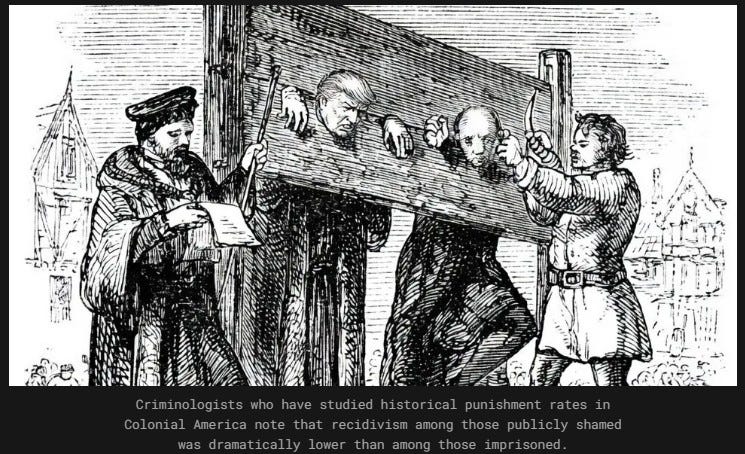
Trial by town square wasn’t some fringe medieval experiment—it was the system. Stockades, pillories, scarlet letters, public whippings: punishment wasn’t private, it was performed. The goal wasn’t just to penalize the offender, but to make the offense both humiliating and unforgettable—to the person who committed it and to everyone watching. By the 19th century, most Western societies began phasing these practices out in favor of prisons, citing cruelty, inconsistency, and, occasionally, the fact that the crowd seemed to enjoy it a little too much. But for centuries, this was considered not just effective, but essential.
“Shame, it turns out, is neurologically devastating in a way that incarceration simply is not,” Lily-Rose continued. “Prison removes you from the social world. Shame weaponizes it. The human brain is wired to prioritize social standing above almost every other survival need. Humiliation in front of your community triggers the same neurological distress as physical pain. It rewires behavior in ways that years of isolated punishment cannot touch.”

It’s not the worst idea I’ve ever heard. It’s not even in the top two thousand. Because I can tell you this: if decades of research still can’t show that the death penalty reliably inhibits crime, adding more dramatic delivery methods probably isn’t going to tip the scales. It may satisfy something—emotionally, culturally, psychologically, politically—but odds are it’s not making society any safer.
If the real goal is prevention (as opposed to revenge, retribution, or some crazy parade of power), maybe we should be focusing on what actually stops people from doing terrible things in the first place. Spoiler: I’m pretty sure it’s not the difference between a needle and an electric chair.

Studies have confirmed that the recidivism rate for dead pedophiles is (checks notes) zero percent.
In truth, such damaged human beings don't feel guilt or shame. Those emotions are there to keep good people in check of their less flattering emotions. If those emotions are absent, they can effortlessly commit brutal crimes against other human beings. If only there was treatment for such broken people.