

As the internet continues to reel over L.A.’s surprise ejection of Spencer Pratt from the highly secure mayoral race, the cognitive dissonance required to defend the state’s election process is reaching levels of pure, unadulterated comedy.
Defenders of that “process” are singularly focused on the counting—the painstaking care they’re taking not to miss a single ballot, the diligence of the poll workers, the “security” of the machines—as if they’re explaining how a Swiss watch works to a colony of goldfish. It would be like a bank showing you a slow-motion, high-definition replay of how perfectly they stacked the counterfeit bills they just handed you.
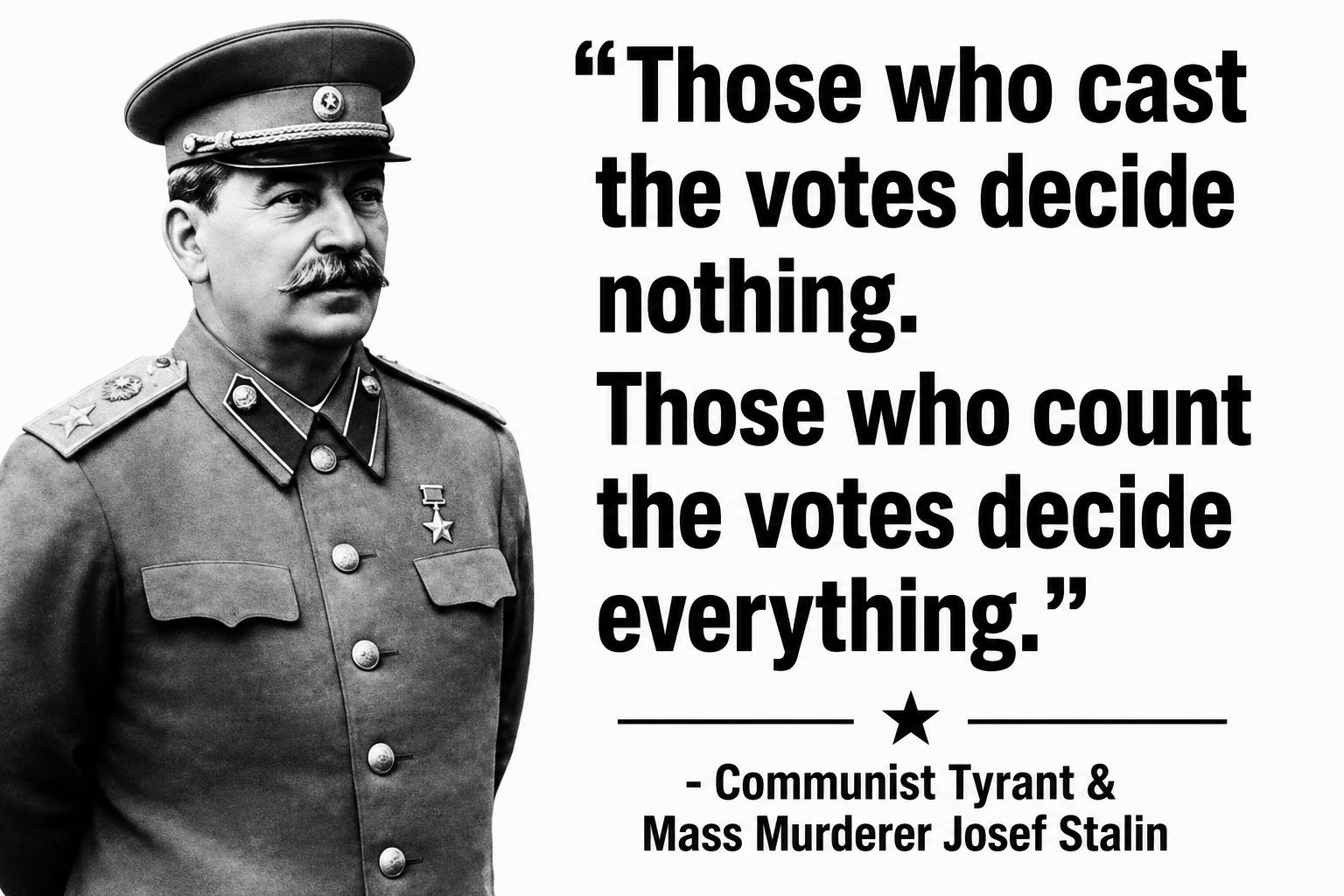
Because “look how transparent the counting is!” is the ultimate shell game. They’re desperate to keep the focus on the tabulation because they have no defense for what’s actually being tabulated.
You can have the most perfectly-calibrated, high-tech, blockchain-verified counting machine in the history of the world, but if the ballots you’re feeding into it were harvested from a port-a-potty in Venice Beach or purchased from a guy who pays a crew to drive around Skid Row with a van full of dollar bills and crack pipes, the “transparency” of the count is irrelevant. It’s just transparently processing garbage.
The media’s response to the backlash has been entirely predictable. MSNBC’s Chris Hayes assured viewers that counting ballots in glass rooms is proof positive that nothing fraudulent could possibly be occurring—as if the walls are the issue and not the piles of questionably-sourced envelopes inside them. CNN explained patiently that late ballots favor Democrats largely because Trump turned Republicans against voting by mail. Which is a real phenomenon worth acknowledging—and also completely beside the point. The question was never whether Democratic ballots arrive late. The question is whether all of those mail-in ballots represent actual eligible voters casting actual legal votes.
BUTCHER: This meat is only four dollars a pound!
YOU: What is it?
BUTCHER: It’s meat!
YOU: I mean, where is it from?
BUTCHER: From this very secure, climate-controlled display case!
YOU: Can you at least tell me what sort of animal it is?
BUTCHER: It’s an animal that costs four dollars a pound! Jeez, what’s with the third degree?
And here’s where California’s “nothing to see here” argument starts to decompose. The Golden State allows voter registration with a gym membership card. A utility bill. A prescription bottle. A Blockbuster card (probably). Documents that would not get you onto an airplane or into a casino or authorize you to drive a car, open a bank account, or check into a hotel. When the DOJ asked to audit the voter rolls—to simply verify that the people on them are real, eligible, and alive—California refused, citing privacy laws. Apparently the state that knows precisely when you turn onto a toll road, the date of your last COVID booster, and exactly how many ounces of water your showerhead dispenses has finally found a category of information too sensitive to verify.
Meanwhile, we have dogs and 126-year-olds casting ballots. We have people convicted of—not just charged with—paying homeless people to vote with fake addresses. Bill Essayli, first assistant U.S. Attorney for D.C., is publicly asking for similar evidence of fraud—and the media is reacting like a blackjack dealer who just got asked to show the deck. “There are rules!” “This is sowing distrust!” “Who does that?” (That’s a direct quote.)
And every time someone raises a question about any of this, the response is the same: But January 6th!
“Just five years after the violent Capitol insurrection, MAGA is pushing another equal parts deranged and idiotic election conspiracy theory,” Hayes scoffed.
“Trump has made election denial a central part of his political movement,” The Guardian explained before invoking—naturally—”the insurrection.”
“More than five years after his supporters, fueled by lies about a stolen election, stormed the Capitol to stop the transfer of power… he can sow substantial chaos [in California] simply by trying to convince voters that the results were fraudulent,” The New York Times blustered.
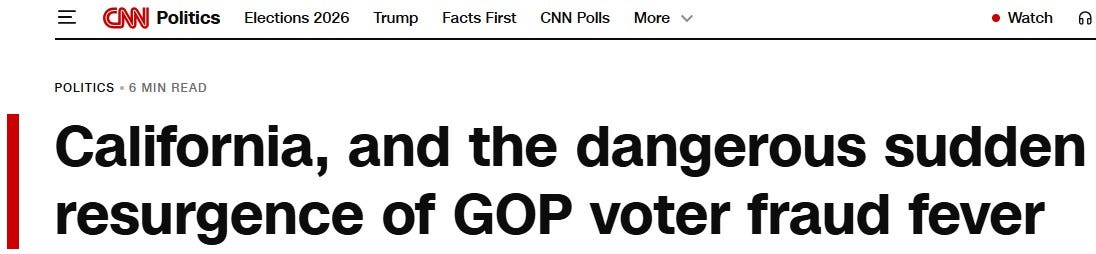
The not-at-all-subtle message: asking questions about election integrity is dangerous rhetoric. Dangerous rhetoric leads to violence. Therefore questions are violence. If that logic sounds familiar, it should—it’s the same framework they used to shut down curiosity about COVID lockdowns, vaccine safety, and Hunter Biden’s laptop. The implication is hard to avoid: the approved narrative is fragile, and the only way to protect it is to make inquiry itself the crime.
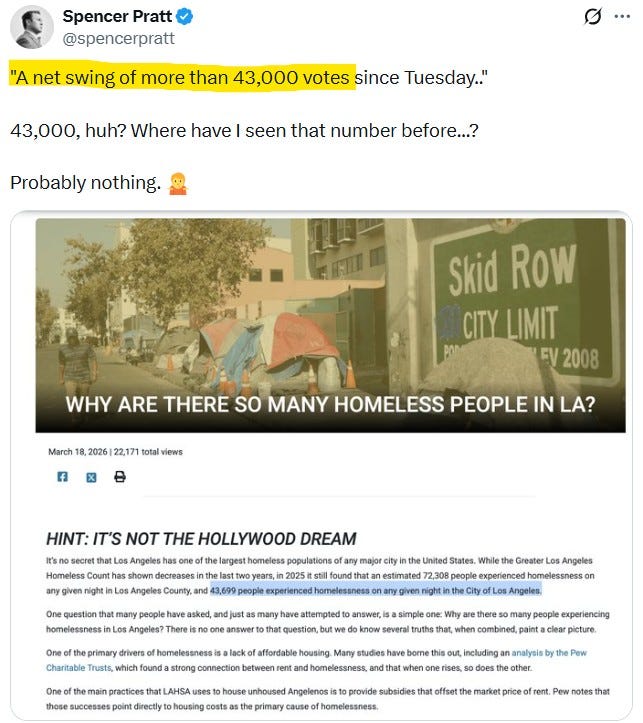
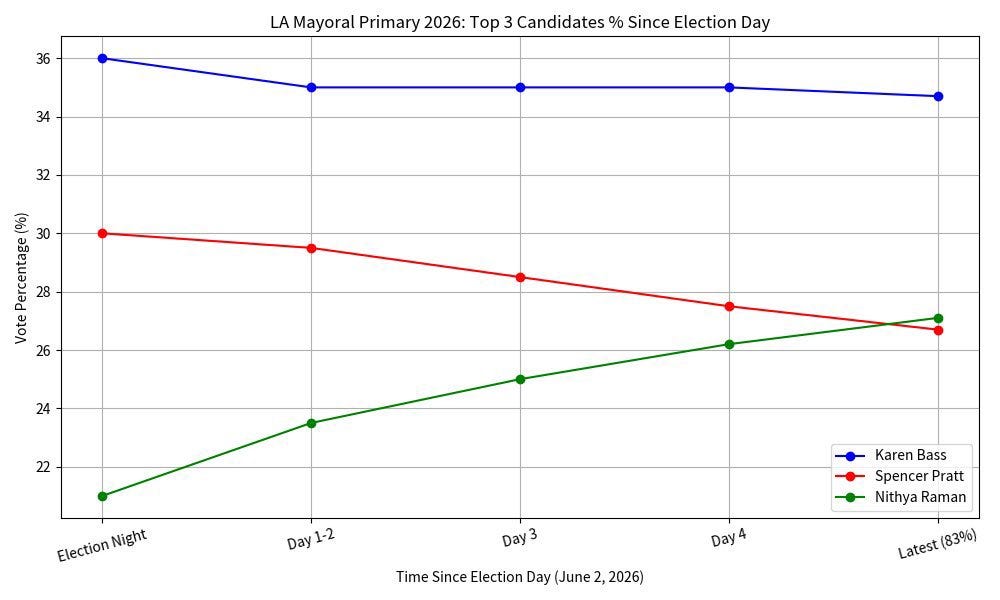
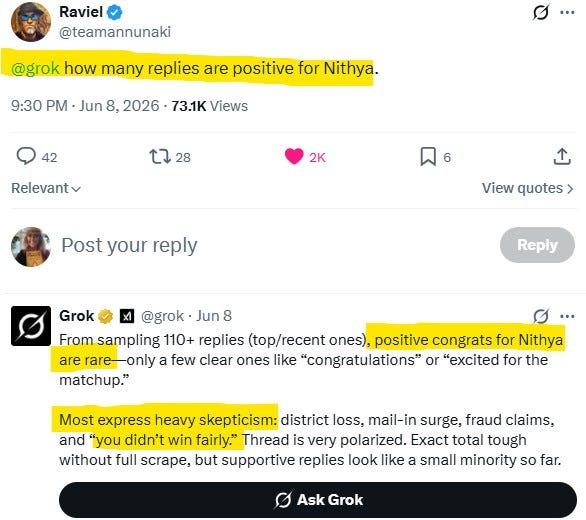
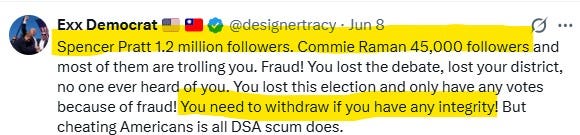
Here’s what nobody in the mainstream press seems curious about: Nithya Raman lost in her own district. The candidate who supposedly surged past Pratt on a wave of late mail-in ballots couldn’t carry the neighborhood where people actually know her. She had effectively conceded the race. And yet somehow the ballots kept coming, and somehow they kept breaking her way, and somehow the media finds the suggestion that this warrants scrutiny to be self-evidently deranged.
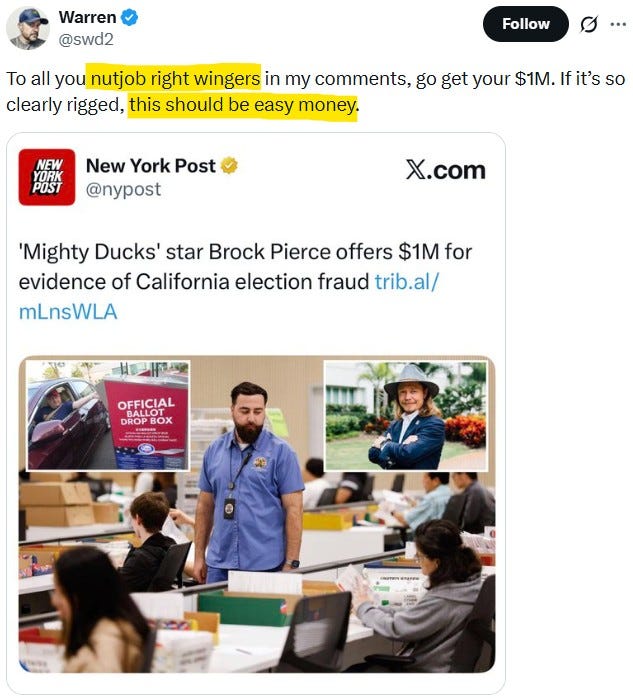
Former Mighty Ducks actor (and apparent mogul*) Brock Pierce is so confident the fraud is there that he’s willing to hand over a million dollars to anyone who can prove it. His Cure the Vote initiative is offering the reward for credible, verifiable evidence of election misconduct—not from MAGA Twitter, but from election workers, government employees, contractors, and whistleblowers. Not a single legacy media outlet felt that was worthy of coverage because, apparently, Cure the Vote doesn’t have glass walls. (I’m speculating.)

*SIDEBAR: Can you imagine being an entrepreneur, venture capitalist, crypto billionaire, and adviser to a foreign government and still being known as the kid from that hockey movie you made when you were twelve? I’m starting to think maybe my mom was wrong when she promised me everyone would forget about that time I face-planted on my eighth grade class trip to Disney World. #TrueStory
And then there’s Gavin Newsom, who—when asked about the possibility of ending up with two Republican candidates for governor and no Democrats—said:
“We all have agencies. We can shape the future. I don’t anticipate this being the case, but there is a ‘break the glass scenario.’ There are many people who have a deep understanding of what it would look like if Democrats were locked out, and we’re going to do everything to make sure that doesn’t happen. I’ll leave it at that.”


He actually said that. The governor of California said he has a break the glass scenario for when Democrats get shut out of elections. Yes, he was talking about the other highly contentious race where two popular Republicans were running, but the message is clear: California has a contingency plan for undesirable election outcomes. Nobody in the press asked him what that meant. Nobody followed up.

So basically California’s got glass walls to ensure election integrity and a governor with a hammer. What could possibly go wrong?
How tough could it be? Pick up a ballot, look at the name and address, go there, find that person who, of course, lives at that address and ask them if that is their signature then get a sample and compare. How many new IRS agents did we get in the last administration? 87,000 wasn’t it? Give them some poop proof shoes and send them out on the streets of LA to find the voters.
I hope Harmeet Dhillon acts quickly. This is the last chance to save LA and CA.